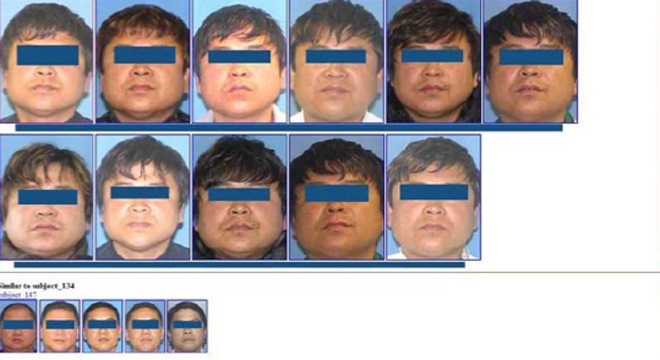
The FBI plans to bring facial recognition technology nationwide in 2014 to help law enforcement agencies throughout the U.S. to identify persons of interest, according to FBI sources, Nextgov reported.
The system will let agents upload photos or screen captures of unidentified persons of interest into a computer that will display the closest matches from a database of 10 million mug shots, according to Nextgov.
The system, which will begin testing in Michigan, Washington, Florida and North Carolina this winter, according to Nextgov, is just one component of the FBI’s so-called Next Generation Identification (NGI) effort, a $1 billion program contract awarded to Lockheed Martin in 2008 to radically upgrade the FBI’s fingerprints database, and to augment it with new biometrics information, including iris scans, voice recordings, palm prints and other detailed personal identification markers.The FBI is surprisingly open about its plans to pursue this system, which it says it needs to complete to speed up the current “ten-print” fingerprint submissions system from “two hours to about 10 minutes on average,” ideally, hypothetically allowing agents to catch everyone ranging from roadside bombers in Iraq to masked bank robbers and child pornography suspects in the U.S.
The agency describes its plans in a fair amount of detail on the FBI website and in a publicly available presentation PDF.
Indeed, Nextgov‘s, primary source is Nick Megna, a unit chief at the FBI’s criminal justice information services division. As the website reported in an article posted Friday:
Today, an agent would have to already know the name of an individual to pull up the suspect’s mug shot from among the 10 million shots stored in the bureau’s existing Integrated Automated Fingerprint Identification System. Using the new Next-Generation Identification system that is under development, law enforcement analysts will be able to upload a photo of an unknown person; choose a desired number of results from two to 50 mug shots; and, within 15 minutes, receive identified mugs to inspect for potential matches.
Slightly less forthcoming about the program is defense contractor Lockheed Martin. In an email to TPM, a Lockheed spokesperson confirmed that the Nextgov report accurately described NGI, noting that it is one of several companies working on the program, including Accenture, Global Science & Technology (GST), Innovative Management & Technology Services (IMTS), and MorphoTrak.
As the spokesperson wrote:
“NGI is a state-of-the-art biometric identification system that the FBI and law enforcement agencies are using to help keep Americans and their families safe…In addition to vastly improving the FBI’s fingerprint identification services, NGI will also provide identification capabilities associated with latent and rolled fingerprints, palm prints, and facial recognition. The NGI program also calls for a pilot study to assess iris identification capabilities…
NGI’s fingerprint identification capabilities went live earlier this year. We are making steady progress on the remaining portions of the system, and are developing NGI with a high degree of technical flexibility so that other biometric modalities can be incorporated in the future, if desired.”
In a March press release from the FBI announcing the initial operating ability of the new fingerprints system, which Lockheed Martin referred to TPM, the FBI said: “NGI provides automated fingerprint and latent search capabilities, electronic image storage, and electronic exchange of fingerprints to more than 18,000 law enforcement agencies and other authorized criminal justice partners 24 hours a day, 365 days a year. Upon completion, NGI will have the ability to process fingerprint transactions more effectively and accurately.”
Lockheed refused to provide the name of the facial recognition pilot program, but did reveal that there are several test activities “being implemented by the FBI independently of Lockheed Martin.”
Lockheed also would not confirm whether or not the facial recognition program would incorporate any 3D facial recognition from Animetrics, a New Hampshire-based company. In September 2010, Animetrics and Lockheed Martin were was awarded a U.S. government contract to “improve facial recognition accuracy.” (Animetrics is also behind an iPhone app that matches users to their celebrity likenesses, which has received mediocre ratings from users. “Saw this app is featured for law enforcement. Yea, good luck with that,” wrote one disgruntled user.)
As the blog Network World states: “Each piece of the FBI system ties together into a fairly alarming service for massive surveillance, identification and tracking.”
TPM has contacted the FBI and Animetrics about the NGI program and will update when we receive a response.
But it is also worth noting that several other major companies are working on similar technology, including Google and Facebook. The Atlantic recently investigated the work of PittPatt, a facial recognition software startup founded by alumni of Carnegie Mellon University’s Heinz College and acquired by Google in July. Facebook’s new facial recognition photo-tagging suggestion software was effectively outlawed by the German government in August, with the company being forced to delete already-collected data or face fines.
And yet, the technology itself may not be very effective at identifying people in the first place: A study of facial recognition technology commissioned by the Defense Department in 2010 found that despite being more accurate at identifying faces than humans, computer programs still exhibited “other-race effect,” that is, they experienced difficulty in correctly distinguishing individuals of races outside of those that predominated in the country where the software was developed.
“The [U.S.] government is interested in spotting people who might pose a danger. But they also don’t want to have too many false alarms and detain people who are not real risks.” Alice O’Toole, a professor in The University of Texas at Dallas’ School of Behavioral and Brain Sciences and the lead investigator of the study, told the blog Space War back in September 2010.