Updated 2:00 pm ET, Tuesday, March 13
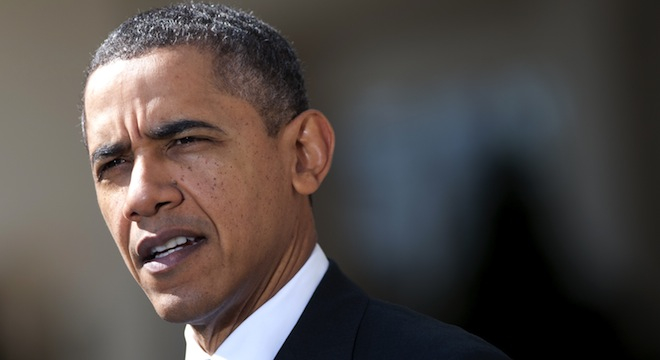
Speaking from the White House Rose Garden on Tuesday, President Obama announced that the U.S. had filed a trade complaint against China over its exportation of rare earth materials — a group of 17 elements of which China owns 97 percent of the world’s production. The rare earths are used by the rest of the globe to make everything from consumer electronics to hybrid car batteries to high-tech weapons.
“If China would simply let the market work on its own, we would have no objections,” President Obama said in a brief statement. “But their policies currently are preventing that from happening and go against the very rules that China agreed to follow.”
Obama explained that the U.S. is joining the Japan and the European Union in filing requests at the Word Trade Organization for a negotiation process with China.
Specifically, the U.S. and its allies want the Chinese government to lift the numerous export restrictions it has placed on the flow of materials out of its country (including export duties, export quotas, export pricing requirements and other restrictions covering 100 different tariff codes, according to a statement from the U.S. Trade Representative), which have resulted in substantial price increases of the materials outside of China, according to the New York Times.
China asserts the restrictions on rare earths are necessary to minimize the environmental impacts of mining and processing them, as the Associated Press pointed out on Tuesday.
If the countries can’t come to an agreement within 60 days, the U.S. can request that the WTO rule on the dispute, which could lead to the U.S. imposing sanctions on China.
“I will always try to work our differences through with other countries, we prefer dialogue, especially when it comes to key trading partners like China,” the president added. “But when it is necessary I will take action, if our workers and our businesses are subject to unfair practices.”
“America’s workers and manufacturers are being hurt in both established and budding industrial sectors by these policies,” said U.S. Trade Representative Ron Kirk in a statement delivered ahead of Obama’s address. China continues to make its export restraints more restrictive, resulting in massive distortions and harmful disruptions in supply chains for these materials throughout the global marketplace.”
President Obama also sought to put the action into the context of his administration’s overall defense of U.S. industries abroad.
“We’ve brought twice as as many trade cases as the previous Administration,” President Obama said in his address, pointing to trade cases the U.S. has successfully pursued against China’s illegal dumping of car tires and the recent creation of a new trade specific advisory board on February 28, the Interagency Trade Enforcement Center, which is tasked with coordinating trade cases across the globe and the various U.S. departments that currently handle them.
The move was welcomed by the the Alliance for American Manufacturing, an industry lobbying organization.
“It’s clear that the administration’s trade agenda is shifting to more aggressive enforcement, which is welcome news for America’s workers and businesses as they face both subsidized Chinese competition in America and restricted access to China’s marketplace,” said a statement from the Alliance for American Manufacturing emailed to reporters.
China, for its part, has so far responded to the challenge to its policies with alternating bluster and defensiveness. Chinese government economists on Tuesday told state news agency Xinhua that they thought the price of rare earth minerals had actually been too low for some time and should be raised due to the cost of environmental considerations being taken during their mining and processing. A Chinese foreign ministry spokesperson told Dow Jones that the allegations of the U.S., E.U. and Japan were “groundless,” and asked that other countries begin producing rare earths materials.
An editorial published on the website of the Wall Street Journal on Tuesday said that the case amounted to political posturing, pointing to the recent, precipitous decline in the price of rare earths thanks to cutbacks by manufacturers and increasing production of rare earths by Australia.
As Tom Orlik and Chuin-Wei Yap wrote: “The irony for China is that the restrictions on exports haven’t done much to entice the higher value added parts of the rare earth value chain to locate on the mainland. What they have done instead is provide trade rivals a case against China in the WTO. For President Barack Obama, an anti-China trade case in a tough election year could be a rare prize indeed.”
Late update: The Consumer Electronics Association, the trade organization representing America’s high-tech gadget industry, released a statement shortly after the President’s address applauding the case against China.
“CEA today welcomes the Obama Administration’s announcement that it will challenge China at the WTO,” said Gary Shapiro, president and CEO of the organization, in the statement. “If China wants to be a world player in trade, it needs to behave like one. For far too long our member companies, particularly small companies manufacturing here in the United States have been bearing the cost burden of China’s unfair practices.”
Correction: This piece was updated to correct the wording of the President’s statements. We originally reported that he said “But they’re not agreeing to the rules,” in reference to China, when in fact he said “their policies currently are preventing that from happening and go against the very rules that China agreed to follow.” The quote has been corrected in copy and we regret the original error.