NASA on Friday put out a call for creative, third-party developers to use the oodles of data collected by the agency’s various missions to make new, accessible consumer apps in the first-ever “International Space Apps Challenge,” set for April 21 and 22.
The event calls upon developers and organizations to answer a number of challenges submitted by the various departments of NASA asking for ways to make their data more useful.
But now NASA tells TPM that apps — at least the kind that most people are familiar with thanks to Apple’s App Store and the Android Market Google Play — are only part of what it is hoping that participants in the challenge cook-up.“It’s much more then just mobile application or software development, which is why we created four broad categories for the event which include: open source software, open hardware, data visualization and citizen science platforms,” wrote Nicholas G. Skytland, program manager at NASA’s Open Government Initiative, in an email to TPM.
Indeed, NASA is keenly interested in seeing participants create physical apps as well. Only one such physical app is currently listed among the 7 initial challenges on the International Space apps website, but Skytland told TPM “we’ll be adding many more prior to the event.” (Emphasis original.)
On Saturday, NASA gave an example of exactly the sort-of thing it’s looking for in a post on its Open NASA blog. As the author of the post, NASA partner David McGloin, a physicist in the Electronic Engineering and Physics Division at the University of Dundee, Scotland, wrote in the post:
We want you to try and make stuff – some of that will be grand theme and grand idea type challenges, but we want to start with something a bit more homely. Can we bring a little piece of home to astronauts in the International Space Station. If you are stuck up in a confined space whizzing round the earth for months, if not years, at a time, you are going to miss the odd home comfort. Can humans survive on trips to further flung reaches of the solar system without the odd reminder of home?
We thought that little says ‘home’ like home baking. With yeast being a model organism for many experiments, and as it often finds itself in zero-g conditions, it seems a natural extension to try and make something with it: bread. How will bread bake in space? And a key technological challenge is, since baking takes a lot of energy, can we device new low power techniques that can be applied on the Space Station, and then ultimately in the new low power homes back on Earth that we will need in the future?
The post also contained a video illustrating the concept:
Not above making a pun, NASA has coined this particular challenge #BakerFaire, in reference to Maker Faire, the world’s largest do-it-yourself tech event, started six years ago by Make magazine.
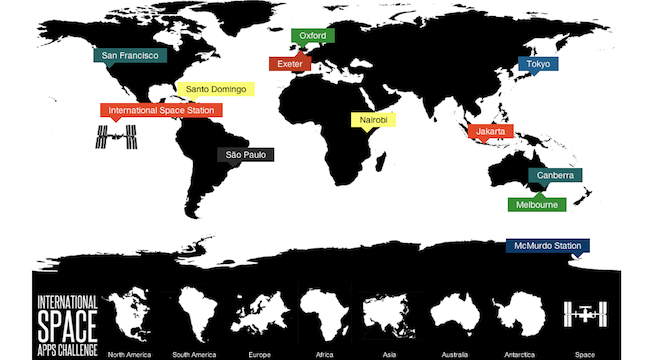
Skytland’s division is taking a leading role in organizing the challenges, which set to take place simultaneously throughout the two days in 11 locations on all seven continents (including Antarctica) and aboard the International Space Station.
“The inspiring astronauts on the space station and researchers at the McMurdo Research are participating in the event as best a their duties allow,” Skytland told TPM. “In addition, they will personally showcase some of the facilities that create the data we use to solve challenges during the event.”
“We anticipate about 100 participants per event location and about 1000-1500 overall,” Skytland said. Skytland said he based those figures on the participation his agency saw in “Random Hacks of Kindness,” a three-year-old partnership with tech and business heavyweights Google, Microsoft, Yahoo!, HP and the World Bank to host “hackathons” — day long development contests — to address social ills.
NASA’s Open Government Initiative, first outlined in April 2010, is an outgrowth of President Obama’s pledge his first day in office to increase government transparency and civic participation in government. It’s also part of the “Open Government Partnership,” an international agreement in the same spirit launched in September 2011 by 8 countries: The U.S., Brazil, Indonesia, Mexico, Norway, the Philippines and the United Kingdom.