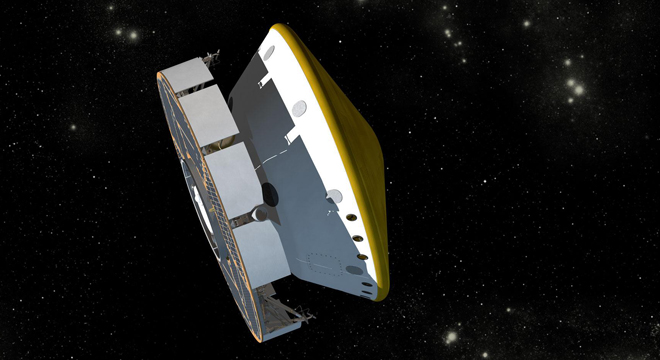
It’s still over 300 million miles (or eight months) away from Mars, but that hasn’t stopped NASA’s nuclear-powered, laser-equipped rover Curiosity from getting down to work. On Tuesday, NASA announced that the rover had begun monitoring cosmic radiation that could be harmful to eventual human travelers to the Red Planet.
The Radiation Assessment Detector (RAD) is the first of Curiosity’s array of 10 precision instruments to come online. A toaster-sized device located on the rover in the center of the 7,500-lbs. cruising spacecraft, RAD’s specific function is to survey the level and types of radiation found within the spacecraft throughout its journey, especially once Curiosity plops down on the surface of Mars in August 2012.“RAD is serving as a proxy for an astronaut inside a spacecraft on the way to Mars,” said Don Hassler, RAD’s principal investigator from the Southwest Research Institute in Boulder, Colo, in a NASA news release. “The instrument is deep inside the spacecraft, the way an astronaut would be. Understanding the effects of the spacecraft on the radiation field will be valuable in designing craft for astronauts to travel to Mars.”
Indeed, small though it is, RAD’s capabilities are great and of tremendous importance to future Mars missions.
The RAD instrument is actually a “charged particle telescope,” containing a stack of silicon detectors and a cesium-iodine crystal which measure a variety of high-energy and potentially hazardous particles, including neutrons, gamma rays, protons, and alpha particles. These particles emanate from the Sun and distant supernovas.
Importantly, RAD will measure “secondary sources” of radiation, the radiation that occurs inside the spacecraft when the high-energy particle streams strike the outside.
As NASA points out, “Previous monitoring of energetic-particle radiation in space has used instruments at or near the surface of various spacecraft.”
But RAD still has its work cut out for it. Once the rover descends onto the Martian surface, RAD will be pointed toward the sky and begin taking 15-minute long measurements of the particle streams entering the atmosphere once every hour. This will allow scientists to determine how much radiation human astronauts would be exposed to.
RAD will also be used to investigate how said radiation has affected the soil on Mars.
Read more about the instrument at NASA’s Jet Propulsion Laboratory website and at the website of the University of Kiel in Germany, which also contributed to RAD’s development.