Updated 3:42 p.m. ET, Friday, September 16
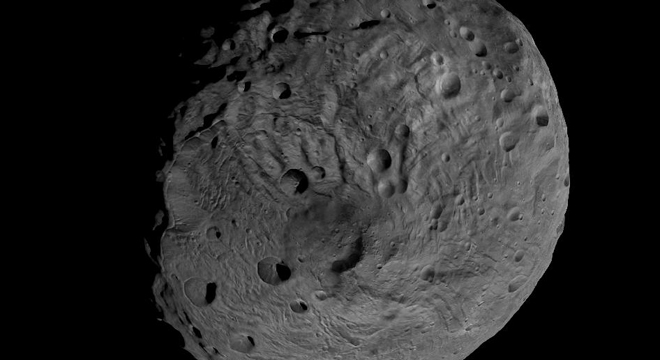
NASA has had a banner week of discoveries, and it’s coming to a rock star close on Friday with the release of an incredible new video and exquisite images of the surface of Vesta, a gigantic asteroid located some 136 million miles away from Earth in the main asteroid belt between Mars and Jupiter. Scroll down to see the video.
The video simulation – made from images of the asteroid captured by the framing camera of the Dawn spacecraft from an orbital distance of 1,700 miles – shows the oblong asteroid, one of the solar system’s largest at 357 miles in diameter, in unprecedented detail.The asteroid’s large south pole depression, for instance, was earlier observed by the Hubble Space Telescope. But the new Vesta images show deep cliffs cutting through the area and a 9-mile high mountain, one of the largest such mountains in the entire solar system.
On the northern end, there’s even a “Snowman,” a series of craters that resemble Frosty’s bulbous form.
Interestingly, NASA notes in a press release that the northern latitudes of Vesta are dark now because it is winter there. Yes, the asteroid is so large it has seasons.
Craters, pockmarks and various other features can also be seen in great detail, giving astronomers a clue as to the asteroid’s history and collisions with other celestial bodies.
And in a nod to the asteroid’s mythological namesake, NASA said it plans to name all of these landmarks after vestal virgins, other Roman women, festivals and towns of the second century B.C. The agency has already identified and named the asteroid’s prime meridian “Claudia.”
And best of all, we’ll be getting an even closer view in October, producing 8 times better resolution, when the Dawn spacecraft lowers its orbit. The ion-propulsion spacecraft, launched in 2007, will in 2015 close-in on the largest object in the main asteroid belt, Ceres, a dwarf planet which is located another 990 million miles away.
Check out the discovery in full over at the NASA website and watch the video below:
Correction: This article originally stated that the Vesta asteroid was 1.8 billion miles away from the Earth. In fact, the Dawn spacecraft traveled 1.8 billion miles to reach the asteroid, but only because it was slingshotted around the Sun first. We regret the error.