The fight over anti-online piracy legislation in Washington has faded from the headlines, but former Senator Chris Dodd (D-CT) is still talking about it.
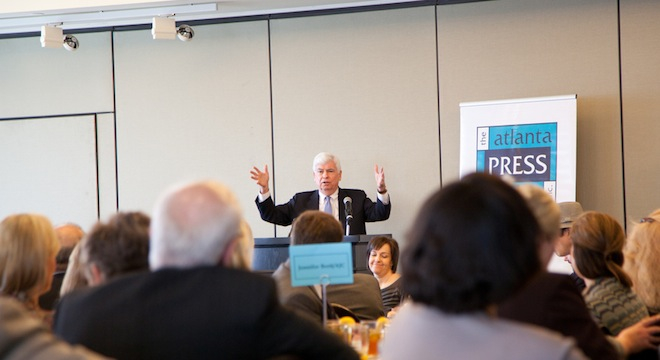
Dodd, who became CEO of the Motion Picture Association of America in March 2011 after deciding not to run again for Congress, had quite a lot to say about the subject — much of it now conciliatory — as he explained to the Atlanta Press Club on Wednesday.
“Let me be clear: Hollywood is pro-technology and pro-Internet,” Dodd told journalists, reading from prepared remarks. “I firmly believe that our industry cannot survive without the innovations that come out of Silicon Valley every day – and know that we must have a free and open Internet to keep those innovations coming.”
However, Dodd did note that “a few tried to disrupt this important debate with misinformation.”
As he continued:
“Despite their claims, these few critics are simply not interested in solving the problem of intellectual property theft – a position that may be explained by the fact that many of them profit from piracy themselves, through online advertising and search engine placement.”
He concluded by inviting listeners to pressure their local representatives to come up with a means of combatting piracy, and encouraged tech companies to join him in the effort.
“If you believe, as I do, that the content industry and the technology industry have more to gain from working together than from fighting each other – then I invite you to join this coalition and help us move towards a solution to this problem,” Dodd said.
The MPAA was among the most prominent supporters of the two bills — the Stop Online Piracy Act (SOPA) in the House and the PROTECT IP Act (PIPA) in the Senate — both of which sought to curb online piracy by forcing U.S. websites to block and advertising and payment processing ties with foreign websites accused of piracy by copyright holders.
Neither bill made it into law, though. In fact, both are presently pretty much dead politically. More on that here. Dodd fought back on several fronts against SOPA protesters throughout and after the ordeal, but seems to have changed his tune now that the political winds have shifted decidedly against his group’s will.
“MPAA’s Chris Dodd extends SOPA olive branch to Silicon Valley,” is how Hollywood blog The Wrap characterized Dodd’s comments to the Atlanta Press Club. Dodd had been invited to speak to the organization of local journalists as part of its “newsmaker luncheon” series of talks.
Dodd also referenced the sheer volume of Web traffic devoted to piracy as a reason why even those in the tech sector needed to get more serious about fighting the problem.
“A study by Envisional found that nearly one-quarter of all global Internet traffic is copyright theft,” Dodd said in his remarks. “And at the heart of the problem is the proliferation of parasitic foreign rogue sites whose sole purpose is to facilitate, and profit from, the theft of intellectual property.”
The study Dodd refers to by Envisional, a UK cybersecurity and anti-piracy firm, was initially published in January 2011, indicating 23.8 percent of all Internet traffic around the world was dedicated to infringing content (though pornography wasn’t included due to the “difficulty” of establishing its copyright status. The study was updated early this year, finding the same level of piracy. The study was commissioned by NBCUniversal, another of the leading supporters of the anti-piracy legislation SOPA and PIPA.
But David Price, the head of Envisional’s piracy research department and the author of the study, told TPM that although NBCUniversal paid for the study, it didn’t exert undue influence on the results.
“When the study was commissioned, neither Envisional or NBCU knew what kind of overall figure would be produced at the end of the study,” Price told TPM via email on Friday.
“I was obviously aware of NBCU’s general position on piracy when putting the report together,” he continued. “However, we have worked in this area for a range of clients for some time and are valued for our independent research and analysis. Clients come to us for our research experience and neutral consultancy.”
Price notably even came out against SOPA and PIPA when presenting the latest results of his research at the Consumer Electronics Show in Las Vegas in January, as Ars Technica reported.
“When I talk to content owners I try to tell them this is not the way to go,” Price said at the time. “You don’t want to hurt people. You want to try and go with a compete approach, put the content out there and hope people will come to you.”
It seems that now, Dodd and the MPAA are finally beginning to listen to his advice.