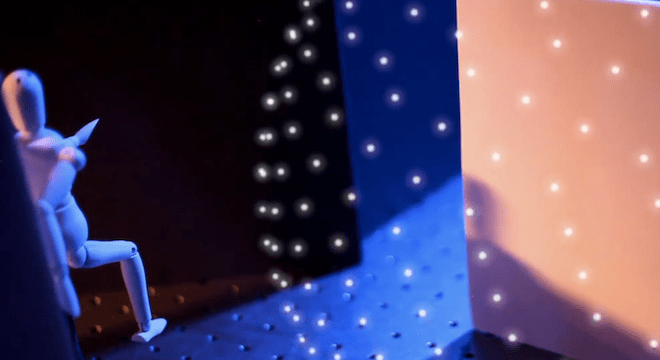
It’s now possible to see around corners without actually peeping one’s head around thanks to a new laser-powered camera developed by researchers at MIT’s Media Lab.
The camera achieves the extraordinary feat by using a combination of two technologies: A femtosecond laser, or a laser that fires pulses of light every one quadrillionth of a second, combined with a home-brewed MIT Media Lab computer algorithm.An animated video by the journal Nature shows the technology in action:
The process by which it functions is actually fairly straightforward, ingeniously so: The laser is attached to a precision camera featuring a high-speed detector. The laser/camera assembly is pointed at a wall opposite the corner that needs to be seen around.
The laser pulses strike the wall, scattering photons in all directions. Some of the photons bounce right back to the camera, others travel around the corner in question and then bounce off any objects on the other side of that wall. These photons then bounce back against the wall and finally reach the camera.
MIT’s camera records the difference in the “time-of-flight,” between all of the photos that strike it, and its algorithm filters out the ones that came directly from the wall from those that bounced off objects on the other side of the corner. The algorithm then reconstructs an image of the object on the other side of the wall.
The imagery isn’t perfect, yet. It comes out a little blurry and discolored, but it’s still quite clear given the constraints, and MIT believes it can rapidly increase the resolution of the images of scenes around the corner, making the technology useful for firefighting and other hazardous occupations and navigational systems.
“Four years ago, when I talked to people in ultrafast optics about using femtosecond lasers for room-sized scenes, they said it was totally ridiculous,” says Ramesh Raskar, an associate professor at the MIT Media Lab, who led the new research, in a statement.
The research itself builds upon MIT’s previous demonstration of a camera sped up to the point that it could record and display individual photons moving along objects. A separate group at MIT is also working on using radar technology to image slight movement through surfaces as opaque as 8-inch thick concrete walls.
MIT published the results of demos of its new camera in a paper in the journal Nature Communications.