MIT’s robotics scientists aren’t just playing in the sand. They have a vision for the future where you will be able walk into a store like Kinkos (technically renamed FedEx Office several years ago) and design and print your own custom made robot.
Yes, you read that right, print out your own custom robot, using something like a standard paper injket or laser printer.
“We imagine that a user would head into something we’ve been fondly calling ‘Robot Kinkos,'” said MIT researcher and robotics professor Daniela Rus, the originator of the idea, in a phone interview with TPM.
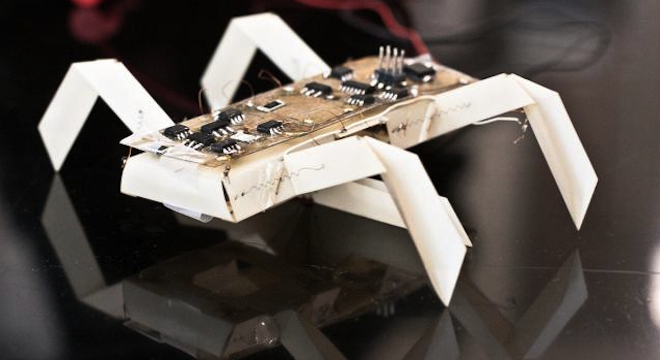
The official name of the project is “An Expedition in Computing for Compiling Printable Programmable Machines,” and it officially launched on Tuesday.MIT has already designed several prototypes of its new robotics manufacturing system, including an “insect”-like design (pictured above), a robotic grabber arm (below) and a robotic fish.

The prototypes were fabricated out of a paper-like material with the strength of plastic called PEEK, that is durable and resistant to high temperatures.
Overall, the goal is to radically simplify and cheapen the robotics manufacturing process, opening it up to the common man and woman, developing what Rus called the “next generation of app stores.”
Rus said that in the future, the ‘Robot Kinkos’ would be either a physical store or an online one where users could see various base designs for building their own simple robots to do any number of tasks — flexible robotic “grabber” arms could reach objects in tight spaces, while other robots could be designed to play with a customer’s cat or clean their room.
“The user could explore and select robot features through a ‘Spore’-like computer interface,” Rus said, referencing the acclaimed video game that allows players to develop their own custom alien species.
Rus continued to explain the innovative manufacturing process to TPM:
“Then, a computer would simulate the resulting robot to check that it meets physical constraints, the database would take your input and propose a design, you could play with the parameters, and once you’re satisfied, you press a button and a day to a week later you get your fully assembled robot, along with a disk containing a programming language with the low-level behaviors that make your device work.”
The idea is good enough to have won a $10 million, five-year grant from the National Science Foundation, giving MIT the resources it needs to lay the groundwork for such a system.
MIT’s Computer Science and Artificial Intelligence Lab (CSAIL) announced the grant on Monday, and the school is working with the University of Pennsylvania and Harvard University on the project.
Check out more of MIT’s prototypes in the following video: