Pretending you’re on a trip to Mars is fun, as any schoolchild knows. But continuing that pretense in a cramped simulator with six other people for nearly a year and a half is decidedly not.
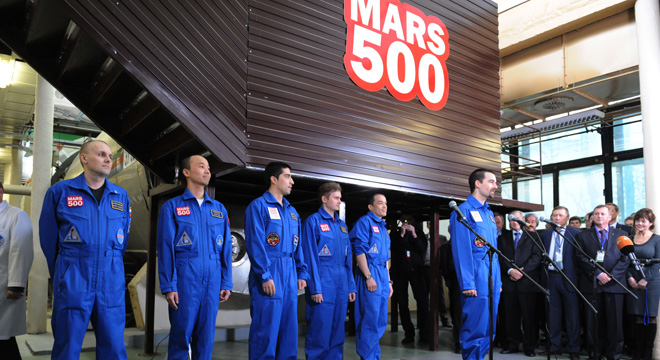
In fact, it’s a grueling, psychologically harrowing and physically taxing challenge, but one that the crew of the Mars 500 simulator managed to complete on Friday.The international crew of six men emerged from their simulator spacecraft at the Institute of Biomedical Problems in Moscow, Russia on Friday at 2:00 pm local time (6:00 am ET) — some 520 days after they were sealed away from the rest of the world to test the human body and mind’s abilities to endure a theoretical trip to the Red Planet. The crew consisted of three Russians, one Italian, one Frenchman and one Chinese man, only two of whom had any prior astronaut training, and the project was lead by the Institute in conjunction with the European Space Agency (ESA).
The six looked pale and slightly haggard upon emerging, but were otherwise healthy, MSNBC reported.
The outcome was better than had been expected, according to ESA.
Upon emerging, Diego Urbina, Mars 500’s Italian crew member, said: “It is great to see you all again.”
The night before they were released, Urbina, who had kept the public updated throughout the mission on Twitter, tweeted: “We come in peace.”
Aside from using Twitter to communicate with the outside world, Urbina and French crewmember Romain Charles kept online diaries and posted video updates of the stationary journey. The trip unfolded in three phases: A flight to the red planet, a 30-day simulation orbit around Mars and brief visit to the Martian surface, and the return trip, conducted in five rooms of the crew’s 19,000 square-foot compound. During that time, the crew conducted more than 100 “experiments,” with researchers closely monitoring their every move and bodily function.
Mars 500 also released a shortened 15 minute highlight reel of the 520-day mission on YouTube.
A realistic delay of 20 minutes was imposed on the crew’s Internet access throughout the mission, and portal windows were simulated by TV monitors, but the zero gravity environment of space and the low gravity environment of Mars were not simulated, The Telegraph notes.
Now that they’ve disembarked, the six will be given medical checks and psychological evaluations as well as private time with family members and loved ones before holding a press conference in Moscow on Tuesday, November 8.
The entire mission cost an estimated $15 million dollars and each crew member was paid $100,000 for their participation, with the exception of China’s Yue Wang, whose compensation wasn’t released by the Chinese government, according to MSNBC.
ESA’s Director General Jean-Jacques Dordain, in Paris, thanked the men with a statement posted online at the ESA website: “I welcome the courage, determination and generosity of these young people who have devoted almost two years of their lives to this project, for the progress of human space exploration.”
The Mars 500 crew’s feat sets the world record for the longest continuous simulation, previously set at 420 days at the same institute in 2000, according to Reuters, but that earlier simulated mission reportedly ended in “drunken disaster,” with organizers having to pull the plug after a crew of different members had too much to drink, erupted into a fistfight and one man attempted to “forcibly kiss” a female member of the crew.
The Mars 500 crew, who were decidedly more laid back, even beat the longest time spent by someone in isolation in actual outer space (that would be Russian cosmonaut Valeri Vladimirovich Polyako, who spent 437 continuous days aboard the Russian space station Mir between 1994 and 1995. Incidentally, his first words upon returning to earth reportedly were “We can fly to Mars.”)
Still, there remains some debate over just how useful the results of the experiment will be in planning an actual human spaceflight to Mars, the technology required for which is still at least a decade away.
Christer Fuglesang, the director of ESA’s human spaceflight division, maintained that the mission was highly realistic in terms of “logistics and communciations,” SPACE.com reported.
Back in 2007, NASA and the Mars Society, a grassroots group that seeks to put humans (where else?) on Mars, had four people spend 100 days living in a cramped confines on Devon Island in Canada, near the Arctic circle, also performing experiments in clunky astronaut-like suits outside in order to simulate a Mars mission.
At the time, Mars Society founder and president Robert Zubrin said that the study was the most valuable yet because it wasn’t “a group in a chamber in isolation in a hangar in Moscow or JSC [Johnson Space Center, Houston, TX], but with an active team out in the field…If the crew is not doing work, the study is of little value.”
The Devon Island station, called the Flashline Mars Arctic Research Station, has seen researchers come and go since 1997, with a team of about 10 researchers spending several months there every summer.
The Mars Society has also regularly hosted an annual volunteer simulation at its Mars Desert Research Station in Utah. The 11th simulation will begin on December 3 and run through May 16, 2012.
We’ve contacted the Mars Society for their response to the conclusion of Mars 500 and will update when we receive a response.
Meanwhile, Russia is also reportedly considering its own, even more realistic simulated Mars mission in zero gravity by having at least two people spend at least 18 months aboard the International Space Station, Russian news agency Itar-Tass reported on Friday (H/T: MSNBC Comsic Log.) But the report also notes that the other 14 member countries of the ISS, namely the U.S., would have to be onboard as well. The earliest that it could happen is 2014, according to the report.
Either way, it’ll be a long time before anyone sets foot on Mars. In the mean time, we’ll have to make do with Mars rovers and robotic probes, the next of which, Russia’s Yinghuo 1 probe, is due to launch for the Martian moon Phobos on November 8. After that comes NASA’s Curiosity rover, set to launch November 25.