Updated 1:00 pm ET, Tuesday, Feb. 21
TINA CASEY
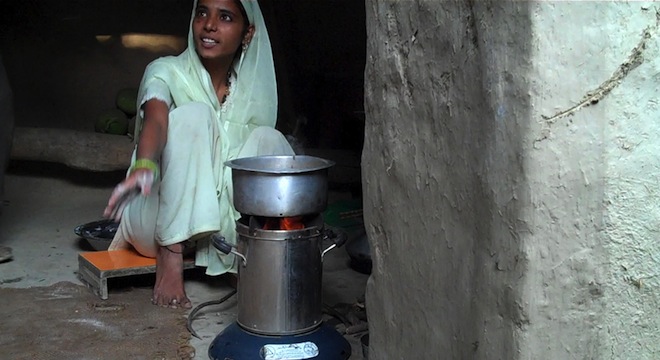
The U.S. has joined with five other countries in a first-of-its-kind international effort to slow the pace of global warming by targeting three greenhouse emissions, one of which is black carbon from the open cook stoves widely used in Africa, Asia and Latin America.
Though there may not appear to be much promise in that angle of attack, cook stoves could in fact hold the key to achieving a quick, significant impact on global warming along with benefits for public health and agricultural production.
The new initiative, called the Climate and Clean Air Coalition to Reduce Short-Lived Climate Pollutants, was launched February 16 by Secretary of State Hillary Rodham Clinton. The founding members are Bangladesh, Canada, Ghana, Mexico, Sweden, the U.S. and the UN Environment Programme.
The project contains a long term goal within a short term goal: It skips over the most notorious greenhouse gas, carbon dioxide, which can remain in the atmosphere for about 100 years, and settles for picking off some some low hanging fruit.
It targets global warming emissions that last only a few days or at most a few years in the atmosphere, namely black carbon, hydrofluorocarbons and methane gas.
All together, these three contribute about 33 percent to global warming emissions.By achieving a clear, measurable success in a relatively short period of time, the coalition hopes to build overwhelming public consensus on the human causes and effects of global warming. That, in turn, should help to build overwhelming support for the kind of long term, coordinated global actions needed to address the problem of carbon dioxide emissions.
In the context of a longstanding fossil fuel industry campaign to undermine public support for global warming action, the new coalition appears to be positioning itself as a street-level public relations counterbalance.
Secretary of State Clinton was not shy about expressing this agenda in her speech announcing the initiative, stating:
“And we know that in the principal effort necessary to reduce the effects of carbon dioxide, the world has not yet done enough. So when we discover effective and affordable ways to reduce global warming – not just a little, but by a lot – it is a call to action.”
As for projects that would help to meet the three short-term goal, cook stoves are an important target because they are estimated to contribute about 25 percent to global black carbon emissions.
Black carbon, a component of soot, only lasts up to a few weeks in the atmosphere but it does a lot of damage on the way up and down. As an emission from open wood burning stoves in developing countries, it contributes to premature deaths especially among women and children routinely exposed to smoke. Once in the atmosphere it absorbs sunlight, and when it falls on snow and ice it causes them to darken and absorb more sunlight, contributing to glacier melt.
On top of all that, soot falling on croplands inhibits agricultural productivity, and the use of wood for fueling highly inefficient stoves contributes to deforestation.
The new coalition will coordinate with other programs that are already under way to help populations swap out of open cook stoves and adopt more efficient low cost alternatives, and even renewable alternatives including solar power.
Among those programs underway are those being spearheaded by the Global Alliance for Clean Cookstoves, a public/private partnership designed to spur the development of a clean cook stove market in the private sector and get 100 million homes worldwide to adopt clean cook stoves by 2020.
The group was launched by the UN Foundation and Secretary Clinton in September 2010 with $50.8 million in initial funding from leading U.S. agencies. Shell Oil’s philanthropic arm, the Shell Foundation, is actually one of the alliance’s founding members.
Meanwhile, the new action plan from the State Department also addresses other black carbon sources including vehicles, primitive kilns, and the practice of burning agricultural waste.
The other two items of concern, man-made methane emissions and hydrofluorocarbons, can be curbed through methane capture at coal mines, agricultural operations and other sources as well as tighter regulation of products like aerosols and refrigerants.
Updated to include mention of the Global Alliance For Clean Cookstoves in copy.