Updated 10:30 am ET, Wednesday, Feb. 22
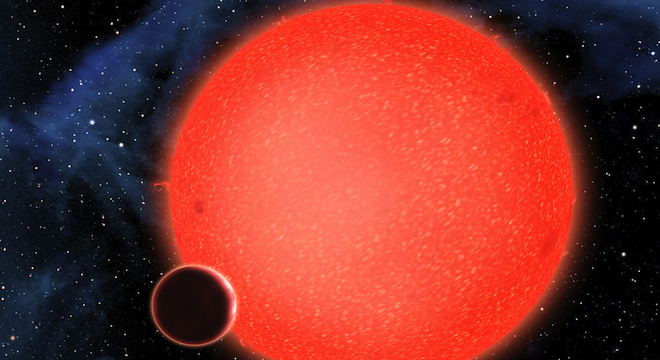
Using NASA’s famed Hubble Space Telescope, scientists have determined that an alien world located just 40 light years from Earth is unlike anything previously found before: A world composed primarily of steam.
The planet, known officially under the unflattering moniker GJ 1214b, “is like no planet we know of,” said Zachory Berta a researcher at the Harvard-Smithsonian Center for Astrophysics, in a release announcing the discovery of the planet’s strange composition, adding: “A huge fraction of its mass is made up of water.”
GJ 1214b was first sighted in 2009 by the Harvard MEarth Project‘s ground-based telescopes located near Amado, AZ. However, it took Hubble’s relatively new Infrared Wide Field Camera 3 to establish a closer view of the planet, revealing that it likely contains a dense atmosphere of water vapor.While that’s not a novel announcement on its own, combined with two other pieces of information known about the planet, it paints an exciting picture of a world that is unlike any ever before spotted by Earth’s observers.
GJ 1214b is 2.7 times the diameter of Earth (so about 21,400 miles straight through) and 7 times as heavy (9.1 Ã 10^25 lbs.) containing far more water than Earth with much stronger gravity.
But because the planet is also in a much closer orbit to its star than Earth is to the Sun (Just over a million miles away compared to Earth’s 93 million miles, with a year of just 38 hours), its surface temperature is way hotter: an average 446 degrees fahrenheit, according to estimates from the Harvard-Smithsonian Center.
That means that the water on the surface of GJ 1214b is doing weird things besides turning into steam.
“The high temperatures and high pressures would form exotic materials like ‘hot ice’ or ‘superfluid water’, substances that are completely alien to our everyday experience,” Berta explained.
Berta and his fellow researchers hope to get a closer view of the planet, which they believe is the first of an entirely new class of steam worlds, when the James Webb Space Telescope is finally completed and launched, hopefully sometime within the decade. That telescope, the successor to Hubble, has narrowly evaded the Congressional chopping block, despite being beset by numerous delays, errors and cost overruns.
Still, for now, the Harvard-Smithsonian team and their collaborators in Europe are savoring their hot new find. They’ve published their results in a recent paper in the Astrophysical Journal.
Their finding is just the latest in a series of amazing new extrasolar planetary finds being made by scientists using NASA equipment, all of which scientists hope will lead us one day to finding a planet that supports extraterrestrial life. Steam world GJ 1214b is an unlikely candidate, despite having so much water, because it is so close to its star, and thus outside of the “habitable zone,” the point at which liquid water can stably exist on a planet’s surface.
Correction: This post originally said that the planet GJ 1214b was 21,400 miles around. In fact, that measurement was for diameter, so the more accurate word would be “straight through.” The error has been corrected in copy. We regret it.