Microsoft is full of surprises. Before the company on Thursday unveiled a new version of its search engine Bing designed to better compete with Google by adding a layer of social networking posts to user searches, it had another shocker to announce on Tuesday: Microsoft as a whole will be going carbon neutral — or offsetting as many carbon emissions as the entire company produces — effective July 1, 2012.
The company said it will reach this milestone through a combination of internal carbon offsets for each of Microsoft’s divisions in over 100 countries, clean power purchases and a program to make buildings “energy smart,” or more energy efficient.
As Microsoft chief operating officer Kevin Turner acknowledged in a blog post: “We recognize that we are not the first company to commit to carbon neutrality, but we are hopeful that our decision will encourage other companies large and small to look at what they can do to address this important issue.”
Indeed, Google and Dell have also been among those to commit to carbon neutrality in the past five years. And while Dell has quietly backed off its commitments, Google is still going strong after reaching its goal in 2007.“We’ve been carbon neutral since 2007 — meaning we went carbon neutral for the 2007 calendar year, and have been since then,” Parag Chokshi, Google’s manager of clean energy public affairs, told TPM via email.
However, Microsoft’s approach on its own is worth noting given that Microsoft’s data centers alone derived over 30 percent of their energy from coal-burning sources, according to a 2011 report from enviromental advocacy group Greenpeace. Microsoft’s own data found that 40 percent of its carbon footprints came from its buildings.
Here’s how Microsoft plans to meet its goal, according to Robert Bernard, the company’s first chief environmental strategist:
“For three-plus years now, we were thinking about continuously updating how we use IT [information technology] to monitor energy usage at our buildings across the world, and changing buildings to make them more energy efficient, and then we thought, ‘what if we apply that to our carbon emissions?'” Bernard told TPM in a telephone interview.
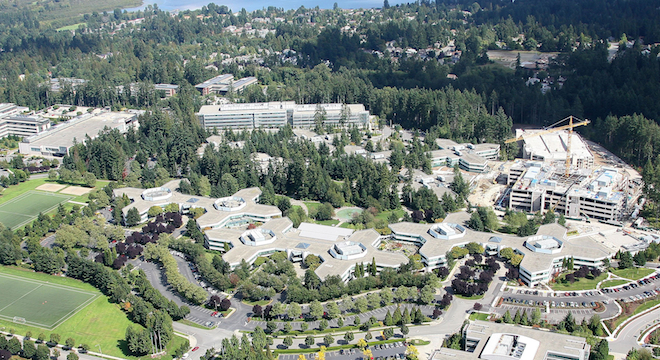
Specifically, Bernard said that Microsoft’s movement toward carbon neutrality was outlined in several white papers: One, published in October 2011, outlined the results of Microsoft’s “pilot program” for improving the energy efficiency of buildings at Microsoft’s sprawling, 118-building headquarters in Redmond, Washington.
Though that pilot program only evaluated 13 buildings, it found that by spending just 10 percent of what Microsoft spends annually for energy on a new “layer” of energy-usage monitoring software, it could recoup the amount spent on that software in energy-savings within 18 months.
Microsoft took a similar approach in deciding to reduce its overall carbon footprint across the company, but expanded it, Bernard told TPM. The new plan is outlined in Microsoft’s most recent whitepaper, published Tuesday.
But the challenge was much greater, as it involved “actually gathering the data across multiple disparate systems operating in over 100 countries arrant he world, in some cases where Microsoft was just one small tenant in larger office building,” Bernard said. “Figuring out how to gather that data, plus data that looks at air travel, and bringing that all together in real-time or near real-time, that was the toughest part.”
To do that, Microsoft partnered with an Australian firm called, fittingly if plainly enough, Carbon Systems, which it picked out of some 50 other similar firms that offer cloud-based IT solutions for managing sustainability data. Of course, Carbon Systems and the rest of the candidates were all Microsoft Windows-based.
“One of the things we wanted to do, one of the things that was important to us, was to work with carbon systems to make their system even more robust,” Bernard explained. “Then they could make that system available to everybody.”
Further, Bernard said that Microsoft was committed to making sure that it wasn’t just paying lip service to the goal of carbon neutrality, as previous carbon neutral companies, namely Dell, have been accused of doing — due to the fact that they don’t take into account their entire supply chain, e.g. the factories that assemble their products and ship them.
Bernard declined to say how far down Microsoft’s supply chain the company was committing to making carbon neutral. However, he pointed out that the company’s new whitepaper on carbon neutrality acknowledges this issue, stating:
We are working with the top direct suppliers of the hardware products that we sell (such as Xbox) and piloting an emissions program with non-direct suppliers that provide us with the hardware we use for our internal operations to accurately measure and actively reduce the emissions associated with our global supply chain.
Further, Bernard added that Microsoft convened with “a number of the world’s leading NGOs [non-governmental organizations]…folks like the World Wildlife Fund, the National Resources Defense Council and the Environmental Defense Fund,” among others, to establish the appropriate benchmarks for measuring and reporting the company’s carbon output.
“If they were take a significantly different perspective than ours, we would adapt to that,” Bernard said. “As we start to roll this out in fiscal year 2013, we will share broadly what we’re finding out and learning on our blog and website.”
Greenpeace, for one, was not wholly convinced.
“Today’s announcement by Microsoft to become ‘carbon neutral’ is a good first step that shows that the company is hearing from its customers who want a clean cloud,” Greenpeace Senior IT Analyst Gary Cook said in a statement on Tuesday. “The question now is whether Microsoft’s ambition will create the transformational real-world impact we expect from the IT sector’s biggest leaders. Microsoft should move quickly to back up its goal by committing to renewable energy for its growing data center fleet and using its influence to demand a shift away from dirty energy, as its peers Google and Facebook have done.”
Correction: This article contained numerous typographical errors when published, retained from an earlier draft form. We have since corrected them in copy and regret them.