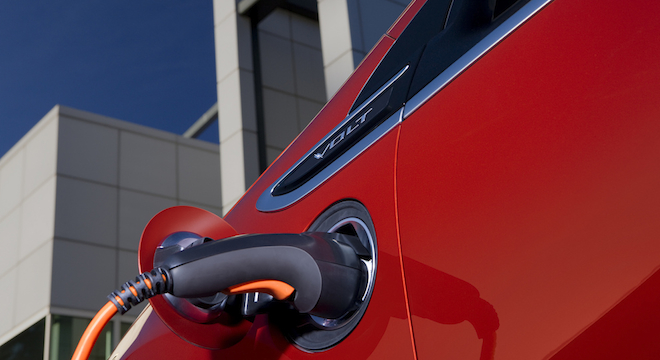
Electric cars are becoming increasingly popular around the globe, but remain a niche market, due in large part to consumers’ concerns over the limited range of the vehicles — 35 miles per full 10 to 12 hour charge in the Chevrolet Volt (pictured), which uses an industry standard lithium-ion battery.
Scientists at the Department of Energy’s Pacific Northwest National Laboratory and Princeton University have a better idea: They cooked up a new form of the nano-wonder material graphene for a new type of battery, the lithium-air battery, and set the highest energy storage capacity ever reported, 15,000 milliamp hours per gram (mAh/g).The previous energy storage record was 9,000 milliamp hours per gram (mAh/g), still an astronomical improvement over the current industry standard lithium-ion batteries, which only achieve up to a measly 150 mAh/g.
Even if you don’t drive an electric car, you’re probably familiar with lithium-ion batteries: They power most laptops, mobile phones and other consumer devices. Lithium ion batteries are made up of three basic parts: A cathode, dervided from a mixture of metal and oxygen atoms, an anode made up of carbon and an electrolyte made up of lithium salt.
Lithium-air batteries, flip the script, using a pure lithium anode and a pororus carbon cathode, which cuts down on the amount of metal, and weight, in the battery. The trick is finding a carbon material that is porous enough to act as the cathode, but scientists think graphene, a nano-material derived from carbon, is the best candidate due to its incredible strength, thinness (one atom thick) and electrical conductivity.
The team at Pacific Northwest National Laboratory, led by materials scientist Jie Xiao, believes that lithium-air batteries using a graphene cathode will shatter energy storage expectations within two decades.
The researchers reported their new graphene lithium-air battery’s record-breaking performance in a paper published in the journal Nano Letters in November.
First though, Xiao said that the team had to figure out a way to harness one of graphene’s most unique properties — its ultra-thin, 2D molecular structure.
“Initial trials failed due to the natural, two-dimensional morphology of graphene,” Xiao told TPM via email.
Solid graphene sheets used in the lithium-air battery’s cathode ended up being too flat to allow the necessary free flow of air molecules in and out of the battery’s cell.
Frustrated, her team pondered a different method: What if they could create a new type of graphene that was 3D, with holes to allow air to flow in and out of the battery freely?
“We successfully synthesized graphene into a highly porous, three-dimensional structure that is well suited not only for lithium-air batteries but also for many other potential energy applications,” Xiao told TPM.
Producing the new, 3D, hole-filled sheet of graphene took “about 2 days,” according to the scientist, “including an overnight drying” period.
Her team used a chemical to break-up solid graphene, liquifying it, then added it to water and stirred, producing bubbles.
When the liquid graphene dried, it settled around the bubbles, forming permanent holes in the structure, as PhysOrg reported.
These holes act as “highways,” for air, allowing it to quickly flow inside and out of the battery cell without damaging it, according to Xiao’s paper.
Conventional lithium-ion batteries are limited, and eventually fail, because their terminals suffer damage from lithium ions passing in and out many times.
However, there are still some big constraints holding Xiao’s team’s discovery back from being tested on the road, let alone installed into commercial vehicles.
For one, the pure lithium used in lithium-air batteries is extremely sensitive to water vapor, and could explode if even a little water vapor gets on it. As such, the battery could only work in a pure oxygen environment at this time, which Earth’s atmosphere is decidedly not.
However, her team has stumbled across a promising work-around to this problem: A standard industrial membrane available relatively cheaply from DuPont, which allowed the battery to function in an environment with 20 percent humidity. Now the challenge will be getting it to function in any humidity level.
But that’s not the only issue, as Xiao explained: “There are still many challenges facing this electrochemical system such as rechargeability, lifetime and power rate.”
Still, he’s hopeful that the number of scientists now looking into the material will lead to rapid progress.
“Many groups are aggressively researching metal-air batteries and we believe this to be a promising technology for future use in fuel-efficient vehicles and also in stationary (power grid) applications,” Xiao told TPM.
Correction: This post originally erroneously identified Pacific Northwest National Laboratory materials scientists Jie Xiao’s gender. Xiao is a woman. We regret the error.