Updated 12:35 pm, Tuesday, October 18
Here’s what happens when you stick a bunch of programmers together in a few small rooms around the country for several hours straight with the open-ended goal of developing new tech tools to help Occupy Wall Street and its associated demonstrations around the globe: A new design movement, among other things.
“Occupy Design,” a new website spearheaded by San Francisco-based designer and social activist Jake Levitas, is just one of over 12 projects developed by programmers over the October 14 weekend at three spontaneous “hackathons” held in San Francisco, New York and Washington, D.C. “Hackathons,” are marathon collaborative programming events designed to harness the skills of various developers to a common end. As such, they’re a natural fit for the Occupy Together global movement, which was from its onset organized using social media and other web tools.
“All three hackathons [were] a coordinated effort,” said Stefan D. Fox, a developer who organized the DC Hackathon and who’s day job is at the New Organizing Institute, a nonprofit organization that provides tech tools to political organizers.
As Fox told TPM via email: “#OWS folks have requested a whole series of tools… There’s no agenda, no set to-do list, the goal is simply to bring people with tech skills together, and give them the space and creative community to apply their skills and create tools for organizers on the ground to use.”
The full list of projects devised by the first Occupy Hackathons is available here at Occupy Hack, but many are still in the process of development. The “Occupy Design” page is perhaps the most fully-fleshed out of the projects so far.
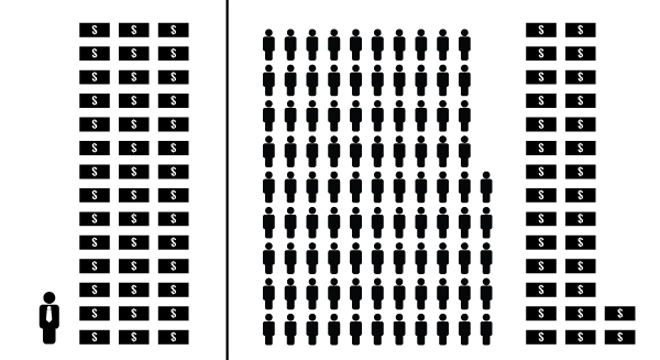
The “Occupy Design,” website was launched on Monday to begin curating a set of universal icons and infographics for the protesters. The icons developed so far represent everything from abstract concepts such as the inequitable distribution of wealth to concrete directional signs for the Occupy encampments (e.g. “Toilet” and “Recycling.”)
As the website notes in its FAQ: “We are in no way trying to fully “design the movement” – we just heard several requests for visual aids from around the world and simply wanted to provide a repository to connect existing designs and designers with those expressing these needs – while providing some designs of our own along the way.”
Meanwhile, other programmers focused on more experimental tech tools, including a new Android app, “Shouty,”, designed to supplement or supplant the “People’s Microphone” – the low-tech system of human amplification that the Occupy Wall Street protesters have resorted to at Zuccotti Park to comply with the law banning sound amplification devices, such as bullhorns and public address systems.
The “Shouty” app, developed by Nathan Hamblen, a platform engineer at New York-based online event planning platform Meetup.com, is still in its bare-bones beta stage, but, works by converting an Android smartphones microphone input into a live mp3 stream, which gets broadcasted to everyone who has the app. It’s available for download here on GitHub, but as Hamblen himself notes on the description: “The interface is really terrible. Can you (yes you!) please fork and make it better?”
Other tools birthed at the hackathons include an “Internet aggregator for all things OWS,” which aims to “grab tweets, events, photos, videos and attempt to assign a location to them.” That one, devised by Meetup.com engineer Andrew Gwozdziewycz, is still being perfected.
“There’s a long way to go with that,” Gwozdziewycz told TPM via email. Still, he and other programmers can’t hide their enthusiasm for assisting the Occupy Wall Street movement.
As Gwozdziewycz explained: “I’ve never been more excited about something like this. I’d love to be more involved… That’s really the major reason that I saw the hackathon through. It’s *a* way to help, even if indirectly.”
Late update: Jake Levitas emailed TPM to further explain and clarify his role in the Occupy Design project. As he wrote:
“I’m not sure if I’d say I’m spearheading the project. It’s a very team-based effort and though I pitched the initial idea at the hackathon, that idea evolved in many different ways based on the input of the team and I would like to communicate that all team members are on an equal playing field.”
“So far over a dozen people have been involved with the project, including occupiers from OccupySF giving us ideas and feedback. They have all been based in SF, but we’ve been coordinating with teams in NYC, DC, and other cities around outreach and the larger concept.”
“We are already receiving interest from designers from all over the world to participate in the project and to use the designs we’ve posted so far. We posted a Designer Toolkit so people can create additional graphics within our template.”
True to the “We Are The 99 Percent,” ethos, to be sure. And as Levitas noted, the team is asking those who use the movement’s designs out on the street to photograph them and upload them to Flickr under the tag “OccupyDesign.” He said the team is working on a more refined system at the time of this post.
On a semi-related note, various Occupy tags around the globe have been, well, “occupying” Flickr’s lists of hot tags over the past 24 hours and seven days.