Google has another big hit on its hands.
Google’s three-year-old web browser has overtaken Mozilla Firefox to become the second-most popular desktop Web browser in the world, according to the latest stats from Web tracking firm StatCounter.
“We can look forward to a fascinating battle between Microsoft and Google as the pace of growth of Chrome suggests that it will become a real rival to Internet Explorer globally,” said Aodhan Cullen, CEO of StatCounter in a release on Thursday. “Our stats measure actual browser usage, not downloads, so while Chrome has been highly effective in ensuring downloads our stats show that people are actually using it to access the web also.”Google’s Chrome browser rose from 25 percent of the browser market in October to 25.69 percent in November, while Firefox declined from 26.39 percent to 25.23 percent over the same month, according to StatCounter.
Microsoft’s Internet Explorer was still number one and actually experienced a slight uptick in an otherwise continual downward spiral, commanding 40.63 percent of the market in November, up from 40.18 percent in October.
So Chrome is only a hair’s-breadth ahead of Firefox, but still enough to vault it into the silver medal spot, a significant development given that Firefox had held the number two position for the entirety of Chrome’s existence up until now, and for most of Firefox’s seven-year history as well.
It’s worth noting that only StatCounter’s statistics show Google Chrome in the second place spot. Another tracking firm NetMarketShare, puts Chrome still in third place in November, with 18 percent global desktop Web browser market-share compared to Mozilla’s 22 percent and Microsoft’s 53 percent.
Nonetheless, the trends are clear: Chrome is coming for Firefox, and fast. The trend is even reflected in TPM’s latest browser-visit statistics, which show a rapid uptick in Chrome and drop-off in Firefox use over the past three years.
More pointedly, the succession can only exacerbate the growing divide between the once-close Google and Mozilla.
Mozilla Firefox still comes bundled with a Google search toolbar, privilege for which Google was paying Mozilla tens of millions in royalties. In fact, Google’s search bar royalties accounted for 86 percent of Mozilla’s operating income in 2010 according to ExtremeTech.
But the contract between the companies, the terms of which are secret, was due to elapse in November. It’s unclear if Google and Mozilla have renewed, and if so, if the terms have changed.
In October, Mozilla made the bold if defensive maneuver of partnering directly with competitor Microsoft to offer a version of Firefox with Bing baked in as the primary search bar. While the decision makes sense if Mozilla is attempting to rely on other sources of revenue, anticipating an eventual termination of its contract with Google, it was also radical in that Microsoft’s Internet Explorer competes directly with Mozilla and Google Chrome, not to mention the fact that Microsoft competes directly with Google in a host of other industries — search, mobile, desktop operating systems, etc. In fact, it’s hard to imagine how that partnership wouldn’t tick Google off.
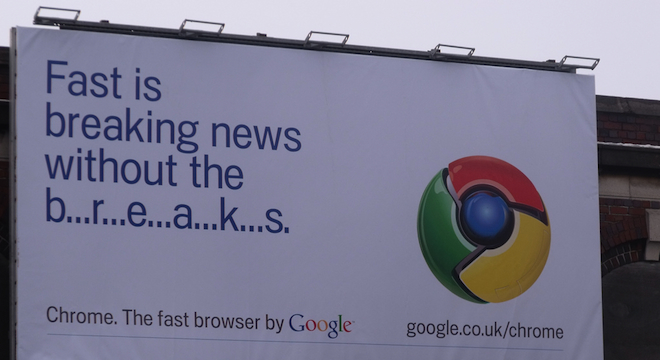
But Google has another reason to celebrate: The company spent untold millions on a massive global advertising campaign designed by Google and agency Bartle Bogle Hegarty to promote the Chrome browser with TV commercials in the U.S. and the U.K., subway adverts in the U.K. and France, and of course, print and Web ads, as well.