Google on Monday unveiled a new feature for its upstart social network Google Plus (Google +) which promises both to help make it more popular and more similar to rivals Facebook and Twitter.
The new feature, called Google + Pages, marks a long-awaited policy change for the company, finally allowing other businesses and brands to be able to openly creating Google Plus profile pages and adding other Google Plus users to their “circles” (that’s Google Plus’s version of Friends and Followers).
“Super excited we are launching +pages today,” posted Google CEO and co-founder Larry Page on his own Plus profile. “Now everyone’s favorite brands — companies, not for profits — can get their page on Google+.”Brands can be found by using another, related new feature, Direct Connect, which involves searching Google plus for a brand name with a “+” directly in front of it, like “+Google,” for Google’s own brand Plus page.
“So far Google+ has focused on connecting people with other people,” wrote Google SVP of engineering Vic Gundotra in a blog post announcing the news on Monday. “But we want to make sure you can build relationships with all the things you care about — from local businesses to global brands — so today we’re rolling out Google+ Pages worldwide.”
The post also included a video from a new Google Plus Page user, Zen Bikes:
Behind that welcoming PR statement is a starker truth: Google wasn’t going to succumb to clamoring from users and businesses to create a place for brands but instead was going to make the change on its own timetable.
Brands had been officially outlawed from the neophyte social network since its launch in June, with Google Plus engineers locating and booting those Plus profiles that had been created under a brand name or pseudonym, enforcing a “real names” only policy that quickly gave rise to a backlash by some companies and those with names that defied conventional Anglo-American construction.
At the time, Google Chairman and former CEO Eric Schmidt defended the policy. As quoted by NPR social media strategist Andy Carvin, Schmidt said: “In the Western world, what we decided to do was to take the position that we wanted people to be willing to be at least identified by some sort of a real name … But we want people to stand for something, we want people to be willing to express themselves. There are obviously people for which using their real name is not appropriate, and it’s completely optional, and if you’re one of those people don’t do it.”
Now, the “Nym Wars,” as the conflict was so-dubbed by tech bloggers, has finally ended, with Google Plus not only creating a specific place to house brands, but actively courting the branding relationships Google already has in place thanks to its lucrative AdWords online advertising service (which forms the bulk of the company’s revenue).
“Since the initial launch of Google+ just a few months ago, we’ve welcomed over 40 million people and introduced more than 100 new features. For all these people, one important part is still missing – your business,” wrote Dennis Troper, the project manager of Plus pages, in a much lengthier post on the AdWords blog specifically designed to guide businesses through the processes of setting up a Google Plus account.
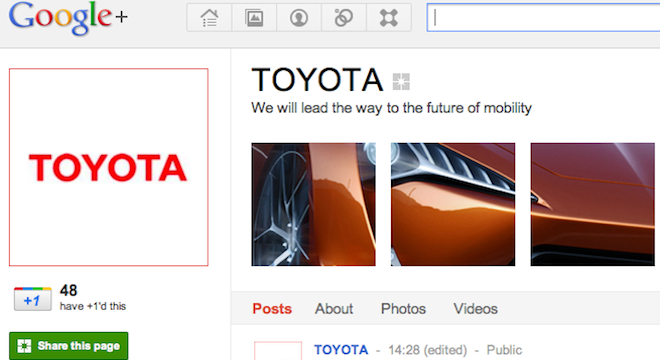
Already, a number of businesses, companies, organizations and brands have flocked to Google Plus since the social network opened its doors to them, including NPR, Toyota, The Dallas Cowboys NFL football team, the British soft rock band Coldplay, the game Angry Birds (though quixotically, the company behind the game, Rovio, is still missing at the time of this posting) to name a few. (Yes, TPM is on there too.)
The few brand pages that have popped up so far are understandably bare bones, but social media blog Mashable offers a compelling vision of what a fully-developed brand page might look like in the near future.
The real question is to what extent brands will help Google grow its audience and engagement. The company has reported 40 million Google Plus users have joined in the five months, giving it a faster rate of initial growth than either Google or Facebook.
But a more important statistic, the number of active users, remains up in the air, as Google won’t release figures on that, yet. That’s compared to 800 million active Facebook users, according to the company, and 100 million active Twitter users out of a total 200 million accounts.
And when it comes to business engagement, both Twitter and Facebook offer distinct opportunities for brands to connect with customers.
“Overall, about 100 million online stories, pictures and other things are ‘liked’ by Facebook users daily,” according to the New York Times.
Meanwhile, the number of small and medium-sized businesses on Twitter doubled between 2009 and 2010, according to a survey from BIA/Kelsey and ConStat. And Twitter users who follow brand accounts are 50 more likely to buy those brands and 60 percent more likely to recommend them to friends, according to a recent study from Chadwick Martin Bailey and Social Media Quickstarter.
So it’s abundantly clear that Google is wise to get into the social media brand space, but whether brands decide to embrace the platform in a big way remains to be seen.
Perhaps more problematically, Google Plus has suffered an embarrassing series of PR flaps since its launch aside from the “Nym Wars” controversy: For instance, tech bloggers noted that CEO Larry Page and other top company executives only use the service sporadically at best.
In addition, well-known Google engineer Steve Yegge accidentally published a public Google Plus post blasting the social network as “a knee-jerk reaction, a study in short-term thinking,” and an incorrect overreaction to the success of Facebook.
That said, Google Plus Pages does have one major thing going for it: AdWords, which is the third largest online advertising platform behind Yahoo and AOL. If Google can convince even a portion of its AdWords customers to begin creating Plus pages, it will be able to serve up more content to users and make Plus a more dynamic and lucrative space.
Of course, allowing brands into Google Plus is a double-edged sword. Inelegant and overreaching ads are also one quick way to anger social networking users.
It’s not an exaggeration to say that how Google chooses to handle the influx of brands to Plus will determine its longterm success or failure. And the last thing Google can afford right now is another social networking flop on the order of its ill-conceived Google Buzz experiment, which Google in October announced it would finally shut down.