Updated 2:21 pm ET, Wednesday, May 2
NASA seeks to make space history again, this time by overseeing the first-ever docking of a privately owned commercial spacecraft with the International Space Station (ISS).
The Dragon cargo vessel developed by private firm SpaceX has been tentatively cleared to launch from Cape Canaveral on April 30, 2012, and is set to rendezvous with the space station a few days thereafter, NASA’s associate administrator of space operations William H. Gerstenmaier said Monday.
The entire mission will take 21 days, at which point the Dragon cargo vessel will re-enter Earth and plunge into the Pacific Ocean, to be recovered and re-used again.“Everything looks good as we head toward the April 30th launch date,” Gerstenmaier said in a press conference at NASA’s Johnson Space Center in Houston, Texas, broadcast live online on NASA’s website Monday afternoon.
However, Gerstenmaier said that while he was “impressed with the overall work” both NASA and private firm SpaceX had done to prepare for the historic mission, there remained “one simulation to do,” and “software testing.”
Gerstenmaier said that the two sides would meet again on April 23 to “re-assess” the proposed launch date.
SpaceX founder and CEO Elon Musk, the 40-year-old high-tech entrepreneur who made his fortune after founding PayPal (he also later founded Tesla Motors), further tempered hopes for his company’s inaugural cargo delivery simulation.
“There’s a lot that could go wrong with a mission like this,” Musk said at the press conference, “There’s a pretty good chance [of success], but I want to emphasize that this is a test flight.”
But although the initial flight is just a test, the Dragon will also be carrying 1,200 pounds of “non-critical” supplies to the ISS, including food for the astronauts onboard.
SpaceX’s Dragon craft, which has been in development since 2005, won a $1.6 billion contract for a minimum 12 flights to the International Space Station.
In the wake of the retirement of the Space Shuttle, NASA hopes that SpaceX will be the first of several companies that will take the shuttle’s place in ferrying cargo, and eventually crew, to the International Space Station.
NASA desperately needs a reliable replacement vessel, too, with crew and cargo currently being ferried to the ISS on Russian Soyuz spacecrafts. NASA pays a reported $63 million per astronaut to fly on the Soyuz. SpaceX earlier told TPM it could carry astronauts at a cost of $20 million per seat aboard the Dragon, but no plans for such missions have yet been finalized. The cargo mission is the only one with a set launch date, for now.
Meanwhile, China, which is aggressively developing its own crewed space program and space station, just overtook the U.S. in total space launches for the year 2011, Wired reported on Monday.
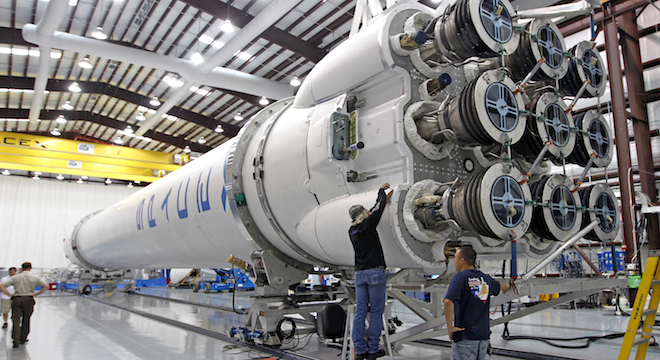
The SpaceX rocket that will transport the Dragon vessel into space, the Falcon 9, in March completed a five-hour readiness test and mock launch countdown, which all went smoothly. The Dragon was originally scheduled to launch for the ISS in February, but was delayed due to SpaceX’s insistence that more simulations be carried out, according to comments from NASA representatives and Musk during Monday’s press event.
“Testing a vast amount of intelligence that’s occurring in the software and making sure that even in highly unusual situations, the mission is successful, that’s what’s taken such a great deal of time,” Musk said.
Come April 30th, SpaceX and NASA will see if all that testing was enough.
Check out the following simulation video of the launch via SpaceX and CollectSpace.
Late update: NASA and SpaceX on Wednesday, May 2, announced that the mission would likely be delayed past May 7, the alternate date previously targeted for launch due to the need for more testing of the launch and docking systems.