The entire history of the observable universe, all 13.7 billion years of it, has been for the first time successfully modeled by six scientists using a French supercomputer.
Called the Dark Energy Universe Simulation (DEUS): full universe run, the historic supercomputer simulation created and tracked 550 billion particles, each the mass of our own Milky Way galaxy or greater, that were thought to be created in the Big Bang — the seminal expansive event that scientists believe birthed all matter into existence — to the present day.
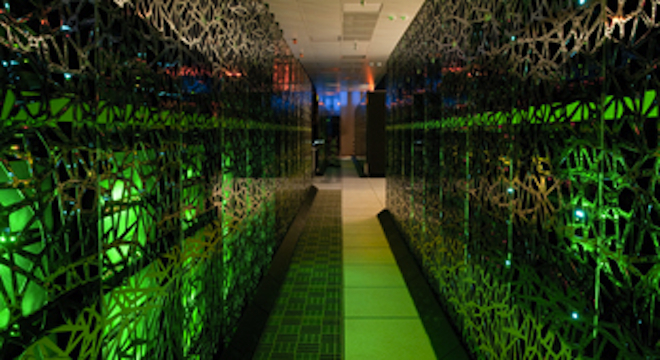
The simulation was run over a two-week period in mid-March on the CURIE supercomputer housed at the Très Grand Centre de Calcul (Very Large Computing Center) in Bruyères-le-Châtel, a commune in Northern France. Recently upgraded to run at 2 petaflops, CURIE is now among the fastest supercomputers in the world.
“The goal of our DEUS project is to understand the nature of the Dark Energy or in other words, the origin of the cosmic acceleration,” said Dr. Jean-Michel Alimi, a scientist with the Laboratoire Univers et Théorie of France’s National Center for Scientific Research (CNRS), who led the project, in an email to TPM.“To do that, we study the imprints that Dark Energy leaves on the distribution of matter in the universe over the course of its entire evolution, from early times to its present state,” Michel Alimi explained.
So far, the first DEUS full universe run has uncovered some hugely important results for the cosmology community, according to CNRS, including the fact that the first large galaxy cluster (exceeding 100 thousand billion solar masses) formed when the universe was a relatively young 2 billion years old.
The run also discovered that the largest galaxy cluster in the observable universe weighs 15 quadrillion solar masses.
“Only this kind of numerical simulation can say what is the most massive object in a given cosmological model,” Michel Alimi told TPM, saying that this super massive galaxy cluster was the most surprising find yet discovered.
As for dark matter, the first DEUS full universe run discovered that fluctuations and distribution in dark matter throughout the known universe are the same as those as the cosmic microwave background radiation observed by satellites.

Alimi told TPM that the project, which is still scheduled to undertake two more “full runs” of the entire history of the universe by the end of May, will allow scientists to understand the formation and present structure of the universe, including “non linear gravitational processes,” or situations where gravity produces gravity.
However, Michel Alimi was quick to dispel any notions that the simulation could yield understanding for the existence of human life on Earth, or even the formation of Earth itself.
“The smallest mass that we can consider is the mass of a galaxy like Milky Way,” Michel Alimi told TPM.
The DEUS project was the result of at least seven years of work by French scientists, according to Michel Alimi. The simulation itself took up all of the resources of the CURIE supercomputer while it was running and will total up to more than 30 million hours of simultaneous simulation, or 3,500 years. The first run generated more than 50 petabytes of data, and in total, the project will generate more than 150 petabytes.
“Maybe the most surprising observation will be next,” Michel Alimi told TPM, regarding the next two DEUS full universe runs.