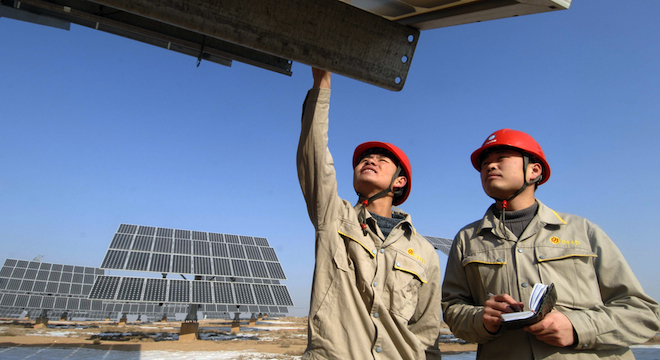
China’s solar industry just got burned by the U.S. government.
Ruling in a contentious international trade case that could spill over into a full-blown solar trade war, the U.S. Commerce Department on Tuesday afternoon found that the Chinese government illegally subsidized solar panel exports to the United States, sources close to the case told TPM.
But the resulting punishment isn’t as bad as had been expected: Most Chinese solar companies will now be forced to pay import duties of 3.59 percent, or an extra 3.59 percent to the U.S. government for every panel imported, sources told TPM.
Two companies in particular, though, were singled out by Commerce for separate import duties: Trina Solar will have to pay 4.73 percent on its imported panels and Suntech, the world’s largest single producer of commercial solar panels, will have to pay only 2.9 percent. Wall Street analysts had expected import duties of 20 to 30 percent, Reuters reported on the eve of the decision.Suntech’s chief commercial officer, Andrew Beebe, said in a statement that the decision on the lowered tariff for his company proved it was engaged in “free and fair competition.”
“Nonetheless, unilateral trade barriers, large or small, will further delay our transition away from fossil fuels at a time when the majority of Americans demand cleaner and more secure energy such as solar,” Beebe added.
The Coalition for American Solar Manufacturing, a trade group of seven manufacturers who filed a case against the Chinese government, responded on Tuesday with muted applause to the Commerce Department’s decision, pointing out in a statement that Commerce is still investigating other Chinese subsidy programs in other tangentially related products, such as metal and glass, which are used in the assembly of many solar panels.
“Today’s announcement affirms what U.S. manufacturers have long known: Chinese manufacturers have received unfair and WTO-illegal subsidies,” said Steve Ostrenga, CEO of Milwaukee, WI-based Helios Solar Works, one of the coalition’s principal members.
In an interview with TPM prior to Commerce’s Decision, Ostrenga said that the last thing he wanted to do when getting into the solar manufacturing businesses was instigate trade cases.
“Our core competency is to make modules,” Ostrenga said, referring to the completed solar panel assemblies. “That is our focus. Our focus isn’t trade cases…Our investors do not want litigation, they prefer us to just make modules and get solar out there on market.”
However, Ostrenga told TPM he was driven to take part in the trade case because of “unfair and illegal” competition from China. Ostrenga said he himself had to lay people off as a result and withhold expansion plans of his company’s facilities, but declined to provide a specific number to TPM.
The trade case drove deep divisions in the American solar industry itself, pitting manufacturers against “downstream” companies — those that provide solar financing, installation, servicing and other extraneous products and services aside from making the panels. Those downstream companies enjoyed a record year in 2011 due in part thanks to the low price of solar panels.
A trade group representing them, called the Coalition for Affordable Solar Energy on Tuesday released a statement applauding Commerce for imposing such lower tariffs.
“Today’s preliminary determination by the Department of Commerce imposing low tariffs on imported solar cells and modules is a relatively positive outcome for the U.S. solar industry and its 100,000 employees,” said CASE president Jigar Shah. “However, tariffs large or small will hurt American jobs and prolong our world’s reliance on fossil fuels. Fortunately, this decision will not significantly raise solar prices in the United States as SolarWorld has sought.”
Shah was referring to SolarWorld America, an Oregon-based subsidiary of a German company that is the largest American manufacturer of solar panels and is also the lead petitioner in the case against China.