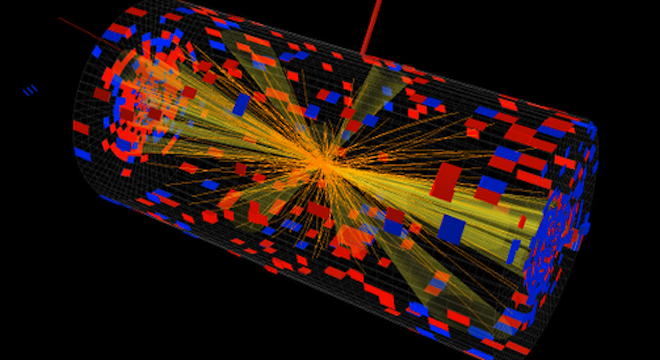
The Large Hadron Collider (LHC), the world’s largest and most powerful particle accelerator, is back online after a four-month long dormant period over the winter when the device underwent maintenance in order to prepare it for its record-breaking return.
On Thursday, the European Organization for Nuclear Research (CERN), which runs the underground particle accelerator near Geneva, Switzerland, announced that it had achieved the highest-energy level for proton collisions yet recorded in history: 8 trillion electron volts (TeV), or about 8 times the energy of a flying mosquito, but shrunk into a space one million times smaller.
“The collision energy of 8 TeV is a new world record, and increases the machine’s discovery potential considerably,” CERN wrote in a press release on its website Thursday.
The agency also posted several photos and videos of the new energy record on its Google Plus page, including the following video simulation of the violent proton beam collision that produced the new record.
CERN achieved this new energy record by smashing together two beams of protons, each one measuring in at 4 TeV and traveling just below the speed of light, around the accelerator’s 17-mile circumference ring. Previously, the highest CERN had raised the level of the beams was 3.5 TeV a-piece, which is how the agency ran the beams over the past two years.
CERN will continue colliding the particles at a clip of hundreds of millions of times per second over the next 11 months. Then, the LHC will again enter a period of dormancy for further maintenance, as the beam energy level is cranked up yet again to 6.5 TeV per beam and then after that finally up to its theoretical maximum level, 7 TeV per beam.
At full energy, the beams inside the LHC could punch through six feet of solid copper, although they are held in place by an immensely strong electromagnetic field, so that shouldn’t be an issue.
Once these proton beams collide, they break apart into trillions of debris which last for a fraction of a second before decaying.
These high-energy collisions are meant to simulate the conditions at the formation of the start of the universe, hence the LHC’s colloquial moniker, the “Big Bang Machine.”
It’s this particle debris that CERN is after, specifically a yet-unseen particle known as the Higgs-Boson, which has been nicknamed “The God Particle.” Scientists have never been able to produce this particle or find it occurring naturally in the universe, but desperately want to, as its existence would confirm the theoretical bedrock of modern physics (The Standard Model). CERN thought it saw something that may or may not be the Higgs Boson back in 2011, but will have to run the accelerator for the rest of this year at least to be sure.
If the particle can’t be found during CERN’s experimentation, then scientists will have to turn to stranger alternate theories, such as that of the holographic universe, which conceives that reality is essentially just a giant 3D projection.
Still, though CERN’s restart of the LHC was mostly picture perfect and bodes well for future discovery, it did not come without jitters and a few glitches. CERN particle physicist Pauline Gagnon related her experience manning the helm of one of the six distinct particle physics experiments that are being conducted around the LHC in a blog post on Quantum Diaries:
“Preparing to take my first shift of the year in the ATLAS control room this week reminded me of first day of school when I was a kid,” wrote Gagnon, continuing:
The whole morning shift crew, about ten people including myself, had been hoping we would be there for this important milestone. As we walked in at 7:00 am, the LHC was delayed by a small glitch that got fixed rapidly. Then they needed to complete one last measurement but lost the beams before completing it. For hours, we kept hoping for some interesting action.
There was not much to do but wait and see if and when the LHC team would be ready. The shift was punctuated by the usual succession of dead quiet periods followed by frantic bouts when one system went bad, a new alarm went off or the daily run meeting ended.
Still, given the glitches that have beset another separate particle physics experiment involving CERN (the faster-than-light speed particles detected at the OPERA experiment), it seems that the LHC is off to a solid start going into 2012.