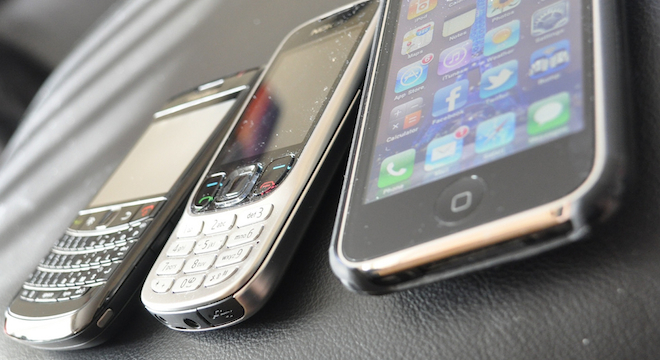
Embattled mobile giant Research in Motion earned back some long-lost love from investors on Tuesday when it announced a new product, BlackBerry Mobile Fusion, which will allow businesses to better manage, coordinate and secure their employees’ myriad mobile devices, even if those happen to be Android and iOS devices that compete with Research In Motion’s signature BlackBerry line.
Mobile Fusion will run in the background on user’s mobile devices, allowing administrators to create groups, update user profiles, install new software and even help users recover lost devices. It has yet to be priced, is undergoing limited beta testing right now and is expected to have a public release in late March 2012, according to RIM.“This is the next generation of mobility management,” said RIM’s director of product strategy David Heit, in a telephone interview with TPM. “We’re envisioning a future where not just companies, but their employees are using a mix of devices for work — a smartphone and a tablet — and the question is, ‘How do I manage these things collectively?’ Mobile Fusion is the answer.”
Shares of RIM rose 8 percent after the announcement, closing up 2 percent on Tuesday. Shares on Wednesday midday trading were up 2 percent as well.
“Research In Motion Does Something Right,” proclaimed the Motley Fool.
Other analysts and bloggers have been less receptive to the news, labeling at best a “defensive” and at worst, a “desperation” move.
In either case, it’s clear that RIM recognizes (perhaps too late) that it’s once ironclad hold on the enterprise mobile phone space is rapidly eroding thanks to the massive uptick in Android and iOS devices.
Globally, RIM’s smartphone sales declined by 58 percent over the last year, market research firm Canalys observed in early November. In the U.S., RIM suffered an even more precipitous drop, down from a 24 percent share of the domestic smartphone market in 2010 to just 9 percent in 2010. That brought RIM shares crashing to a 7-year-low, Reuters reported.
A global service outage that lasted nearly a full work week in October didn’t help RIM’s reputation either. But Heit remains upbeat.
“As mobility goes much more mainstream, the ‘company-issued device’ is going to take on a whole new meaning.” said Heit, “People are going to decide what they want to use.”
He pointed to the automobile market as a model for how RIM views its role in an increasingly competitive mobile space.
“When the auto industry started, everyone wanted a Ford — that was pretty much the only car anybody knew about,” Heit noted. “Not everyone drives one now. But they all drive on the same roads and all of their cars have seat belts. As the mobility market matures, you’re seeing the same thing.”
With statements like that, combined with the recent de-listing of the BlackBerry Playbook tablet from Best Buy’s catalog, it’s not illogical to presume the company is pivoting away from devices to focus on a more nascent, business-friendly market.
But any presumptions that BlackBerry’s expiration date is looming are flat out wrong, according to Heit, who told TPM that Mobile Fusion would be tailor-made to support RIM’s long-awaited new operating system, BBX.
Like BBX, which was borne out of RIM’s $200 million April 2010 acquisition of Canadian software company QNX, Mobile Fusion was also the fruit of an acquisition: RIM’s May purchase of German software maker Ubitexx for an undisclosed sum.
Heit told TPM that it was Ubitexx’s pre-existing agreements with Google and Apple to provide security software that allowed RIM to develop Mobile Fusion for Android and iOS devices.
“Ubitexx had the relationship,” Heit said. “It’s still run as a separate company.”
As for what competitive advantage Mobile Fusion offers other competitors already offering similar services in the space — such as MobileIron and BoxTone, as VentureBeat noted — Heit told TPM that Mobile Fusion’s price point would be competitive when revealed, but added that RIM has far more experience in the field than most.
“We have 11-plus years of experience,” Heit said, referring to the release of BlackBerry Enterprise Server in 1999, “We’ve matured our offerings over time. Our competitive advantage is the size of our shared base and the products and services we’ve built around that. Our global reach is important.”
Still, Heit maintained that Mobile Fusion would be far more than just the latest update to BlackBerry Enterprise Server, and that RIM would continue to evolve to meet the needs of its customers.
“Mobile Fusion is based on what our customers are asking for,” Heit said. No doubt RIM would prefer they not be asking for phones and tablets made by the company’s competitors.