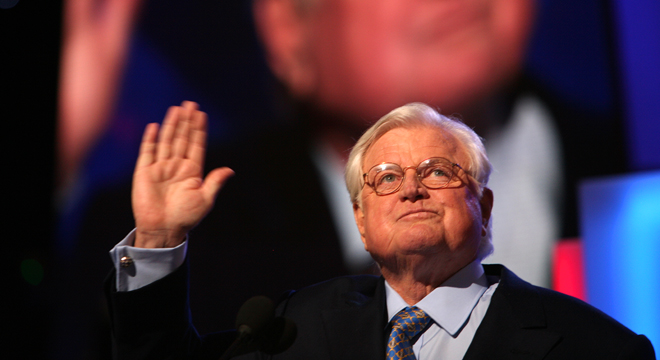
Health care reform and the late Sen. Ted Kennedy, who spent decades pushing for universal health care coverage, are often mentioned hand-in-hand.
Kennedy’s wife, Vicki Kennedy, reiterated her late husband’s commitment to the cause of health care Thursday, but warned that the fight to implement all of the health care reform act’s provisions isn’t over:
I applaud the decision by the United States Supreme Court this morning, upholding the constitutionality of the Affordable Care Act. We still have much work to do to implement the law, and I hope we can all come together now to complete that work. The stakes are too high for us to do otherwise. As my late husband Senator Edward Kennedy said: “What we face is above all a moral issue; that at stake are not just the details of policy, but fundamental principles of social justice and the character of our country.”
House Minority Leader Nancy Pelosi also invoked Kennedy’s memory in her statement celebrating the ruling Thursday.
“I want to say a word about Sen. Kennedy,” Pelosi said. “He called it the great unfinished business of our country, of our society. I knew when he left us he would go to heaven and help pass the bill. And I now I know he was busily at work until this decision came down, inspiring in one way or another. And now he can rest in peace.” Pelosi said Thursday that she had spoken with Vicki Kennedy and Patrick Kennedy, the senator’s son, about the ruling.
Kennedy called health care reform “the cause of my life,”shortly before his death in August 2009. “For four decades I have carried this cause — from the floor of the United States Senate to every part of this country. It has never been merely a question of policy; it goes to the heart of my belief in a just society.”
Kennedy began calling for universal health care in the 1960s and made it central to his primary challenge to President Jimmy Carter in 1980. In the 1990s, Kennedy was behind the creation of the Children’s Health Insurance Program (CHIP), the largest expansion of health care coverage for children at the time in over three decades. President Obama signed a reauthorization and expansion of the program in early 2009, while Kennedy was still in the Senate.
Kennedy died before health care reform passed through Congress. But many have suggested he was the force motivating Obama to push for the bill. In a tribute to Kennedy in the New Yorker in September 2009, Nicholas Lemann said, “Barack Obama, early in his presidential campaign, did not push universal health care as forcefully as his rivals did… That changed after Edward Kennedy endorsed him, at a crucial moment in the campaign — most likely, as a result of Kennedy’s prodding.”
Â
Â
Â
Â