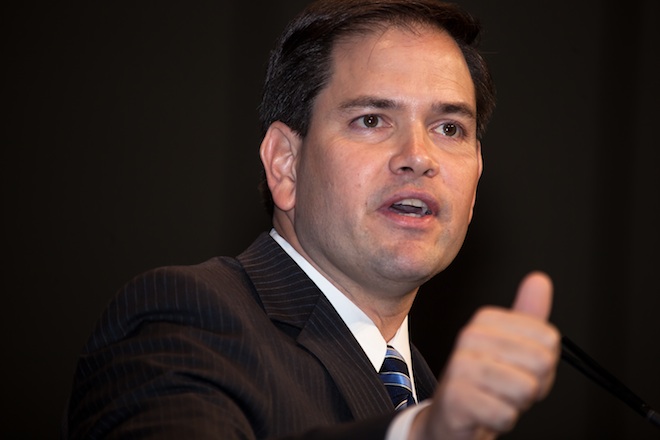
Sen. Marco Rubio (R-FL), already the most fervently discussed of all of Mitt Romney’s potential vice presidential candidates, boosted his profile further on Wednesday with a broad address on foreign policy to the Brookings Institution.
Rubio was introduced by Sen. Joe Lieberman (I-CT), the GOP’s favorite Democratic caucus member on foreign policy, and launched his speech with a lengthy passage praising bipartisanship — and harshly condemning many members of his own party.The freshman senator said he was surprised upon entering federal office to find that many within his own party had grown isolationist — a reference to the tea party movement and its standard bearers like Sen. Rand Paul — while many Democrats were now at the forefront of prosecuting the nation’s latest military campaigns.
“On the one hand, I found liberal Democrats and conservative Republicans working together to advocate our withdrawal from Afghanistan, and staying out of Libya,” he said, according to prepared remarks. “On the other hand I found myself partnering with Democrats like Bob Menendez and Bob Casey on a more forceful foreign policy. In fact, resolutions that I co-authored with Sen. Casey condemning Assad and with Sen. Menendez condemning fraudulent elections in Nicaragua where held up by Republicans. I recently joked that today, in the U.S. Senate, on foreign policy, if you go far enough to the right, you wind up on the left.”
Rubio said at the outset that he has “many” disagreements with the Obama administration, but the few he made explicit echoed Romney’s foreign policy attacks. He criticized the White House’s “reset” of relations with Russia, for example, saying it undermined allies in Europe. That echoed Romney’s frequent charge that Obama wants to “lead from behind” in participating in international alliances, most notably in Libya.
“Yes, global problems do require international coalitions,” Rubio said. “On that point this administration is correct. But effective international coalitions don’t form themselves. They need to be instigated and led, and more often than not, they can only be instigated and led by us. And that is what this administration doesn’t understand.”
At times, though, Rubio strayed from Romney. His take on Iran sounded extremely similar to President Obama’s, for example — Rubio stressed international pressure through the U.N. and regional allies and urged remaining open to Iranian negotiations if they seem credible. Romney has largely condemned Obama’s early talk of negotiations with Iran, long since abandoned in favor of a sanction-oriented approach, as an example of weakness.
“Preferably, we can succeed through coercive means short of military force,” Rubio said. “We should be open to negotiations with Iran. But always remember that they should not be deemed a success when they only lead to further negotiations. Stronger pressure shouldn’t be postponed in the expectation our forbearance will encourage Iran to act in good faith. Nothing in our experience with Iran suggests it considers such gestures as anything other than a lack of resolve on our part.”
Rubio later said during a Q-and-A period, that his “bigger concern is that a reliance on negotiations would somehow lead us to postpone sanctions.”
An audience member asked whether there was really much difference between him and Obama on foreign policy in general, since so much of his speech sounded largely in line with the White House agenda.
“I always try to keep foreign policy as nonpartisan as possible,” Rubio said, though reminding that he still had “fundamental” differences with Obama.
Rubio even noted that he heard Libyan people thank Obama personally on a recent trip for helping overthrow Muammar Gaddafi. The Obama campaign quickly noted on Twitter that Romney called for a more limited mission at the time and specifically criticized the administration’s goal of removing the dictator as “mission creep.”
But in general, Rubio carefully threaded a needle between embracing the neoconservative agenda associated with Romney and his advisers — which he largely did in substance (and which isn’t necessarily that far off from Obama’s policy) — and reassuring moderates that America should still be a willing partner in international institutions like the U.N., the IMF and the World Bank. If he was auditioning for the vice presidency, he did so by trying to soothe the intellectual class’s fears rather than showcasing an ability to serve as an attack dog on foreign policy.