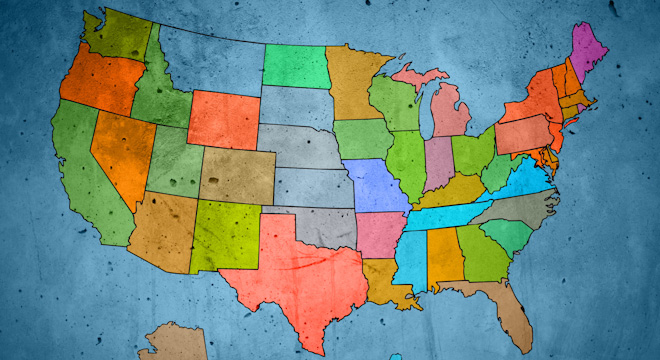
When it comes to swing states it’s always been Ohio, Ohio, Ohio. Now it might be Virginia, North Carolina….and maybe Ohio.
In 2008, when then Senator Obama took states no Democratic candidate had come close to winning in decades, there was necessarily some skepticism he could repeat the feat in 2012. Sure, he’d made gains in the south and west. But given the awful current economic circumstances, it stands to reason that the newest states on the redrawn political map would be the first to go — and with a recession coupled with a highly partisan atmosphere, voters would return to their typical corners. Except they haven’t done that yet.
How else can one explain President Obama’s numbers suffering greatly in a place like Pennsylvania, one of the bluer swing states, while he’s remained slightly ahead through most of 2011 in North Carolina, a state he won by less than a percentage point. A look at the numbers now suggests there really is a new map, and it looks like economic and demographic changes have solidified it.The Center for American Progress (CAP) released a report in late November called “The Path To 270: Demographics versus Economics in the 2012 Presidential Election” by Ruy Teixeira and John Halpin, two Senior Fellows at CAP. The paper lays out the changes in the political makeup of swing states new and old. In an interview with TPM, Teixeira said that the mix of economic performance, education levels and changes in demographics are the chief drivers in redrawing the political battle lines. “The math becomes a bit more forgiving — we haven’t forgotten the old swing states — but there are few more on the map,” he said.
In both the report and the interview, Teixeria pointed to the growing gap between working class and college educated whites as a new fault line in presidential politics. College educated whites “are significantly less likely to dismiss government as a remedy for the jobs situation,” he said. “Anti-government hostility is the best card for the GOP to play with white working class voters.”
A few decades ago, says Teixeria, there weren’t major differences between college educated and working class whites. But the economic downturn of the 1970s solidified the hostility toward government, creating a schism that remains today. So the combination of a struggling economy and attempts to use government to solve problems are doubly unhelpful to the candidate who employs that solution — and in this case that candidate is President Obama. Social scientists like Gallup’s Editor-in-Chief Frank Newport make the argument that the seminal debate in 2012 will be about the scope and role of government, and if the aforementioned trends hold, that could be at one of the President’s chief obstacles to re-election.
The CAP report goes into detail about the challenges faced by Democrats in rust belt states where this scenario is most likely to occur.
The poor economic situation, however, weighs heavily on that relative friendliness and it is likely to reduce enthusiasm for Obama among his coalition of the
ascendant. That will give Republicans an opening in these states [Iowa, Michigan, Minnesota, Ohio, Pennsylvania, and Wisconsin], especially in Ohio. McCain lost the state by only 5 points in 2008, the white working class was notably sympathetic to the GOP even then (McCain carried them by 10 points), and except for Michigan, the economic situation is worse than in the rest of these states. A strong GOP mobilization effort could take the state, especially if there is no significant economic improvement between now and the election.GOP chances in the other five states are not as good, though Pennsylvania, with the most friendly white working class, and Michigan, with the worst economy, provide serious opportunities. For Obama’s part, his ability to keep his coalition of the ascendant together and avoid catastrophic losses among the white working class in all five states will be heavily dependent on whether and how much the economy improves as we near the election.
In short, if a bad economy remains the chief issue of 2012, and working class white voters reject arguments utilizing government as the solution, the resulting backlash against Obama will be much more likely to happen in the industrial east and midwest than it is in states that are growing and have more college educated whites. Below is a chart of the increase in voters with a college degree, showing the trend much higher in the “new” swing states of North Carolina and Virginia.

But movement among the diverging sets of voters is one of two factors working in the president’s favor in these new swing states. One senior Democratic strategist working on campaigns in Virginia and North Carolina said that on the ground, the economy is simply not as bad. But he said that along with a better economy is the more cited growth of minority groups in the urban areas of the “new south,” which provide Democrats with a larger base. “One of the challenges is going to be to duplicate our success from 2008,” the strategist said, pointing to the 21 point swing from red to blue in the Charlotte, North Carolina area and the 16 point swing in Raleigh, NC as examples — meaning the need for massive turnout efforts in minority communities that showed up for Obama in 2008.
Teixera and Halpin echoed that assessment of what’s happening on the ground in their CAP report, describing a confluence of these factors in Virginia in particular. “Virginia is more promising for the Obama campaign, with a solid minority vote, a relatively friendly white college-graduate population, a tight link between growing areas and increasing sympathy for the Democrats, and a fairly decent economic situation,” they wrote.
Other strategists also pushed the importance of demographics as the chief long-term mover, second to economic growth, especially in the western states. But those states also seem to differ greatly — the economy of Nevada, won handily by Obama in 2008, is famously stalled due to the foreclosure crisis. Yet New Mexico hasn’t suffered as much, and continues to be solidly in the Obama column.
It seems that in 2012, there may be a close election determined by a world beyond the suburbs of Philadelphia, turnout in Cleveland and the trends of the Florida panhandle — and how it all plays out might make the new political map a little more permanent.
Image from leigh / Shutterstock.