For years, Republicans carried the flag in the war against activist judges, a war that peaked during President Bush’s second term, with savage battles over federal court appointments and the late Terri Schiavo. Under President Obama, Democrats picked up their banner, blaming Bush’s appointees for gutting the campaign finance system in favor of the ultra-wealthy. Now nobody knows what to think.
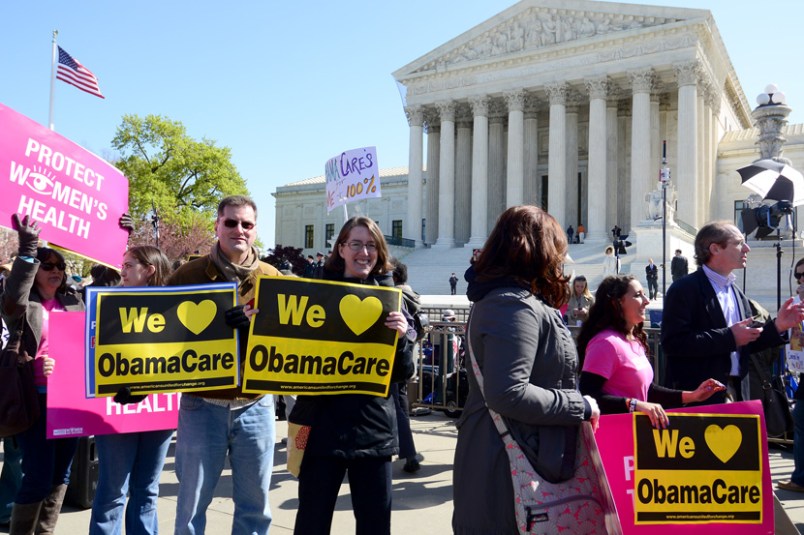
Two landmark decisions by the Supreme Court this week, Thursday’s ruling in favor of the Affordable Care Act and Monday’s ruling overturning portions of Arizona’s SB 1070, have complicated both sides’ claims that they are the true guardians of an independent judiciary.
In the days leading up to the decision, liberal commentators preemptively lamented that the judicial branch was likely lost for a generation as a credible institution.
A ruling overturning health care reform “would mean that the Supreme Court had officially entered an era where they were frankly willing to overturn liberal legislation just because they don’t like it,” Kevin Drum wrote before the decision. “Pile that on top of Bush v. Gore and Citizens United and you have a Supreme Court that’s pretty explicitly chosen up sides in American electoral politics.”Instead, not only did the court side with the administration, but it was Chief Justice John Roberts — architect of the hated Citizens United ruling that kicked off a liberal renaissance of Supreme Court bashing — who rescued the law from annihilation.
That twist caused considerable amounts of confusion for both sides, and leaves President Obama and challenger Mitt Romney without a clear way to make the court a significant villain or hero in their general election pitch.
“The fact that Roberts sided with liberals and Kennedy sided with conservatives makes it trickier to just rely on the usual talking points, doesn’t it?” one unaligned GOP strategist told TPM. “Democrats can’t really complain about the ‘Roberts Court’ today, and I don’t think saying [Romney is] committed to appointing judges in the Roberts mold will work quite as well for Romney after today somehow.”
On the left, Roberts, if still viewed skeptically nonetheless received praise from liberals, Thursday.
“I’m surprised and delighted,” Sen. Dianne Feinstein (D-CA) told The Hill. “I do think it was a very brave decision by the chief justice.”
Jonathan Cohn, one of the leading journalists who advocated for health care reform, said the court “not only validated the Affordable Care Act. It has also validated its own reputation.” Jonathan Chait, another liberal voice who had been extremely supportive of the health care bill, wrote that while he was still suspicious of Roberts, he had “peered into the abyss of a world in which he and his colleagues are little more than senators with lifetime appointments, and he recoiled.”
On the right, reactions were even less clear-cut. Justice Anthony Kennedy had long been vilified in certain conservative circles as an untrustworthy moderate, and plenty would have been quick to pounce on him if he had been the deciding vote. But instead it was Roberts, beloved in conservative circles, who helped the administration across the goal line, a development that caused no small amount of cognitive dissonance.
“Historians are going to look back on today and equate it with Plessy v. Ferguson and Dred Scott,” Tea Party Patriots co-founder Jenny Beth Martin told Buzzfeed. “I think that right now today people feel betrayed by the majority of the court.”
Others could not believe that Roberts would abandon them after having become such a respected figure on the right. Redstate co-founder and influential conservative commentator Erick Erickson suggested he was merely issuing his ruling, which included a nod to limiting the commerce clause, as part of a longer-term scheme to undo the so-called welfare state.
“John Roberts is playing at a different game than the rest of us,” Erickson wrote. “We’re on poker. He’s on chess.”
The result is a street fight with murkier boundaries, and it’s unclear whether either campaign will be able to play politics with charges of an “activist court” beyond the usual nod to the base about nominating sympathetic judges. During the Republican primary, Newt Gingrich tried to court the right with a plan to impeach Supreme Court justices who ruled against conservatives (a plan that gained little traction), a judicial enemies list that presumably did not include Roberts. Romney, as recently as Thursday, still had a pledge on his website to appoint conservative justices “in the mold of” Roberts. Obama famously called out Supreme Court justices to their faces in the 2010 State of the Union address for its Citizens United ruling, prompting a bitter reaction from Justice Samuel Alito. That kind of bombast seems unlikely anytime soon.
“[It’s] not really clear if there’s enough oxygen in the room for a SCOTUS issue to get front and center,” GOP strategist Rick Wilson said. “Economics uber alles, I think.”