The now split Wisconsin state Senate, brought about by the resignation of a recall-targeted Republican legislator, could turn out to have only a limited impact, depending on how other events play out.
The reason: The state Senate adjourned this week for the rest of the year, anyway. This means that the range of activity remaining for the legislature is constricted, under a category called “limited business”: Reconciling contradictions between bills passed in the previous session; gubernatorial appointments requiring Senate confirmation; review of gubernatorial vetoes; and symbolic joint resolutions.
“No new bills can be taken up about anything, because everything dies on the 15th,” said Acting Senate Clerk Jeff Renk, in an interview with TPM. “If they wanted to take up anything specific, both houses would have to agree, or have the governor call a special session.”Nevertheless, a power-sharing arrangement will be needed in order to manage the Senate, until the upcoming recalls — which now include what is effectively a special election for Galloway’s seat — put the chamber back at its full membership. Unlike in some other state legislatures, there is no tie-breaking vote.
State Senate Republican Leader Scott Fitzgerald told the Wisconsin State Journal that he will meet next week with Democratic Leader Mark Miller, to discuss the changes.
The Milwaukee Journal Sentinel reports on what some of these changes are already set to be, with committee rosters changed to being equally divided. For example, the very important committee that organizes the Senate will now be increased from three Republicans and two Democrats to a 3-3 split, with the addition of a Democrat. The Joint Finance Committee, which includes members from both houses and has had a 12-4 Republican majority, will now be shifted to a 10-6 Republican margin.
In addition, the paper notes, the new arrangement could potentially have an impact on a specific kind of limited business: Redistricting. The Republican-majority legislature passed a redistricting bill last year, in the run-up to the previous round of recalls. That law is now being litigated. If that three-judge panel were to find constitutional flaws and send that bill back to the legislature – which is a possibility, but not any guarantee — then it would be the newly-split Senate who would address the topic.
A full return of the legislature can occur in one of two ways: A “special session” in which the governor calls both houses of the legislature back, or an “extraordinary session” in which both houses of the legislature decide to come back, in both cases for a specifically laid out business.
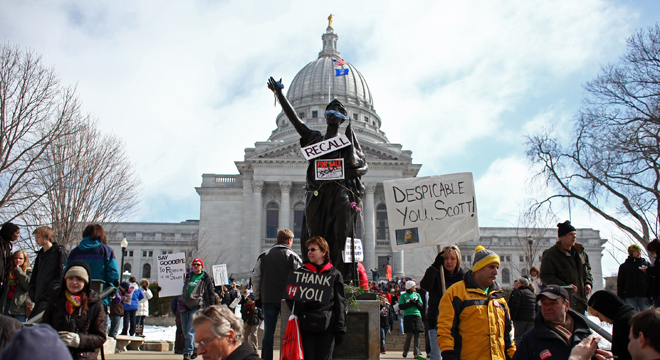
This also has some consequences for the upcoming recalls. If the Democrats were to win the Senate, but Republican Gov. Scott Walker also won his re-election battle, the new Democratic majority would only be able to come back for new business this year if Walker or the Republican Assembly also agreed to it. It certainly seems to say that for such a thing to happen, it would need to be very important.
On the other hand, if Walker were to lose his re-election fight to the Democratic nominee (who is yet to be determined), then presumably the new governor would call the legislature back for a special session based on their platform from the election.