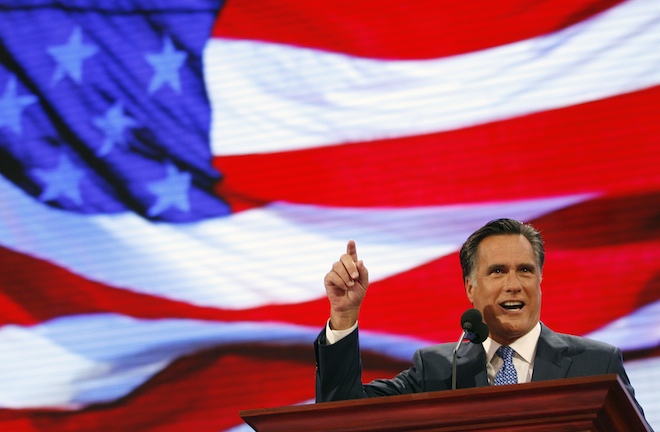
Mitt Romney condemned President Obama on Friday for showing insufficient pride in America in a foreign policy address at The Citadel, a South Carolina military academy.
“I believe we are an exceptional country with a unique destiny and role in the world,” Romney said. “Not exceptional, as the President has derisively said, in the way that the British think Great Britain is exceptional or the Greeks think Greece is exceptional. In Barack Obama’s profoundly mistaken view, there is nothing unique about the United States.”For the most part, however, the speech was more concerned with laying out a world tour of America’s coming foreign policy challenges, from a rising China to a shaky and uncertain mission in Afghanistan. But aside for a concrete call to expand the Navy and explicit opposition to defense cuts, he largely kept his options open.
On Afghanistan, he promised “a full review of our transition to the Afghan military to secure that nation’s sovereignty from the tyranny of the Taliban,” but that was about it. Romney has been dinged by Democratic and Republican opponents alike recently for hitting both rhetorical sides of the debate over the war: in one debate he said that “One lesson we’ve learned in Afghanistan is that Americans cannot fight another nation’s war of independence,” before his campaign clarified that he would base his decisions on reports from the commanders on the ground.
Regarding America’s place in the world’s international institutions, Romney both reassured the audience that the USA would always be out in front, but also played up the importance of its alliances:
[T]he United States will exercise leadership in multilateral organizations and alliances. American leadership lends credibility and breeds faith in the ultimate success of any action, and attracts full participation from other nations. American leadership will also focus multilateral institutions like the United Nations on achieving the substantive goals of democracy and human rights enshrined in their charters. Too often, these bodies prize the act of negotiating over the outcome to be reached. And shamefully, they can become forums for the tantrums of tyrants and the airing of the world’s most ancient of prejudices: anti-Semitism. The United States must fight to return these bodies to their proper role. But know this: while America should work with other nations, we always reserve the right to act alone to protect our vital national interests.
In a briefing with reporters ahead of the speech, one Romney advisor said that he would place a strong emphasis on soft power — the nation’s ability to influence policy through its cultural, institutional and diplomatic strengths — in addition to military might.
Democrats quickly seized on Romney’s speech to tie him to President Bush, passing around a video clip on CNN in which reporters compared the two and noted Romney has many advisors who served in the last Republican administration. Asked before the speech how Romney’s approach might stack up compared to Bush, the same Romney advisor replied that they “don’t know if it’s a departure in policy,” but that Romney’s would be inherently different because he was dealing with a Middle East characterized by protest movements and new regimes.
Romney’s speech addressed the Arab Spring directly: he pledged to appoint an administration official “with the authority and accountability necessary to train all our soft power resources on ensuring that the Arab Spring does not fade into a long winter.” His open support for the uprisings in the Middle East are not shared by the entire Republican field: Michele Bachmann, for example, has condemned President Obama for not doing more to stop them.
Romney, who has surprised observers with some very tough rhetoric against China’s trade policies lately, spent less time discussing the country on Friday. But he did warn of the possibility of a China several years in the future “intimidating their neighbors, brushing aside an inferior American Navy in the Pacific, and building a global alliance of authoritarian states?”
Ben Labolt, spokesman for Obama’s re-election campaign, criticized Romney afterwards for failing to mention Al-Qaeda in his speech, taking the opportunity to highlight the administration’s recent successes against the terrorist organization.
“Governor Romney raised real questions about his capacity to lead this country and wage the fight against terrorism,” LaBolt said. “He didn’t outline a strategy to strengthen America’s security and promote our interests and didn’t even identify defeating al Qaeda as a goal. President Obama has degraded al Qaeda and dealt huge blows to its leadership, including eliminating Osama Bin Laden, ended the war in Iraq, promoted our security in Afghanistan while winding down our commitment in a responsible way and strengthened American leadership around the world. Governor Romney proves once again that he is willing to say anything, regardless of the facts, to get elected.”