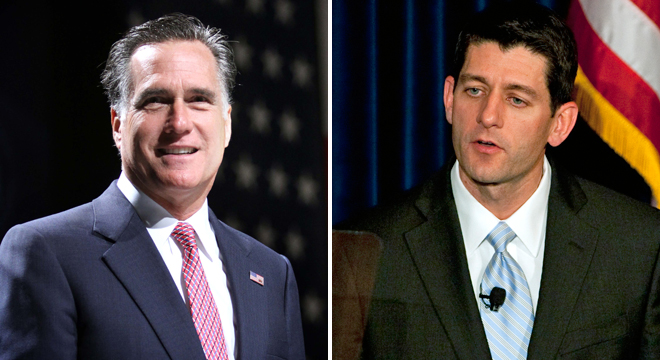
When Mitt Romney picked Paul Ryan as his running mate, he pledged a new “campaign of substance” that would finally silence critics who’ve attacked his policy proposals as unworkably vague. But far from clarifying his platform, Romney’s positions have become even more confusing since Ryan joined the ticket.
Ryan’s choice was intended to bolster Romney’s promise to cut spending. In a bizarre twist, however, the only concrete policy change since Ryan joined the ticket has been a new promise to reverse $716 billion of Medicare savings enacted under the Affordable Care Act, complicating an already fantastical promise by Romney to balance the budget within eight years.The politics of Romney’s Medicare pledge were clear: Ryan’s call to privatize Medicare and reduce its average benefits puts Romney on the defensive, especially in senior-heavy states like Florida. But the policy side is gibberish. House Republicans have twice passed budgets that included the same $716 billion in cuts. Both budgets were written by Ryan himself, and Romney previously pledged to sign them if elected.
But there’s a reason Ryan included the ACA’s savings, which do not come out of Medicare recipient’s benefits, in his own budgets. It’s incredibly hard to close the deficit while cutting taxes and protecting defense spending. Under Romney’s platform, defense spending would actually increase, requiring catastrophic levels of cuts at every other level of government to meet his second-term balanced-budget vow.
Despite his new promise to add hundreds of billions of dollars to the deficit, Romney has not scaled back his goals at all.
“I’d get us to a balanced budget faster than the plan [Ryan] originally put forward,” Romney boasted to CBS.
As for his long-term Medicare plan, Romney is even less clear. He disavowed Ryan’s 2010 proposal to privatize the program and dramatically cut seniors’ benefits over time to bring down the deficit. But once again, he’s refused to fill in the details as to how many savings he’d achieve with his own partial-privatization plan, making it impossible to judge its impact.
Meanwhile, Ryan’s selection has done nothing to clarify the other gaping hole in Romney’s budget plan: taxes.
As the independent Tax Policy Center noted in a study last month, Romney’s promise to cut income tax rates by 20 percent across the board by eliminating tax deductions for the rich simply does not add up. Even under the most charitable estimates, the study concluded Romney’s approach would raise taxes for 95 percent of Americans on average while slashing them for the wealthiest Americans.
Romney called the study “garbage” Tuesday, but his new running mate confirmed this week that they would not release any more information before the election as to how they would pay for their plan instead.
“That is something that we think we should do in the light of day, through Congress,” Ryan told FOX News.
Romney’s latest explanation for his tax plan raises even more questions than it answers. He claimed to CBS that he based it on tax proposals recommended by the Simpson-Bowles deficit commission. But beyond lowering income-tax rates, the two plans have little in common. Bowles-Simpson actually raised tax revenues overall by including additional hikes on capital gains taxes that affect wealthy investors like Romney, prompting Ryan himself to vote against the commission’s findings. Romney has actually called for additional tax breaks on investment income, making the math even harder.