Mitt Romney is not likely to win over many new black supporters in his speech to the NAACP Wednesday, a number of black Republicans told TPM. But, they say, that’s not really the point.Romney will address the annual convention of the civil rights group, bringing the projected Republican presidential nominee face-to-face with the leaders of an electorate that fiercely supports President Obama, the nation’s first black chief executive, to the tune of 86.8 percent to Romney’s 9.5 percent, according to the PollTracker Average.
Ahead of the speech, several prominent black Republicans laid out their expectations for Romney’s high-profile address — and they set the bar low. But they believed his attendance at the event was nonetheless an important symbolic nod toward inclusion, and could put the GOP on a path toward winning black voters in the future.
“I think it says a lot about Mitt Romney, not the guy running for president, but the person Mitt Romney, that he’s heading to Houston to talk to the NAACP when you’re perceived to be someone who can’t win the votes,” Rep. Tim Scott (R-SC) told TPM. “I wouldn’t recommend he spend all this time trying to find ways to embrace folks who may not vote for him, but I tell you, it says a lot about his character and his integrity that he believes he would be the president of all Americans and not just the ones that vote for him.”
Former Democratic Rep. Artur Davis (AL) — who recently defected to the Republican Party and is making friends with the tea party — said he doubted Romney’s appearance at the NAACP is even aimed at black voters.
“I suspect that Romney’s goal is not to move votes, but to convey that a Romney presidency would be inclusive and to signal independent suburban whites that he is not a race-baiter,” Davis told TPM. He said winning black votes was a lost cause for Romney. “The black vote is locked into Barack Obama to the tune of 95 percent or better,” he said.
Davis attributed that unshakable support to “an intense black indentification with Obama and the first lady as role models, and as symbols of a successful black life and relationship” and a “historically flawed” view among blacks “that no other president has encountered the same opposition and that the conservative resistance to him is racial.”
Others said that even if Romney’s speech doesn’t earn him any black votes this time around, it will mark an important step in helping the party win them down the road.
Former RNC Chairman Michael Steele, who took flak during his tenure at the head of the GOP when he openly acknowledged his party’s failure to reach out to African Americans, told TPM that it’s probably too late for Romney to make any gains with black voters in 2012 — but he said it’s not too late for his party in the long run.
“As far as I’m concerned, at this stage of the game this is kind of a moot point,” Steele said. “The RNC has done very little since I left office to expand on the work that we had done in this area. They’ve got a website, God bless them. It’s always good to put a website up with some black faces on it. Outreach.”
There’s another way to go, Steele said, and it involves moving the party away from its push for ideological purity (a warning he’s been broadcasting to his party for years).
Steele called on Romney to advocate “creating an extensive national network of coalitions, relationships, personal relationships, empowering black Republicans in communities to be the advocates, the voice on behalf of the party in their communities, not judging if they’re right, center or left but just saying, ‘damn glad you’re Republican.'”
Though Romney’s speech is in many ways a step onto his opponent’s home turf, there are in fact conservative Republicans within the NAACP. Brandon Andrews, chairman of the D.C. NAACP’s committee on political action and a staffer for one of the most conservative Republicans on Capitol Hill, Sen. James Inhofe, is deeply passionate about the organization. He told TPM that if Romney wants to really reach out to NAACP members, he needs to get real about race, and stay serious about expanding the Republican base.
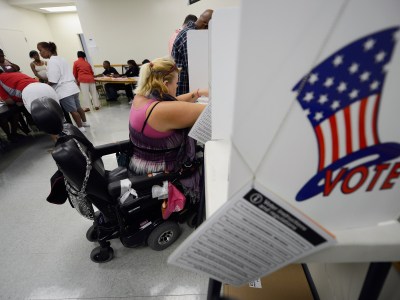
Like other NAACP leaders, Andrews called on Romney to cast a skeptical eye on the voter ID laws sweeping Republican-led states across the nation, and to specifically condemn the Texas GOP plank calling for the repeal of the 1965 Voting Rights Act.
Like Scott, Andrews said Romney can get some traction with the black vote by focusing on their disproportionately sky-high unemployment. That’s one aspect of minority outreach Romney is very comfortable with, and the listing economy is likely to play a big part in his speech.
But beyond that, Andrews said, Romney needs to make it personal.
“Gov. Romney needs to tell, if he has some, personal anecdotes and personal stories,” Andrews said. “Coming from Boston, which is where a lot of people associate him with, and coming from Utah, you know both of those places have had significant issues with equal rights, even after the movement of the ’60s.”
A previous version of this article misstated Artur Davis’s home state. He represented Alabama in the House. This post has been updated and we regret the error