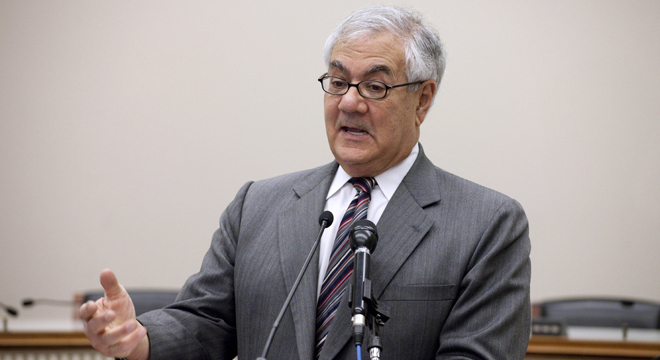
It’s the end of an era in Congress, with Rep. Barney Frank (D-MA) heading for retirement, capping off 32 years in the House of Representatives as an outspoken voice for liberal Democrats.
The Boston Globe reports that Frank’s decision was spurred in large part by redistricting, with him having lost some key strongholds and gained some relatively more conservative areas. On the other hand, Dem sources point out that the redrawn district is still heavily Democratic, having voted 61% for Barack Obama in 2008. A Dem source in Massachusetts says that a potential candidate is Brookline Selectwoman Jesse Mermell, who is said to have been putting her name around in case of a possible Frank retirement.
Frank will perhaps be best remembered on Capitol Hill for his quick wit and pugilistic attitude in political debates, combining both a serious approach to the issues and a certain lightheartedness about himself. From a 1996 interview with the New York Times:
“I’m a counterpuncher, happiest fighting on the defensive. Besides, I really dislike what the Republicans are doing. I think they are bad for the country and for vulnerable people. I feel, ‘Boy, this is a moral opportunity — you’ve got to fight this.’ Also, I’m used to being in a minority. Hey, I’m a left-handed gay Jew. I’ve never felt, automatically, a member of any majority. So I started swinging from the opening bell of this Congress. It got to the point where Newt Gingrich was saying, ‘Barney Frank hates me.’
Among Frank’s jousting partners over the decades have been Rep. Henry Hyde (R-IL), who headed up the Bill Clinton impeachment; Rep. Michele Bachmann (R-MN); Senate Minority Leader Mitch McConnell (R-KY); conservative reporters; and many others –Â even including the Obama administration, with whom he has simultaneously worked closely and criticized from the left.
Most recently, Frank took a lead role on financial reform, as chairman of the House Financial Services Committee from 2007-2011, when Democrats controlled the House.
As with health care reform, the financial reform passed without any Republican votes in the House, though it later picked up three Republicans in the Senate. Frank replied to the House GOP’s bloc opposition with his usual acerbic qualities: “the antithetical feeling that the Republicans have to regulation leads them to talk crazy.”
Frank was first elected to the Massachusetts state House in 1972, before going on to win an open Democratic House seat in 1980 — the same year that Ronald Reagan was first elected to the presidency. Frank won his first term by 52%-48%, but would never have a race that close again.
Frank publicly acknowledged his homosexuality in 1987, after years of it being something of an open secret in Washington, becoming the first Congressman to come out voluntarily. “I don’t think my sex life is relevant to my job,” Frank told the Boston Globe at the time. “But on the other hand, I don’t want to leave the impression that I’m embarrassed about my life.”
However, a scandal from Frank’s personal life would end up resulting in a reprimand by the House in 1990. Back in 1985, Frank paid for the services of a male prostitute named Steve Gobie — who he then began a personal relationship with, hiring him as his personal aide using his own money. However, Gobie continued his escort services, which Frank said had gone on without his knowledge.
“I made a misjudgment,” Frank said in 1989, when the scandal came to light. “I thought I was going to be a liberal who got involved directly with an individual who needed help, that I had an individual who was going to get help — and he took me.”
Ultimately, the House voted overwhelmingly to reprimand Frank, but also turned back efforts by conservatives to more strongly censure or even expel him.
(Ironically, one of the Republicans who pushed for a stronger censure was Larry Craig — who would later retire from the Senate in disgrace in 2008, following his arrest for allegedly seeking out gay sex in an airport men’s room. And one of the Republicans who voted for expulsion was Bob Livingston, who would later resign due to his own sex scandals.)
However, the scandal did not end Frank’s career by any means, as he continued to serve in the House for over two decades more, consistently winning overwhelming landslide margins or often running unopposed. The 2010 Republican wave turned out to be Frank’s closest race as an incumbent — but even then, he won by 54%-43%, which would be considered a decent margin for most members of Congress.