

 Members-Only Article
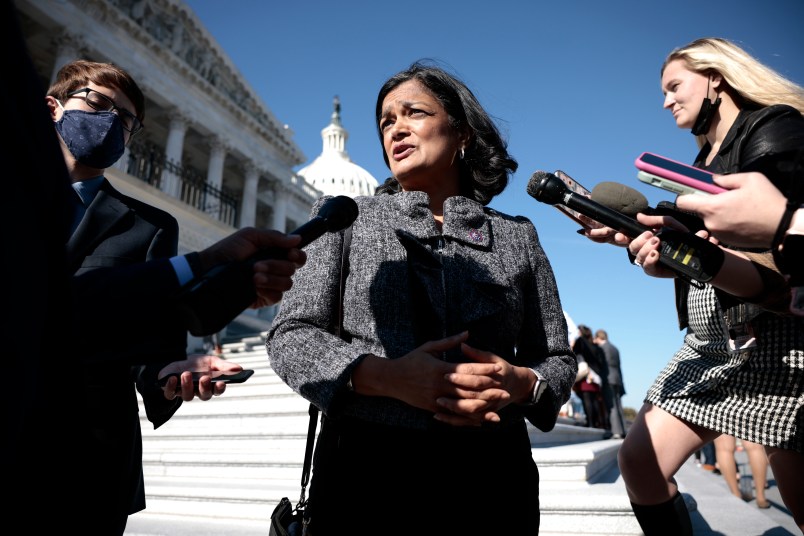
Yesterday 30 members of the House Progressive Caucus signed a letter urging President Biden to pursue direct negotiations with Russia and a diplomatic settlement to the Russo-Ukraine war. Given the fairly united support for Ukraine in the U.S. political class and fairly broad support among the public in general, the letter was bound to spur some controversy. But the letter itself was an incoherent mass of contradictions. It pressed for immediate negotiations and a ceasefire while also insisting on defending Ukraine and not taking any steps without Ukraine’s support. For the moment at least these are irreconcilable positions. Ukraine’s war aim is to drive Russia from most and likely all of its territory. Russia’s position is to annex large parts of Ukraine and force it into a permanently subordinate position to Russia. One side or another has to substantially shift its demands or there’s little to talk about. The letter could have said, “The threat of escalation and the danger to the global economy is so great that the U.S. needs to make Ukraine shift its goals.” But it didn’t. It stated two irreconcilable positions at once.
Then things got weird.
Soon the leader of the Progressive Caucus Pramila Jayapal put out a statement to “reaffirm support for Ukraine” and “clarifying the position of a letter to President Biden.” Her clarification amounted to a recantation of the initial letter: “We are united as Democrats in our unequivocal commitment to supporting Ukraine in their fight for their democracy and freedom in the face of the illegal and outrageous Russian invasion, and nothing in the letter advocates for a change in that support.” Another signer, Rep. Mark Takano, put out a statement again basically recanting or disavowing the letter.
Next Rep. Mark Pocan went on Twitter and said that the letter was being misinterpreted and he wasn’t sure why it was dated 10/24 as it was “written in July.” What? Responding to criticism from one person on Twitter, Pocan said, “I agree the timing makes little sense. It was from July.” In another comment he appeared to suggest that he wasn’t even aware in advance that the letter was being released.
Clearly the whole episode had become something of a debacle as at least three of the signers, including the head of the Progressive Caucus, were distancing themselves from it or recanting its contents within hours of its appearance. But Pocan’s comments raised real questions about whether the signatories had actually read the letter or even knew in advance that it was going to be released. Again, Pocan suggested it was something he and his colleagues had done in July — in other words, three or four months ago.
Rep. Ro Khanna defended the letter and suggested that the reaction to the letter was an effort to “silence or shout down debate.”
My own initial read of the letter was that one group of signatories had worked with an outside group, the Quincy Institute, on a letter calling for a push for a ceasefire. Others among the signatories weren’t really prepared to do that and insisted on adding various commitments to Ukraine’s independence and no actions not supported by Ukraine. Unable to agree on these points they piled both conflicting positions into one letter and signed it. More generally, I think there are people in the Progressive Caucus who simply weren’t comfortable with a position indistinguishable from the rest of their party and indeed from many more mainstream Republicans. But the fallout from the release of the letter shows a clumsiness and obtuseness I would not have expected from members like Rep. Jayapal or Jamie Raskin or Ro Khanna. And here I want to distinguish between positions I might disagree with versus position statements that are simply logical contradictions or ones that need to be recanted or explained or abandoned within hours.
The truth is that Biden administration has and continues to pursue diplomacy. There are no public negotiations because the two sides are simply two far apart for them to make any sense. Taken on its face the letter calls on the administration to do what it’s actually already doing (using diplomacy to find a settlement) while not doing what the letter says it shouldn’t do (act without Ukraine’s support) and has actually not done.
It’s really not clear to me whether most of the signatories knew this letter was being released, whether they’d signed it knowing it would be released at this time or frankly whether they’d actually read it. Pocan’s comments in particular made me wonder whether the outside groups involved in drafting the letter — particularly the Quincy Institute — had perhaps nudged it public to a degree on their own.
The whole thing is a weird and hard-to-explain debacle entirely apart from whether you believe the U.S. should be supporting Ukraine’s war effort or believe our goal should be to negotiate a ceasefire as soon as possible.