
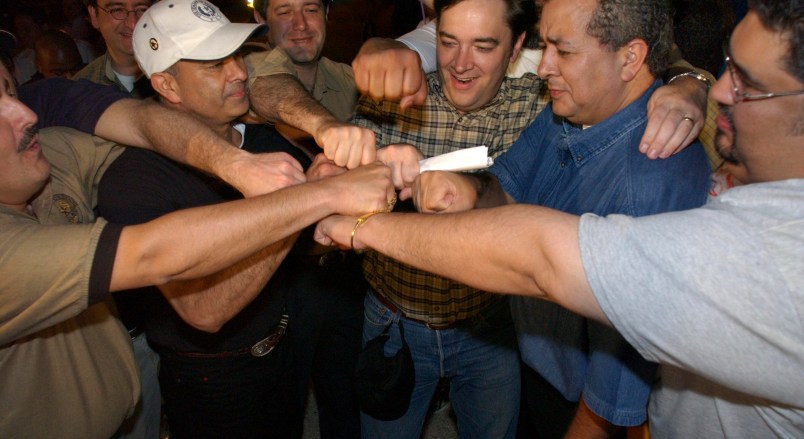
With Texas Democrats fleeing the state to prevent the quorum state Republicans need to ultra-gerrymander their state, I’m surprised there isn’t more mention on how the exact same thing happened 22 years ago when Texas legislators did the exact same thing. This all happened back in early 2003. More than a few of you will remember this. But it’s more than a bit of interesting trivia. Because the circumstances of that earlier example are a key, though semi-forgotten, step in understanding how we arrived where we are today.
Twenty-two years ago, mid-decade redistricting was unheard of. There was, as we say now, a very strong norm against it. The U.S. Census comes out every decade and then congressional seats are redistricted for the next election. That created regularity and prevented the chaos and gamesmanship of state legislatures rushing to redistrict at every moment of partisan advantage.
In 2002, Republicans had secured full control of the Texas state legislature for the first time since 1873. Texas was already a fairly conservative state. And it was trending increasingly Republican. But inertia and incumbency had allowed Democrats to hold on in the House. That ended in 2002. Too bad for Texas Republicans that it hadn’t happened two years earlier! Then they could have used those new majorities to redistrict the state in Republicans’ favor. Oh well!
But that didn’t account for Tom DeLay, House Majority Leader and largely the power behind the throne of House Speaker Denny Hastert. DeLay, who was also facing an increasing swirl of legal troubles, saw an opportunity to pad the Republican majority in the House, and he took it.
Again, this all sounds rather quaint today. There was no law prohibiting mid-decade redistricting. And there was a decent argument that the state was more Republican than its state delegation would suggest. But it simply wasn’t done. And for good reason. It was a significant brake on the inherently anti-democratic potential of the redistricting power, where politicians chose voters as opposed to vice versa. Tom DeLay didn’t care about any of that crap. You have your power and you use it. Period. End of story.
That’s a philosophy that either appeals to or seems necessary to many of us today. But again, it’s a key step in the way we got here. Norms are nothing. Power is everything. DeLay was a creature of the Gingrich Revolution in Congress and the GOP. But he was more focused and disciplined than the impulsive and emotionally needy than Gingrich. He survived after getting engulfed by the Lewinsky scandal he’d done so much to stoke in late 1998. He’d been the House Whip in the team of Gingrich, Dick Armey and DeLay. After Gingrich was replaced by Hastert he remained in place. He ascended to Majority Leader over Armey’s mangled political corpse in January 2003. This was DeLay’s heyday. (They eventually won the redistricting standoff.) The 108th Congress was the peak of Abramoff-era GOP House corruption. And the law was catching up with DeLay. After the 2004 election, his first priority was to get the House GOP caucus to rescind the rule that provided that no member of the party leadership could be under indictment. (Quaint, right?) He was out as Majority Leader by the end of 2005. He left Congress altogether in June 2006. Dancing With the Stars wasn’t too far off in the distance.
DeLay didn’t survive politically. But DeLay-ism did. DeLay’s hardball tactics are a lineal genetic ancestor of Trumpism. The redistricting ultimately went through because a few of the Democrats who fled out of state didn’t have the heart to continue and returned home. Meanwhile, the whole scuffle triggered a series of secondary scandals. Like this one: DeLay intervened with the Department of Homeland Security, demanding federal police be deployed to arrest the runaway Dems and bring them forcibly back to Austin. (That seems like a precedent worth keeping an eye on today.)
We’ve been here before. And it didn’t end well the last time.