

 Members-Only Article
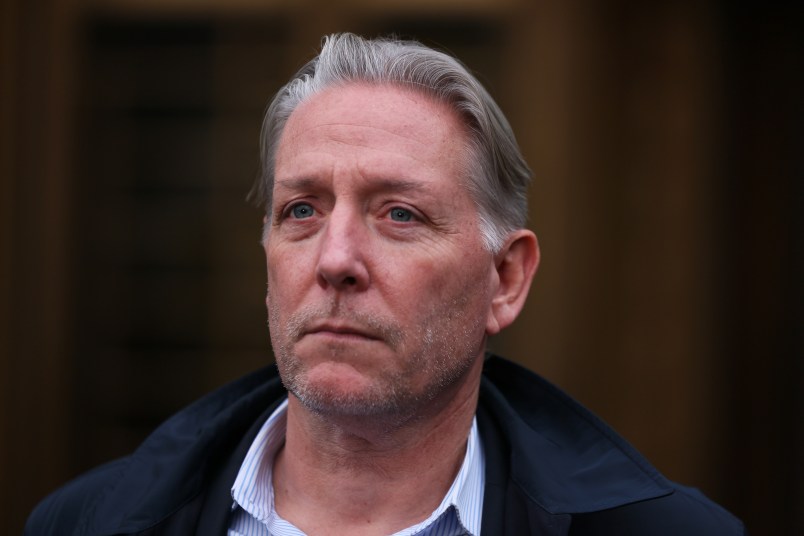
I want to draw out a few points I mentioned last night about the arrest of Charles McGonigal. When I first heard about the indictments, I understood them to be one (D.C.) that dealt with events while McGonigal still worked at the FBI and one (New York) that dealt with events after he worked at the FBI. But as I noted last night, it’s not that clear cut. The relationship with Oleg Deripaska and a reputed former Soviet/Russian intelligence officer, Evgeny Fokin, began when McGonigal was still at the FBI.
The New York indictment is elusive about just what it’s suggesting about McGonigal and Fokin in 2018, when the former still worked at the FBI. It is also unclear about whether McGonigal was compromised by a foreign power or was simply building a relationship with Fokin and Deripaska for money he would make after he left the FBI.
Was he compromised by Russia? Or was he just compromised by Deripaska? Needless to say, there’s not necessarily a bright line separating these two scenarios.
The D.C. indictment includes a seemingly separate cast of characters. On its face, it tells the story of a foreign government (Albania) paying McGonigal to use his investigatory powers to harass a U.S. citizen that the foreign government had a beef with. It’s quite unclear whether these two alleged acts of corruption (New York and D.C.) were related to each other. On its face, or in a limited view, they suggest a senior FBI agent who wasn’t compromised by or in the pay of any one foreign power, per se, but simply dirty, ready to abuse his power for cash and seemingly ready to work with all sorts of people.
But last night Michael Beschloss noted a few connections which may be coincidences but are hard to ignore. He noted that in 2018 the Times reported that “the C.I.A. noticed in late 2010 that its spies were disappearing.”
“As fears of a mole grew, the government set up a secret task force,” the article continues. “A veteran F.B.I. counterintelligence agent, Charles McGonigal, was assigned to run it.” The FBI director at the time was Robert Mueller.
On Oct. 28, 2016, James Comey wrote a letter informing Congress that he was reopening the Clinton emails probe because of emails found on Anthony Weiner’s laptop in the separate investigation of Weiner. On Oct. 31, the New York Times published its notorious headline: “Investigating Donald Trump, F.B.I. Sees No Clear Link to Russia.”
These events, as Beschloss and I noted yesterday, came three weeks after James Comey announced he was putting McGonigal in charge of counterintelligence at the FBI New York field office. As I noted yesterday, however, the press release about McGonigal’s appointment stated he would “assume this new role at the end of October.” In other words, if we think Comey appointed McGonigal and a few weeks later these big bombs started going off, the timeline doesn’t really line up with that. It more suggests that McGonigal got started in New York right as these things were happening, and thus probably arrived too late to have been involved with them.
Of course, that’s not the only possible interpretation. A new appointee can and often does hold sway prior to their formal takeover. And we can’t rule out the possibility that he showed up earlier than late October.
The FBI’s New York field office has long been a source of controversy and concern. Both James Comey and then-Deputy AG Sally Yates testified that they assumed agents in New York would leak the news about the new emails whether Comey brought the news to Congress or not. Rudy Giuliani was out publicly bragging that big news was about to drop out of the investigation and out of New York before that in fact happened. Giuliani’s role in all this and his illicit access to this information has never been properly investigated or really investigated at all, despite promises going back more than six years.
As Beschloss notes, if we assume that McGonigal was at least dirty — ready to trade with foreigners for cash — he shows up at a disquieting number of key junctures. In 2010, in 2016, possibly in 2019 when Deripaska seemed to be getting lenient sanctions relief. If we assume he was compromised in some deeper sense and for a longer period, the whole thing gets much darker.
For now, let’s zoom back out to ask a couple questions. McGonigal was arrested after flying back from Sri Lanka. As I noted last night, McGonigal and his confederate Shastakov knew they were under active investigation at least as far back as November 2021. There was a major press report on the investigation — albeit little noticed — back in September of 2022. So far the DOJ has mostly approached this as a public corruption rather than an espionage case. But given the gravity of what McGonigal is accused of it seems extraordinary he was allowed to travel abroad freely. Yes, he hadn’t been charged with let alone convicted of a crime. But there are various lawful ways of dealing with someone who would seem be a huge, huge flight risk and someone who could do immense damage if he sought asylum abroad.
On its face, maybe the DOJ just doesn’t think he’s a flight risk? Hard to imagine. But who knows? Perhaps they’re confident this is simply a very bad public corruption case, and not really an espionage case? Or perhaps he was wired on that last trip? There’s pretty strong circumstantial evidence in the indictments that there were plea negotiations with McGonigal in the months leading up to his arrest. Presumably those broke down and that’s what led to his arrest and indictment.
We simply have too little information to know what we’re dealing with in this case. An egregious but largely isolated instance of public corruption? Or something deeper that reshapes our understanding of some of the most consequential events of the last decade?
Not clear.