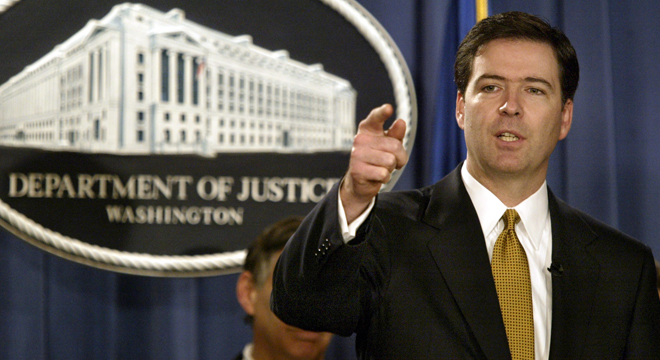
If you didn’t follow the trials and tribulations of the Bush Justice Department — or you did and your memory is fading — then the significance of President Obama naming James Comey to be FBI director may be lost on you. Comey was one of the good guys in a very dark period for the department and for the country. The complete story of that period still remains unknown, but it began to unravel in part with the U.S. attorney scandal in 2007.The investigations that followed exposed some of the deep rifts that had developed within the administration over classified counterterrorism activities (in the broadest sense) and perhaps more significantly over the proper role and traditional independence of the Justice Department itself. Things had gone so far off the rails, we learned, that John Ashcroft — a fierce partisan and loathsome figure to many Democrats — wound up in the unexpected position of a bulwark against the Bush White House during that first term, when Dick Cheney still held enormous power within the administration.
At a certain point in the mid-oughts, the customs and conventions of democracy were stripped away. The inner workings were laid bare. The exercise of raw power was on full display. Which party you were in, what tribe you belonged to, your policy preferences, all the usual political touchstones receded. What was left was the profound dividing line between those who believed in the rule of law and those who did not. Comey came down on the side of the rule of law.
I offer that as a prelude to the video of Comey’s Senate testimony in 2007, describing the night in 2004 when White House Chief of Staff Andrew Card and White House Counsel Alberto Gonzales tried to take advantage of a very ill Ashcroft, who was in the ICU at George Washington Hospital. Comey, the No. 2 at DOJ, was acting attorney general. President Bush had dispatched Card and Gonzales to the hospital to get him to reverse a decision that the Justice Department could no longer certify as legal what we now know was a sweeping domestic surveillance program being run the NSA. Alerted by Ashcroft’s wife, Comey raced to the hospital, along with FBI Director Robert Mueller — the man Comey will likely now succeed — and other top brass in the Justice Department to intercept Card and Gonzales.
It is as riveting as any congressional testimony you’ll ever see (thanks to the Washington Post’s Paul Kane for the reminder):
When the full story of that period is ultimately declassified, I suspect I’ll be deeply troubled by some of the things Comey et. al did approve and sanction. I’m not under any illusion about that. And if you’re unhappy with the legal framework for counterterrorism under Obama in all its permutations — Gitmo, surveillance, drone strikes, etc. — then Comey doesn’t mark a departure from the status quo. Comey and other holdouts within the Bush Justice Department were among the early architects of that legal framework. But at a crucial moment, when the stakes were the highest and it was time to line up for or against the rule of law, Comey stood on the right side.