


Last week, after the death of Dolly Parton, I wrote about how Parton had aggressively and carefully preserved her various royalty rights through her life and how that was the foundation of her fortune, much of which she gave to charity. I also noted a story which figured prominently in many obituaries and commentaries: how Parton had refused to hand over a chunk of her royalties in exchange for Elvis Presley recording “I Will Always Love You” — a song which Parton herself had had a country number one hit with in 1974 and would later become a global mega-hit for Whitney Houston in 1992.
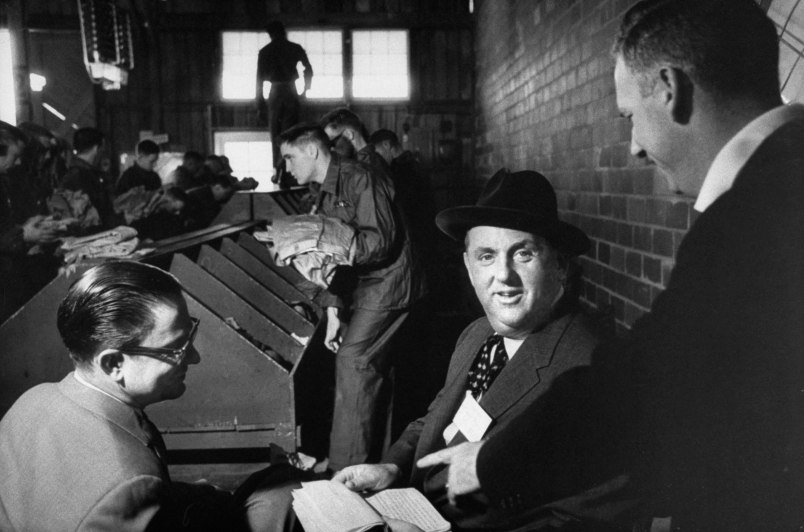
This reminded me of something I’ve wondered about for a long time, because it was tied to a bundle of interrelated minor interests of mine. To set the stage, the guy who actually put the squeeze on Dolly was a guy named Colonel Tom Parker. And yes, “Colonel” could easily have been mistaken for his first name. Parker was technically Presley’s manager. But that greatly understated the nature of the relationship, along with his role in Presley’s rise to fame and arguably his slow downfall. Parker was a kind of cigar-chomping, hard-charging good ole boy, someone out of central casting or perhaps a comic book. Maybe one part Albert Grossman, Bob Dylan’s early manager, and one part Boss Hogg — one of a long line of impresarios who both have some claim to making their charges into stars, but also then cocooning them, cheating them and cutting them off from other channels of advice, contact and more. And he wasn’t really one in a line — he was arguably the archetype, at least in the post-war era and in the history of Rock ‘n Roll and late 20th century popular music.
In case you’re wondering, Parker was a “colonel” in the sense that Colonel Sanders was a colonel, which is to say he wasn’t a colonel. He got the title bestowed on him on an honorary basis by the governor of Lousiana in 1948 in exchange for some campaign help. This was actually a pretty common thing in the South. Sanders got his from the governor of Kentucky in 1935.
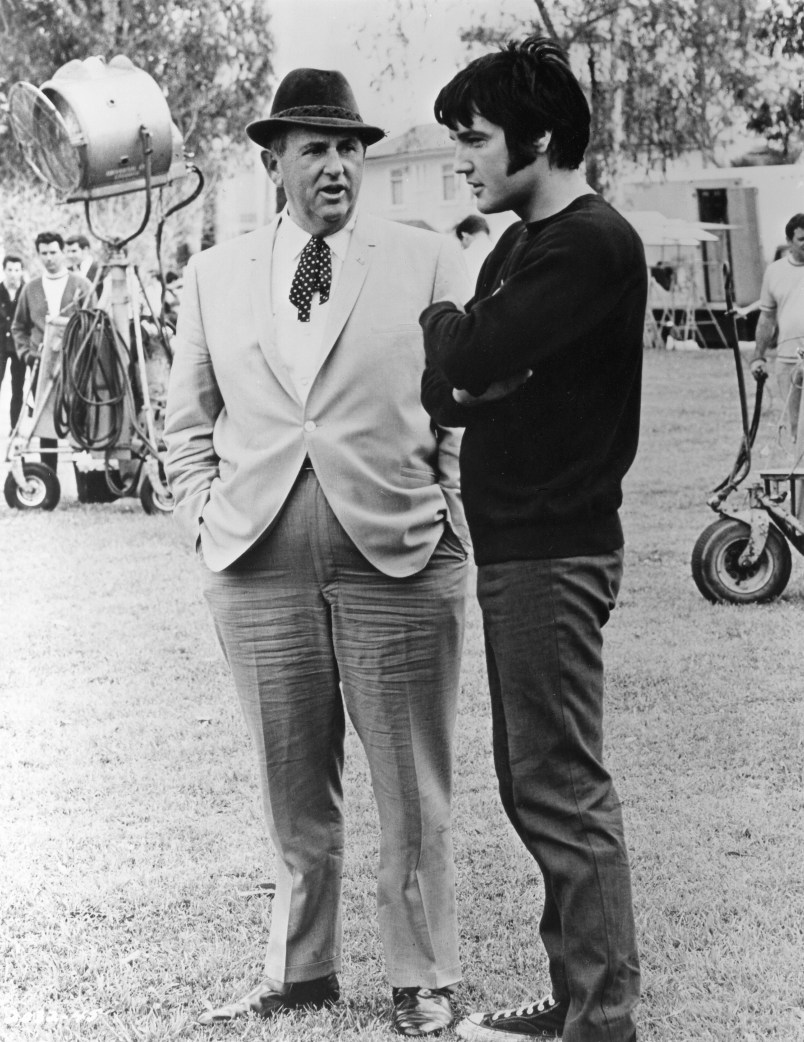
For the story I’m about to tell it’s important to understand that Parker was always a very public part of Elvis’s entourage, really a public figure in his own right — not just someone in the background who shook down people like Dolly for publishing rights. And this was Parker’s story right through Elvis’s death in 1977. But in the years just after his death it emerged that Parker wasn’t some central casting Southern good ole boy born in West Virginia, as he claimed. He was actually born in the Netherlands — Andreas Cornelis van Kuijk — and came to the U.S. illegally in 1929 at the age of about 20. He was worked as a seaman on shipping vessel. Basically he just hopped off a ship in New York City and that was it.
First he did odd jobs at one point before World War II, and soon got drummed out of the service. He did more odd jobs and then started working on the road show circuit where he eventually got into talent management. He grabbed hold of Elvis right at the dawn of his career in early 1955. And the rest was history.
But here’s the part I never understood and which ties to another minor interest of mine. If you learn a second language after early puberty — say around 12 or 13 years old — it’s all but impossible for most people ever to fully lose their accent. It’s not an absolute rule. And different people go through those neurological and physical changes at slightly different times. But it applies to almost everyone. And the few people who are able to do it generally have to really work at it beyond whatever natural brain and neuromuscular plasticity they have. It has to do with how parts of your brain “fix” into place during puberty and ways that you learn to construct sounds in the musculature of your mouth and throat at around the same time. You might be able to capture an American (or any other non-native) accent perfectly for a short period — after all, actors do this all the time in movies. But as the way you naturally talk it’s very, very uncommon.
This whole issue of language acquisition has fascinated me for years. You can learn new languages through your life. But you lose the ability to learn those very subtle elements of articulating certain sounds. Your brain at 10 isn’t the same as it is at 20. As it happens, I know a TPM Reader, now a friend, who came to the U.S. at roughly the same age. The one time we met in person I didn’t notice any accent. But I think that’s because he went to an American school as a child. So notwithstanding when he immigrated, he must have gotten the accent down as a child. But I digress!
So how is it that Parker, a quite prominent public figure for decades, managed to maintain his false identity as well as the fact that he was in the country illegally and pull off his Southern good ole boy persona? He had a Dutch accent, albeit a relatively mild one. One side note here: as far as we know, Parker never left the United States during the entire time he represented Elvis, from 1955 to 1977. He couldn’t. He didn’t have a passport and couldn’t get one. And it’s often suggested that this is why Elvis, despite being one of the most famous people in the world, basically never toured abroad. Because Parker couldn’t accompany him.
But back to our story: how did Parker pull this off? I had to figure this out. So over the weekend I chased this mystery down a true rabbit hole. The answer, to me at least, was as fascinating as the mystery. He kind of didn’t hide it. He had a reasonably good accent. And what he did have was affect and he got people to think that he had a bit of a lisp or speech impediment. This also seems to be the reason he came with a fraudulent backstory about being born in West Virginia, despite the fact that his professional life was all around Mississippi and Louisiana and Tennessee. First, West Virginia is fairly far from those states in the Lower Mississippi Valley and second, there are all sort of odd-sounding (to us) Appalachian regional sub-dialects. So if anyone ever thought or said, “Well, Colonel Tom speaks a bit funny, don’t he?” The answer would just be, “Well, he has some kind of upcountry hillbilly twang from somewhere in West Virginia where he’s from and also he’s got a lisp. So just let it go.” And they did. So basically that’s how he hid his accent: he didn’t. Parker apparently spoke a variety of Lower Mississippi English with a mild Dutch accent that you’d expect from someone who by the mid-50s had been in the U.S. for about 25 years. But he had this cover story of the lisp-cum-West Virginia accent you don’t know about. And it worked.
I have to imagine that Parker was helped along by the fact that there weren’t many people at the time in the U.S. who knew what a Dutch accent sounded like. On many fronts, I think this is the kind of thing you could get away with in the middle of the 20th century but couldn’t manage in the age of the internet.
It all started to come out in the years right after Elvis died when a Dutch journalist, Dirk Vellenga, got a tip of some sort and started digging in “Parker’s” hometown of Breda. That journalist apparently dug especially hard because he was told that “Parker” had killed a man in the Netherlands and that might have been why he left in the first place. The journalist was never able to come up with any evidence of the alleged murder. And as best I can tell it seems like the alleged murder part of the story probably wasn’t true. Who knows? But eventually this guy’s reporting made it to the United States and this is how the story came out.
Parker had had some close calls. His sister in the Netherlands, Nel Dankers-van Kuijk, saw him in a publicity photo about Elvis in 1960 and identified him. But she agreed to keep the secret. Then the following year, 1961, “Parker’s” brother came to the U.S. for a couple weeks and met Parker in California where Elvis was then shooting Blue Hawaii. “Parker” got a call from Time magazine asking about this Dutch guy who said he was the Colonel’s brother. But Parker managed to shut the questioning down. He ended up putting his brother up in his Hollywood apartment for a couple weeks and made clear he needed to keep his mouth shut. He showed him around town as just a friend, but apparently told Elvis and his entourage that he was his “brother,” maybe leaving unclear precisely what that meant.
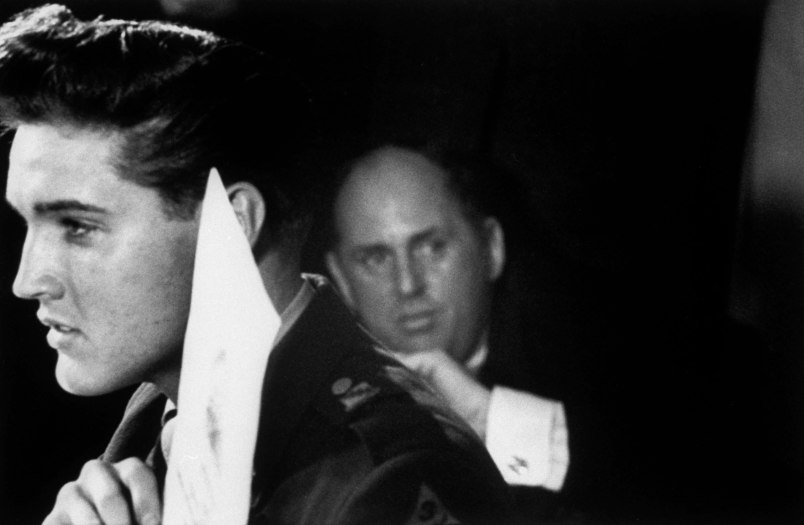
In any case, the upshot is that no one ever heard anything about it and it never appeared in the U.S. press. It got a mention in a Belgian publication. But that was it. No one ever heard about that in the U.S. or apparently anywhere else outside of Belgium. So it was only in 1981 when an Elvis biography by Albert Goldman included Vellenga’s reporting and broke the whole thing wide open. By the following year, in one of the many lawsuits surrounding Elvis’s estate and various publishing and songwriting rights, “Parker” actually shifted gears and used the whole thing in his favor, claiming either that he was a Dutch citizen or actually stateless and thus that the suit in question couldn’t be brought against him, or, at least, not in the way it had been. Sort of a huckster until the end. Parker was saying essentially, ‘You can’t sue me. I’m not even from here, bro. I’m Dutch.’
Parker died in Las Vegas at age (apparently but who knows?) of 87. Thank you for coming to my Dolly, Elvis, Colonel Tom Parker/Andreas Cornelis van Kuijk, undocumented/illegal alien TED Talk.
Addenda: Here are two Youtube videos of Parker, in case you’re curious and would like to hear what Parker sounded like. As you can tell the accent is subtle. These are videos from 10 and 16 years after Elvis died. I can pick up the accent and it’s interesting that it becomes more prominent over the course of the interview. As I said, the accent is mild. But he certainly doesn’t have a Lower Mississippi or West Virginia accent.