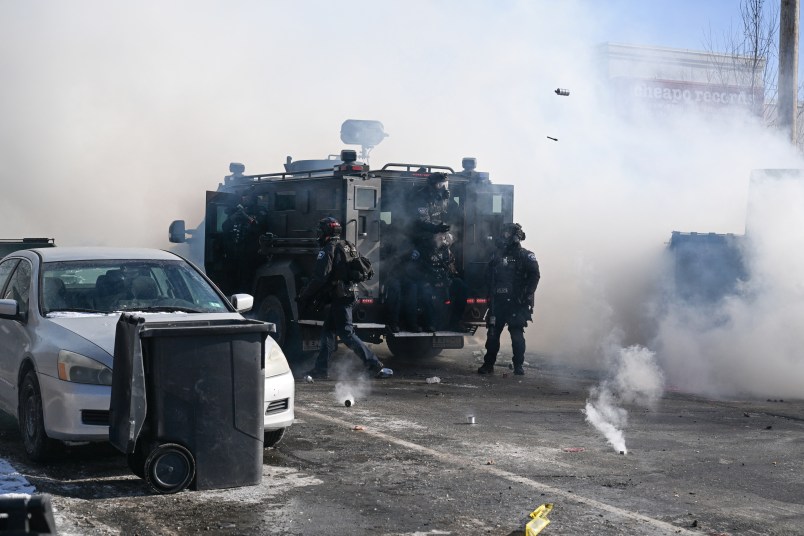
I’m going to post TPM Reader DS’s note and follow up on the concept of “escalation dominance” and who exactly has the upper hand in Trump’s war on blue cities. I said in my earlier post that the White House thinks it has escalation dominance, the stronger hand at every stage of escalation. I think they’re wrong. The simple explanation is that they think this is a battle of force. It’s not. It’s ultimately a battle over public opinion. And it’s one they’re already losing. Escalating the contest of force will make them lose harder.
The concept of escalation dominance comes out of Cold War deterrence and strategic theory. DS shares some more thoughts on that. But one of the key things about these concepts, which emerged in the 1950s, is that they’re highly theoretical, in both senses of the word. The real world isn’t as linear or as predictable as you expect. There are various ways that weakness can be turned into strength. And, as DS notes, the point of escalation dominance is to keep the weaker party from escalating at all. It’s supposed to be a framework of deterrence for the stronger power.
The other point I want to note in DS’s email is the very correct focus on the incredible discipline of those protesting and operating as observers. In each of these horrible murders, you have victims acting in a very disciplined, non-confrontational manner. That doesn’t happen by accident. If you’re participating in these protests, you can get killed for doing nothing. It’s sounds grandiose or hyperbolic but it’s true. Or perhaps we’d like it to be hyperbole. But clearly it’s not hyperbole. But the ranks of those joining the opposition to these marauding terror gangs are waxing rather than waning.
Here’s DS:
I appreciated your excursion into Cold War nuclear game theory, but your invocation of “escalation dominance” raises more questions than it answers. You write
But a complementary explanation is this belief in escalation dominance. It may not be popular but they believe public resisters will eventually have to knuckle under. So they’re happy to keep escalating. Because they have more and bigger guns and eventually those who oppose them will have to give in.
But the whole premise of the escalation ladder was that when you’re dominant at the current level you don’t want to escalate. Hermann Kahn introduced the “escalation ladder” in the context of planning for nuclear war, in the 1960s, and “escalation dominance” was intended as a model of deterrence, as a an argument for how to prevent a weaker adversary from pushing all the way to Mutual Assured Destruction. According to Lawrence Freedman’s The Evolution of Nuclear Strategy,
he defined [escalation dominance] as ‘a capacity, other things being equal, to enable the side possessing it to enjoy marked advantages in a given region of the escalation ladder.’ Dominating in this particular region would put the onus on the other side to take the risks of escalating to the next stage, which might be more deadly and dangerous.
As I understand it, the idea is that when you control a “region” of the ladder — the current level and nearby levels — you can avoid the risk of gradual escalation, salami tactics, etc. It’s very much not about enabling the dominant party to escalate, but about enabling them to prevent escalation.
Regardless of whether my amateur nuclear-game-theory review is historically correct, I think it’s intuitive that escalation is bad for the stronger and more established party, whereas a weak opponent may want to take a chance on moving the conflict up to a higher level; they have less to lose, and some new influences may shift the balance of power. And that’s the way the U.S. government has long behaved, internally and externally. So that’s why the whole world is scratching their collective heads over U.S. actions over the past year. Why is the U.S. knocking over the international game-board while they’re on a century-long winning streak?
And domestically, it’s the same. Protestors have been acknowledging the federal government’s escalation dominance on this “region” of the ladder, by adopting and enforcing incredibly disciplined non-confrontational tactics. (I’d really like to see more reporting on how organizers are keeping a lid on things. What happened to the “riots are good, actually” crowd?)
So why is the federal government then escalating? Why do they want to change the rules of a game where they have every advantage? In the nuclear context, this would be like JFK forcing the Soviets to withdraw their missiles from Cuba, and then deciding to drop a couple of nukes on Cuba anyway. The only explanation is either a completely disordered mind in charge of the strategy — or more than one! — or a strategist who is playing a different game, for whom their current stable dominance counts as a loss, so that the risks of escalation are worth trying. (This could be because for some members of the administration, the only acceptable end state for the U.S. involves significant ethnic cleansing, which is not really possible outside of civil war conditions, or because of the need to permanently destroy the rule of law to maximize long-term graft.)