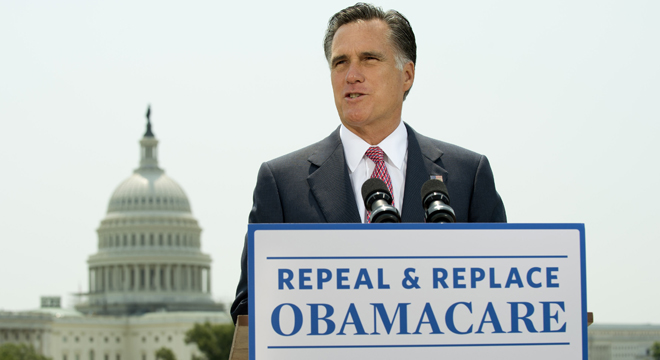
It led to some snarking over the weekend. But it was actually a very telling moment when Mitt Romney said that staunch support for ‘Obamacare’ from minority and low-income voters was a key reason for his loss.That’s not a surprising statement. And it seems to be true — though it’s difficult to disentangle precisely which issues were most important in driving the support of President Obama’s key voting groups. But it does focus attention on one key point: if ‘Obamacare’ is such a critical driver of support for the President and for Democrats now, what’s going to happen when people actually start deriving its key benefits? In other words, at this point, ‘Obamacare’ is mainly a promise. There are some changes on pre-existing conditions and so forth and coverage for people under the age of 26 who can remain on their parents’ plans. But the main benefit — something close to universal coverage — only starts at the end of this year.
It goes without saying that Republicans have ensured that health care reform is entirely identified with President Obama. After all, even the White House eventually gave in and decided to embrace the ‘Obamacare’ label. So Obama and by extension the Democratic party which paid a significant short-term political price for passage owns this in every way.
This will all be a big, big deal going forward. And it recalls Bill Kristol’s famous or infamous memo during the Clinton health care reform debate. At the time that Republicans were inclined to negotiate on health care reform with Clinton, Kristol came forward and said Republicans needed to embrace 100% opposition. No reform at all — just no. In political terms it ended up being fabulously successful. Reform was defeated and the political aftermath was the GOP takeover of Congress the following year. But the key point is what Kristol predicted about the consequences of the success of reform: the public would like it, would never let it get overturned and it would become the cement of a new Democratic coalition, much as Social Security and other parts of the welfare state were a couple generations before. We may be seeing just that happening today.