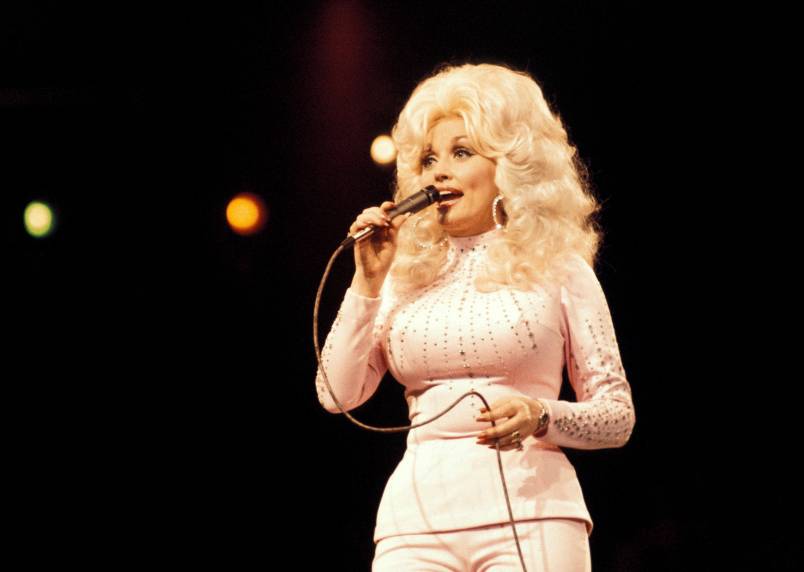
When some stars or legends die, they spur outpourings and commemorations that appear to transcend the mere mechanics and scaffolding of their fame. Dolly Parton was clearly one of those stars. For many reasons, with her this isn’t surprising. It was predictable and for very good and understandable reasons. But it still hits a certain way when you watch it unfold. It’s certainly not her greatest or hundredth greatest accolade. But I saw someone point out that in the hours after her death she was lauded on the social media feeds of the Democratic Socialists of America and Donald Trump’s — an emblem of her ability to transcend some of the most acidic divides in contemporary American society.
Music has always played a central role in my life. And I have an uncannily strong aural memory, despite having until quite recently virtually no technical knowledge about music theory at all — which tones are associated with which alphabet letters, chord progressions, etc. What I’ve studied pretty closely through my life is popular music history. And if you study the history of the production, composition and performance of music starting around the beginning of the 20th century, you know that one of the biggest throughlines separating the happy stories from the sad and tragic ones is rights and royalties and songwriting credits. Which will bring us back to Parton in a moment.
I’m always amazed at just how much money rights and royalties throw off over time. You can be a huge, huge pop star and if you don’t write the songs, you can end up with little or nothing a few years after the peak of your stardom. But writing the song is just the start of it. There’s a complex bundle of rights and powers associated with a composition. First there’s the moral right involved, the ability to say, ‘I wrote this song and you didn’t.’ Then there’s control over who gets to do what with the song. Then there are money streams which are traditionally and typically divided 50/50 into songwriting royalties and publishing royalties. Again, if you write songs and you hold onto most or all of these rights and, critically, if you write songs other people want to sing or record, it’s hard to overstate just how much money this can bring in over time. This is why Bob Dylan, within just a few years of his fame, was already a millionaire a few times over (a much bigger deal in the mid-’60s than now). So many other acts were covering his songs.
Parton, early in her career but really throughout, often indulged or leaned into the caricature of herself as a loud-looking, big-boobed, hillbilly girl. But she was a shrewd self-advocate and businesswoman from the very start. In 1966, at the age of 20, she set up her own music publishing company, something highly unusual for a country artist at the time, especially a female one. She didn’t have full ownership of the music publishing company at the start, though she gathered the remainder back over the next few years. That decision set the stage for roughly doubling the income she drew from her own songbook by holding both the 50% that went to the songwriter (Dolly Parton) and the 50% that went to music publisher (Dolly Parton).
Parton guarded those royalties consistently and aggressively. In one oft-told story, Elvis Presley, during his mid-’70s comeback, wanted to record “I Will Always Love You,” what turned out to be one of Parton’s signature songs and a #1 country hit for her in 1974. That was a big deal for Parton, still relatively early in her career. But at the last minute — apparently literally the night before the studio session — Presley’s notorious manager, Colonel Tom Parker, called Parton with a catch. It was their standard practice, according to Parker, that when Elvis recorded a song he got half the publishing rights. Not just half those rights and revenues on his recording, but half the publishing rights to the song itself in perpetuity. An anguished Parton refused, and that was the end of it. When Whitney Houston had a global mega-hit with the song in 1992 (many people, especially outside the U.S., have no idea it’s even Parton’s song), she had a massive windfall because of this close management of that bundle of rights. Published reports put her royalties on that recording, just during the ’90s, at over $10 million. That would be over $20 million today.
One of the consistent themes of all the obituaries and remembrances of Parton we’re reading today isn’t just her multifaceted talent but her bounteous and fairly low-profile philanthropy over many decades. This meticulous and far-sighted management of her songbook, which runs into thousands of songs, was the cornerstone of the fortune that made it possible.