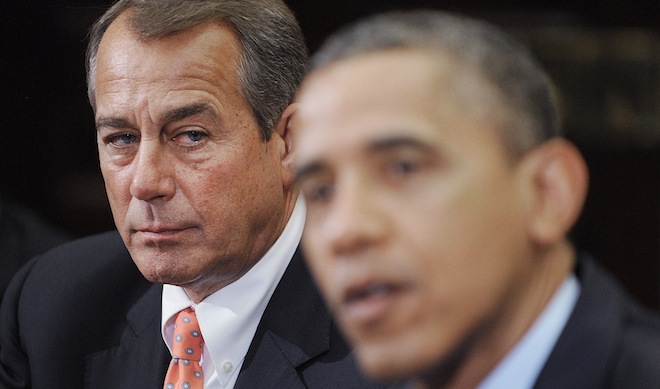
Major progressive activists organizations, along with liberal members of Congress, are concerned that the White House will cut a bad year-end budget deal with House Speaker John Boehner (R-OH), including, perhaps, agreeing to raise the eligibility age for Medicare, and are pressing Democrats to reject any deal that cedes anything of such magnitude to Boehner at this time.
Without ruling out any possible deal, the White House wants to quiet that speculation.
“While lines of communication are open, the GOP still hasn’t moved on rates so any ‘deal’ out there is just speculation,” said a senior White House official.Boehner and Obama met privately at the White House Sunday, two days after Obama met with House Minority Leader Nancy Pelosi (D-CA) and spoke with Senate Majority Leader Harry Reid (D-NV). Aides to all parties have been silent about the discussions, suggesting party leaders are making substantive progress in negotiations.
But there are some basic barriers to a major budget accord.
Republican leaders are trying as hard as they can to somehow head off the increase in top marginal income tax rates scheduled at the end of the year. If President Obama wants the GOP-led House to pass legislation preserving lower rates for middle income taxpayers, they say, he’ll have to pay a price. Democrats will have to settle for a top marginal rate below 39.6 percent, where it was at the end of Bill Clinton’s presidency. Or they’ll have to agree to unpopular Medicare cuts, including, perhaps, raising the retirement age. Or maybe both.
The problem with these demands is that in three weeks, tax rates will go up for everybody with or without any concessions from the White House.
That’s the single most important fact to know about the ongoing negotiations between Obama and Boehner to avert large tax increases and spending cuts at the beginning of 2013.
The GOP’s weak hand is reflected in admissions from high-profile Republicans that their party will have to yield to Obama on tax rates. Those members — including Rep. Tom Cole (R-OK) and Sen. Bob Corker (R-TN) — are trying to position the party for an aggressive, but separate fight, to cut spending on programs like Medicare and Social Security next year.
If that were the full story there’d be almost nothing for Obama and Boehner to discuss. The House could either pass Senate legislation to extend middle-income tax rates, or allow all of the Bush tax cuts to expire and try to fix the problem retroactively.
But the White House has requests of its own. It wants to extend stimulative policies like emergency unemployment benefits and the payroll tax cuts. It wants to (at the very least) delay the defense and domestic spending sequesters. And above all, it wants to raise the debt ceiling without a replay of the 2011 brinksmanship that damaged the economy, which is still suffering in the aftermath of the 2008 financial crisis.
These asks provide Boehner and the GOP some leverage. That leverage, combined with the fact that Obama agreed in principle to raise the Medicare eligibility age in 2011, in private negotiations with Boehner, explains the jitters on the left. But the White House is suggesting that a GOP cave on tax rates is a predicate for a broader deal that could include Medicare cuts, as opposed to a negotiable part of such a deal.