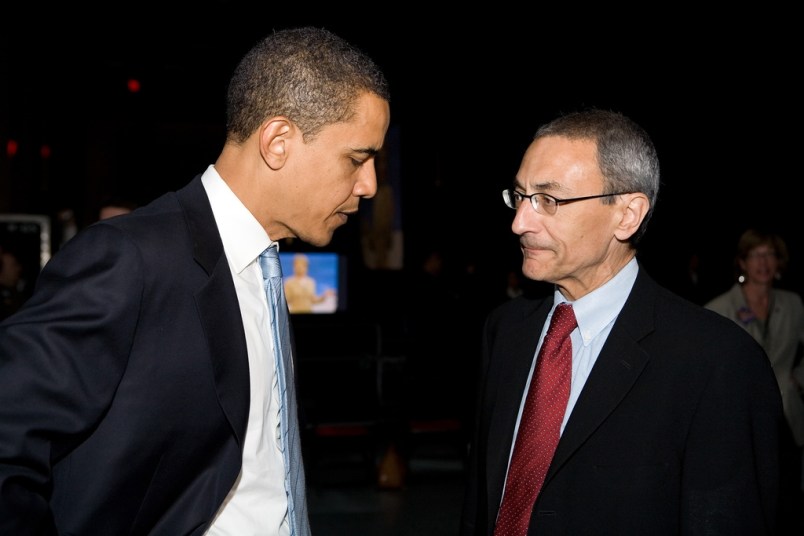
The man who chaired Barack Obama’s transition to the presidency, and who runs the most influential Democratic think tank in Washington has a message for the Senate: The House won’t pass your health care bill until you take action first–so it’s on you.
“My own view…is that you have to insure that the Senate goes first,” John Podesta told me after an event with leading union figures at the Center for American Progress this morning. “You have to have the fix before the package can pass the House. I just didn’t see any way, if you will, that the House was going to bet” on the Senate acting later.
“It seems me that asking the House to take a flier on what the Senate can do–we’ve kind of watched that move all along the past year, it hasn’t worked out that good. So it’s incumbent upon the Senate to really go first,” Podesta added.
Podesta is the latest influential Democrat to endorse a version of what’s come to be known as “Plan B” for health care reform. The House can pass the Senate health care bill, but only if there’s a guarantee that the Senate will be able to pass a separate bill, making significant changes to some of its key provisions. Podesta says that means the Senate needs to take concrete steps–promises won’t suffice.
His view is echoed by SEIU President Andy Stern, who said all the other options on the table–a scaled down reform effort, or a multiple bill strategy–ought to be taken off the table.
“It seems to me to be the easiest path–the only path–forward. To do something comprehensive both for jobs, the deficit, and health care is to take the Senate bill as it is as a foundation, to find ways, whether through reconciliation or other legislative processes to fix the things that I think a lot of people agree need to be fixed, both now in the House and the Senate.”
Putting the onus on the Senate may be necessary, but it won’t be easy. Stern described Senate Democrats in withering terms, saying they squandered their supermajority by negotiating with “terrorists” on the party’s right flank. “Voting doesn’t seem to be something that they’re very good at,” Stern said. “Or debating. They had a chance, a gift, from the American people–60 votes, so they could, for the first time in their life, debate any single issue they chose to debate. And they squandered it. They squandered it badly. And I think they paid a price up in Massachusetts, and they’ll continue to pay a price.”
“We should send the national security people over to explain to them why we don’t negotiate with terrorists,” Stern said. “There are a lot of terrorists over in the Senate who think we’re supposed to negotiate with them when they have their particular needs that they want met.”