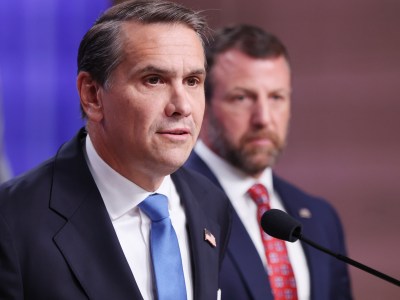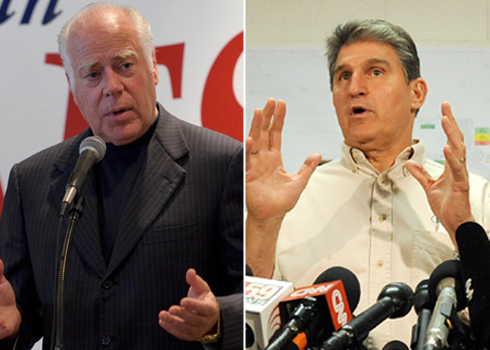
The candidates for Senate in West Virginia met tonight for their one and only debate — if it can be called a debate. For the most part, the four candidates seemed to use the night as an opportunity to present themselves for the first time to the voting audience. Republican businessman John Raese pitched himself as a man of the right; Democratic Gov. Joe Manchin put himself forward as a man of the commonsense middle; Mountain Party candidate Jesse Johnson, the candidate of the state’s Green Party affiliate, was a man of the left; and Constitution Party candidate Jeff Becker was a man of the loony bin.
To be sure, there were attacks and replies between the candidates. But in many ways, even this was a part of them presenting themselves to the public. Going into the debate, the TPM Poll Average gave Manchin a very narrow lead of 46.8%-45.2%. So how did they do?John Raese, Republican
Raese really brought the most ideological heft to the discussion, clearly aiming to mobilize the Tea Party right. “I don’t know how we couldn’t be negative in this country right now,” he said in his opening statement, “because when you look at the unemployment situation right now in the United States, it is really of catastrophic portions.”
His prescription: “Bring back the spirit of America in this country. It’s called capitalism and free enterprise.”
In answer to a question on cap-and-trade, he declared that global warming of any kind — not just man-caused global warming — was a myth: “The myth, and I say myth, that there is global warming, and the other myth that man causes global warming, that really differentiates me from the other candidates here, because I don’t believe in that myth.”
On health care reform, Raese said: “Well I don’t like socialism, to tell you the truth. And when you have a doctor-patient relationship, that’s the way it’s supposed to be, that’s how we have the greatest health care system in the world, and that’s going to change from here on out.”
Raese complained that the doctor-patient relationship would be replaced by a “patient-bureaucrat relationship,” with patients having to get approval from government boards for any procedure. “What I’d like to do, I’d like to repeal every part of it. Because it is pure unadulterated socialism, it is the worst bill that has ever come out of the United States Senate and House.”
(Of course, the health care bill is not government-run health care — it is a system of the government regulating a privately-run health care market. And this point came up from the Mountain/Green candidate Johnson.)
At one point, Raese was asked about his long-stated opposition to the minimum wage. His answer, in a reversal, was that it’s too low! “Well, my opposition to minimum wage is, I don’t agree with minimum wage. Minimum wage is something nobody can live on, it’s too low,” said Raese. “I don’t like government setting price controls, I don’t like government setting wage controls. I want a better wage for everyone in this country.”
Raese’s rhetoric would lead one to believe that the minimum wage is a ceiling, rather than a floor, saying that “Manchin and Obama, they enjoy people working for $7.25. I don’t.” He also added: “And as we know, minimum wage is one of the worst things possible for unemployment,” he added. “So I would like to raise the level of the playing field.”
Joe Manchin, Democrat
Manchin, the two-term governor, began this race as the frontrunner, but ended up falling behind Raese in many polls as a result of the state’s high disapproval of President Obama. During the debate, Manchin pitched himself as a centrist, relatively conservative West Virginia Democrat who would be independent from Washington. And above all else, he frequently pointed to his record as a consensus-builder. Like Raese, tried to tap into anti-Washington anger, pitching himself as someone who works to defuse partisan bickering.
Manchin declared during his opening remarks that “putting party first, Democrats and Republicans are both wrong at this. They’re putting special interest second, and the country third.”
Manchin’s approach to government can in some ways be summed up by his answers on earmarks and infrastructure projects. “Those are thing that the free enterprise system is not going to go, there has to be a market for these things.” But, he further cautioned: “The federal government has to be your partner, not your provider…You have to look at what are the returns on the money that is invested. And it has to be transparent.”
Manchin also characterized himself as a fiscal conservative, coming out for a balanced budget amendment to the Constitution (with exceptions for national emergencies and wartime). He also pointed out that he supported the first stimulus — but proudly noted that he faced some criticism for not spending West Virginia’s money fast enough, and also said he would not support a second one: “People have become so dependent, and that dependent mentality means people are waiting for someone to take care of them. We don’t do that in West Virginia, people take care of themselves.”
He also opposed allowing the Bush tax cuts on incomes of over $250,000 to immediately expire, citing the rough economy: “I don’t think during a time of recession, you mess with any of the taxes or increase any taxes.” He touted his own record as governor, of how he has cut taxes and cut wasteful spending. When he first entered office, he said: “They said we might have to raise taxes, and I said, I can’t look the people of West Virginia in the eye and ask them to pay a penny more, until we know we’re running a government that’s efficient.”
Manchin also said that he opposes Obama on cap-and-trade, and he took a middle-line position on health care reform, saying the new law would have to be rewritten in part: “I’m not prepared to scrap the entire bill. There are parts that need to be changed, there are parts that need to be repealed I am sure, and we have never passed a perfect piece of legislation. I’m not prepared to tell your child who has a pre-existing condition that you can’t have insurance.”
Manchin noted that he has been endorsed by such different groups as the coal association and organized labor, as well as the medical associations, and the National Rifle Association: “These people don’t endorse me because we agree on every issue – they’re too diverse. They endorse me because we have a plan in place, and we work it out.”
Jesse Johnson, Mountain/Green Party
Johnson was an exception to the general rule of the debate, acting as the sole true ideological foil to Raese. His response to Raese’s denunciation of any progressive government efforts as “socialism.” was a good example: “This country is a melting pot of race and religion and ethnic background. And we are also an amalgam when it comes to who we are,” said Johnson. “And Robert C. Byrd certainly stood up for the Constitution. The Constitution dictates and spreads the promise of this country. That is not just capitalist, but we have socialistic constructs that are intrinsic to our identity. Our success in the 21st century is born of the fact that we have policemen, we have firemen, we have tremendous infrastructure. And if we were purely based on capitalism alone, we would not have that.”
As for Raese’s attacks on the health care law as “socialism,” the socialism-friendly Johnson argued that the bill is not socialism at all: “I’m stunned that this health care bill is being characterized as socialism. It’s not socialism — it’s capitalism on steroids. You have to buy something from a private company, and you’re penalized if you do not do so.”
Jeff Becker, Constitution Party
Becker’s sole standout moment, other than his rambling opening statement about repealing the direct election of Senators, came when he was asked about his position on the war in Afghanistan.
Becker’s long and off-topic answer had little to do with Afghanistan itself — but was a long discussion of 9/11 Truther conspiracy theories, involving the alleged organized demolitions of the Twin Towers and the 7 World Trade Center building, the foreknowledge of this by the BBC, and the buildings’ owners taking out special insurance policies for the contrived terrorist attack. “The only way for the official story to make sense is if the laws of physics had changed that day,” said Becker.. “And I’m an engineer, I can tell you they did not.”
After that answer, Becker wasn’t called upon again until the closing statements. For his closing statement, Becker discussed how the Senate is characterized by unlimited debate. “I only wish that I had more time tonight to do that,” Becker said, but in lieu of speaking more he instead gave his Web address, and invited viewers to visit his site.
(Ed. note: All quotes used here are rush transcriptions, and may be subject to future editing.)