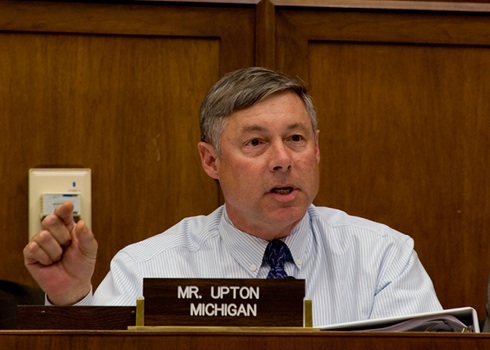
If House Energy and Commerce Committee Chairman Fred Upton (R-MI) really wants to know what deals were struck between the White House and the health care industry to pass health care reform, he may end up giving health care reform some free advertising.
As part of his quest to publicize all of the dealmaking that characterized the health care reform process, Upton says he’ll consider pressing industry leaders for details on their private negotiations with the Obama administration.
“It’s something that’s not off the table, in terms of what we may do,” Upton said at a recent press conference with House leadership.
So far, Upton has directed all of his inquiries at the White House, to no avail. Changing course would give him easier access to the information he seeks (or claims to seek), but might put him behind the eight ball politically. That’s because many of the stakeholders in question — drug manufacturers, hospitals, and other interested parties — either support the law, or entered a sort of non-aggression pact with the administration.
And if Upton drags those leaders — many of whom lean Republican — up to the Hill for a public hearing about their participation in the process, he may hear more about how they think it’s a good law, than about how shady the whole process was.
“The passage of the health care reform bill lays a solid foundation for America to build upon with the expansion of coverage for 32 million people and important insurance reforms so that more people will get the care they need when they need it,” said Rick Pollack, executive vice president of the American Hospital Association, in a statement to me. “Since no legislation is completely perfect, the AHA is focused on working with the administration and Congress on the multitude of regulations related to implementation including Accountable Care Organizations, Value Based Purchasing, State Insurance Exchanges and IT.”
In an interview, former PhRMA CEO Billy Tauzin, who negotiated a deal with Senate Finance Committee Chairman Max Baucus to help finance the legislation, said he thinks Upton won’t get much.
“We ended up endorsing the final package, primarily because it didn’t contain an egregious public plan that we vehemently opposed, didn’t contain the House-passed price controls in it,” Tauzin said. “We stuck pretty much to the agreement we reached with the Finance Committee.”
That agreement required PhRMA to agree to pony up billions of dollars, so long as Congress eschewed key — and in many cases popular — reforms, including drug reimportation. It also probably cost Tauzin his job. PhRMA’s current position on the law is that one of its key price controls — the Independent Payment Advisory Board for Medicare — must be repealed.
“We talked very publicly about it, not just about it but what the deal contained … and it was a pretty open affair,” Tauzin said. “As I told Fred I don’t think there’s anything new to be learned. I’d be happy to join him in a discussion if he wanted. … We’re very close friends, and I offered to provide any assistance to the committee. I don’t think there’s a whole lot more to learn. ”
That’s basically Rep. Henry Waxman’s (D-CA) take. He was chairman of the Energy and Commerce Committee at the time, and opposed many of the deals Baucus and the White House struck with industry.
“It has nothing to do with the reality, they just want to go after the administration,” Waxman told me in a brief interview. “Most of what concessions were made to different industry groups is pretty much out there. It was in the press. There’s nothing more they’re going to find.”
Waxman and House leadership took serious exception to the deals when they were revealed in the press. Indeed, House Democrats passed a bill that ignored both the PhRMA deal and other deals, and PhRMA publicly opposed their legislation. Tauzin joked, “Waxman didn’t like ’em because I didn’t make ’em with him!”
Ironically, the one deal observers widely believe the groups cut with the White House and congressional principals, but was never officially disclosed, was the one that doomed the public option. If Upton’s investigation revealed that deal it would confirm progressives’ suspicions about the White House’s public bad faith, but verify that President Obama had foreclosed on a policy that Republicans hate.
Upton is asking the White House for just about every scrap of paper and data that exchanged hands between government officials and stakeholders — a request the White House is refusing as overbroad.
If Upton’s really interested in what went down, there’s a much better way for him to go about it.
“If you ask the trade associations ‘do you have any correspondence?’ Ok that’s one thing,” Waxman, a veteran investigator, told me. “If you ask the White House “do you have any correspondence?” that’s another. “If neither of them give it, you can subpoena. But you should pretty well have an idea of what you want to subpoena to know that there’s such a thing as a document or emails.”