

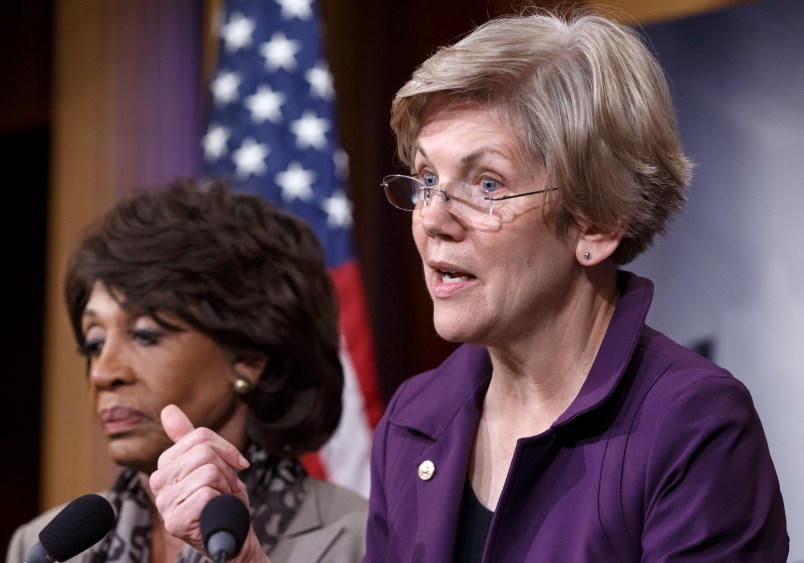
There’s an ongoing question centered on the possibility that Sen. Elizabeth Warren (D-MA) might run for president in 2016: how would Hillary Clinton (who looks all but certain to run) respond to Warren’s push to make the economy a signature Democratic issue?
At a Christian Science Monitor breakfast on Thursday Democratic-leaning pollster Celinda Lake and Republican-leaning pollster Ed Goeas unveiled results of a new George Washington University battleground poll which said that 77 percent of those surveyed are worried about current economic conditions. The poll found that 31 percent said the economy is getting worse, 25 percent said the economy is in bad shape and not changing. But just 11 percent said the economy is in a good condition and 30 percent said the economy is getting better.
The problem for Democrats, Lake said, is that they haven’t been able to articulate a broad economic message for improving the economy. Calls for raising the minimum wage, Lake said, are good but not big enough.
Hillary Clinton will have to craft an economic message in 2016 and to do that it’s hard to imagine her completely ignoring Warren, even if she’s not running for president, given that liberals are increasingly siding with Warren’s critiques of Wall Street and using that as a springboard for her to challenge Clinton in the 2016 Democratic primary. Liberal groups have recently begun fully embracing a potential Warren 2016 run and on Wednesday Democracy for America announced that it would invest $250,000 in the campaign to draft Warren. So how will Clinton respond to that?
After all, Warren has recently been on an all-out-crusade in the name of Wall Street reform: urging Democrats to oppose a crucial spending bill to keep the government open until a provision rolling back Dodd-Frank is taken out, opposing an Obama administration nominee for a key position at the Treasury Department, and railing against CitiGroup in speech after speech.
“I don’t see any reason that Hillary won’t be able to get Elizabeth Warren Democrats,” Lake said. “What Elizabeth Warren did was really set an agenda around Wall Street and if you read Elizabeth Warren’s biography, one of the more interesting small passages in there is she talks about how she and Hillary Clinton went together to the White House to lobby for the Consumer Financial Protection Bureau and that actually Hillary convinced Bill [Clinton] to be supportive of it.”
Reporters at the Monitor breakfast pressed Lake on this. How can Clinton really win over Warren supporters who love the Massachusetts senator’s ant-Wall Street message when Clinton is delivering speeches at Goldman Sachs events?
“I mean Hillary Clinton and Bill Clinton present together an economic vision and people think overwhelmingly the Bill Clinton years were much better economically,” Lake said. “People think of Bill Clinton as the comeback kid. They know him better than they know her. So they know that he has that influence. They also have the perception that she came from a middle class family, though they don’t know it that well.”
Lake then pivoted to the fact that conservative columnist George Will has said that fighting the CFPB should be a top priority.
“George Will said the number one fight that we’re going to have is the Consumer Financial Protection Bureau. In his top ten list he said that’s the number one thing that we should take down,” Lake said. “Okay, Elizabeth Warren and Hillary Clinton are very strong on keeping the Consumer Financial Protection Bureau. So when you actually talk about implementing these policies, tax fairness, ending job credits for jobs going overseas and investing that money here at home I don’t think you’re going to find any problem with Hillary Clinton articulating —and you know frankly Bill Clinton articulated a pretty populist economic message in 1992.”






This is the core issue for the party in '16. Failing to take credit for the successes of Obama’s most progressive maneuvers and failing to use Obama’s successes as a launching pad to articulate a vision of economic hope for the middle class contributed greatly to Democratic losses in November.
I see little sign that Hillary grasps the problems of middle class folks or is willing to side with ordinary folks against the people who fund her. This is the core issue for the party right now. Failing to take credit for the successes of Obama’s most progressive maneuvers and failing to use Obama’s successes as a launching pad to articulate a vision of economic hope for the middle class contributed greatly to Democratic losses in November.
I see little sign that Hillary grasps the problems of Middle Class folks or is willing to side with ordinary folks against the people who fund her. I hope I’m wrong.
Democrats should develop and embrace an employee bill of rights that improves the lives of growing share of Americans who work for low wages. A living wage, workplace rights, scheduling protections, limits on executive pay. I’d like to see a link between executive salaries at public corporations and entry-level pay, perhaps a limit of 52-to-1.
Hillary will show support for Warren’s new economic message just like Obama did when talking his support for the progressive message while running for pres. Basically, BS. The scarier question is will Warren, if she runs and wins the presidency, will she support her new economic message?
Will Hillary Clinton Embrace Warren’s Economic Message?
Answer: NO.
Prediction: HRC is going to campaign on the idea that people who are successful and wealthy shouldn’t be villified. After all, that’s what success is all about and something we should all aspire to. What we should be doing (in her opinion) is coming together as a country to work towards lifting everyone up, blah. blah. blah.
For her, Wall Street won’t be the country’s problem; they’ll be the country’s partner.
And it will resonate with no one.
It can be a really simple message: Don’t deny anyone their ability to run a private business and don’t deny them the ability to make a profit. Just ask that they do so responsibly. Is that really too much to ask? If they’re not willing to take responsibility for their actions, if they’re not willing to be accountable for their behavior, then it is the duty of the Federal Government to hold them accountable and to make them take responsibility, for the good of the country. Being accountable and taking responsibility are some of the first things we teach our children. Why do adult business people get a pass?