


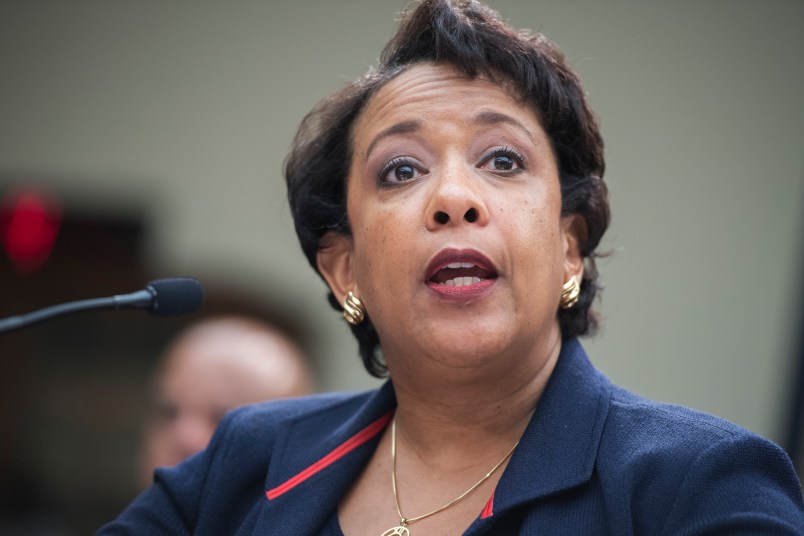
The Department of Justice announced Monday that it plans to send more than 500 agency members to monitor election sites across across the country, a significant decrease from the roughly 780 of elections monitors deployed in 2012, according to the AP.
DOJ personnel will be at 67 jurisdictions in 28 states Tuesday, an agency press release said.
“The bedrock of our democracy is the right to vote, and the Department of Justice works tirelessly to uphold that right not only on Election Day, but every day,” Attorney General Loretta Lynch said in the release. “We enforce federal statutes related to voting through a range of activities – including filing our own litigation when the facts warrant, submitting statements of interest in private lawsuits to help explain our understanding of these laws, and providing guidance to election officials and the general public about what these laws mean and what they require.”
This will be the first presidential election since the Supreme Court’s Shelby County v. Holder decision, which gutted a provision of the Voting Rights Act requiring certain states to get federal approval for election policy changes. The Justice Department also interpreted the decision to limit its ability to send elections observers to the so-called “pre-clearance” states. Elections observers have more latitude and authority than elections monitors. For instance, DOJ observers are allowed inside polling places, while DOJ monitors can only enter if invited by local officials.
“We can’t deny the costs of Shelby County,” Vanita Gupta, assistant attorney general for civil rights, told NPR last month.
The scale-back in DOJ’s ability to observe elections site comes as Donald Trump has employed campaign rhetoric amount to a vigilante poll watcher call-to-arms, particularly to “certain areas,” which some fear will lead to voter intimidation tactics.
Here’s the list of jurisdictions where DOJ personnel will be present, according to Monday’s release:
Bethel Census Area, Alaska;
Dillingham Census Area, Alaska;
Kusilvak Census Area, Alaska;
Yukon-Koyukuk Census Area, Alaska;
Maricopa County, Arizona;
Navajo County, Arizona;
Alameda County, California;
Napa County, California;
Siskiyou County, California;
East Hartford, Connecticut;
Farmington, Connecticut;
Hartford, Connecticut;
Middletown, Connecticut;
New Britain, Connecticut;
Newington, Connecticut;
West Hartford, Connecticut;
Hillsborough County, Florida;
Lee County, Florida;
Miami-Dade County, Florida;
Orange County, Florida;
Palm Beach County, Florida;
Fulton County, Georgia;
Gwinnett County, Georgia;
Hancock County, Georgia;
Chicago, Illinois;
Cook County, Illinois;
Finney County, Kansas;
Orleans Parish, Louisiana;
Quincy, Massachusetts;
Dearborn Heights, Michigan;
Detroit, Michigan;
Hamtramck, Michigan;
St. Louis, Missouri;
Douglas County, Nebraska;
Mineral County, Nevada;
Washoe County, Nevada;
Middlesex County, New Jersey;
Cibola County, New Mexico;
Kings County, New York;
Orange County, New York;
Queens County, New York;
Cumberland County, North Carolina;
Forsyth County, North Carolina;
Mecklenburg County, North Carolina;
Robeson County, North Carolina;
Wake County, North Carolina;
Benson County, North Dakota;
Rolette County, North Dakota;
Cuyahoga County, Ohio;
Franklin County, Ohio;
Hamilton County, Ohio;
Allegheny County, Pennsylvania;
Lehigh County, Pennsylvania;
Philadelphia County, Pennsylvania;
Pawtucket, Rhode Island;
Providence, Rhode Island;
Bennett County, South Dakota;
Jackson County, South Dakota;
Oglala Lakota County, South Dakota;
Shelby County, Tennessee;
Dallas County, Texas;
Harris County, Texas;
Waller County, Texas;
San Juan County, Utah;
Fairfax County, Virginia;
Prince William County, Virginia, and
Milwaukee, Wisconsin.




Elections observers have more latitude and authority than elections monitors. For instance, DOJ observers are allowed inside polling places, while DOJ monitors can only enter if invited by local officials.
Ok, I’m guessing that Lynch has to send the less effective monitors, right? If she can send 500, why can’t she send more? I know the SC gutted many protections in the Voting Rights act, but I don’t see why if Lynch can send 500 monitors, she can’t send 1,000 and just inundate the iffy places.
Mail-in ballots solve the voting intimidation problem. I filled out my ballot and dropped it in the collection box with no possibility of intimidation by anyone. But of course, that would be counter to the expressed goal of the GOP to hamper any group who’s body of votes skews for Democrats. If only Republicans didn’t hate America.
For what it’s worth, I’m an election official in Fairfax County, VA, which is one of the counties listed in the article. Today, we received notice that “Department of Justice (DOJ) representatives” “have authorization to visit any precinct in the County”. Any difference between observers and monitors was not identified as relevant.
That’s very comforting. Thanks!