


This article is part of TPM Cafe, TPM’s home for opinion and news analysis. It was originally published at The Conversation.
The big tax and spending package President Donald Trump signed into law on July 4, 2025, will cut government spending on health care by more than $1 trillion over the next decade.
Because the final version of the legislation moved swiftly through the Senate and the House, estimates regarding the number of people likely to lose their health insurance coverage were incomplete when Congress approved it by razor-thin margins. Nearly 12 million Americans could lose their health insurance coverage by 2034 due to this legislation, according to the nonpartisan Congressional Budget Office.
However, the number of people losing their insurance by 2034 could be even higher, totaling more than 17 million. That’s largely because it’s likely that at least 5 million Americans who currently have Affordable Care Act marketplace health insurance will lose their coverage once subsidies that help fund those policies expire at the end of 2025. And very few Republicans have said they support renewing the subsidies.
In addition, regulations the Trump administration introduced earlier in the year will further increase the number of people losing their ACA marketplace coverage.
As a public health professor, I see these changes, which will be phased in over several years, as the first step in a reversal of the expansion of access to health care that began with the ACA’s passage in 2010. About 25.3 million Americans lacked insurance in 2023, down sharply from 46.5 million when President Barack Obama signed the ACA into law. All told, the changes in the works could eliminate three-quarters of the progress the U.S. has made in reducing the number of uninsured Americans following the Affordable Care Act.
Millions will lose their Medicaid coverage
The biggest number of people becoming uninsured will be Americans enrolled in Medicaid, which currently covers more than 78 million people.
An estimated 5 million will eventually lose Medicaid coverage due to new work requirements that will go into effect nationally by 2027.
Work requirements target people eligible for Medicaid through the Affordable Care Act’s expansion. They tend to have slightly higher incomes than other people enrolled in the program.
Medicaid applicants who are between 19 and 64 years old will need to certify they are working at least 80 hours a month or spending that much time engaged in comparable activities, such as community service.
When these rules have been introduced to other safety net programs, most people lost their benefits due to administrative hassles, not because they weren’t logging enough hours on the job. Experts like me expect to see that occur with Medicaid too.
Other increases in the paperwork required to enroll in and remain enrolled in Medicaid will render more than 2 million more people uninsured, the CBO estimates.
Many of those who aren’t kicked out of Medicaid would also face new copayments of up to $35 for appointments and procedures — making them less likely to seek care, even if they still have health insurance.
And an additional 1.4 million would lose coverage because they may not meet new citizenship or immigration requirements.
In total, these changes to Medicaid would lead to more than 8 million people becoming uninsured by 2034.
Many of those who aren’t kicked out of Medicaid would also face new copayments of up to $35 for appointments and procedures — making them less likely to seek care, even if they still have health insurance.
The new policies also make it harder for states to pay for Medicaid, which is run by the federal government and the states. They do so by limiting the taxes states charge medical providers, which are used to fund the states’ share of Medicaid funding. With less funding, some states may try to reduce enrollment or cut benefits, such as home-based health care, in the future.
Losing Medicaid coverage may leave millions of low-income Americans without insurance coverage, with no affordable alternatives for health care. Historically, the people who are most likely to lose their benefits are low-income people of color or immigrants who do not speak English well.
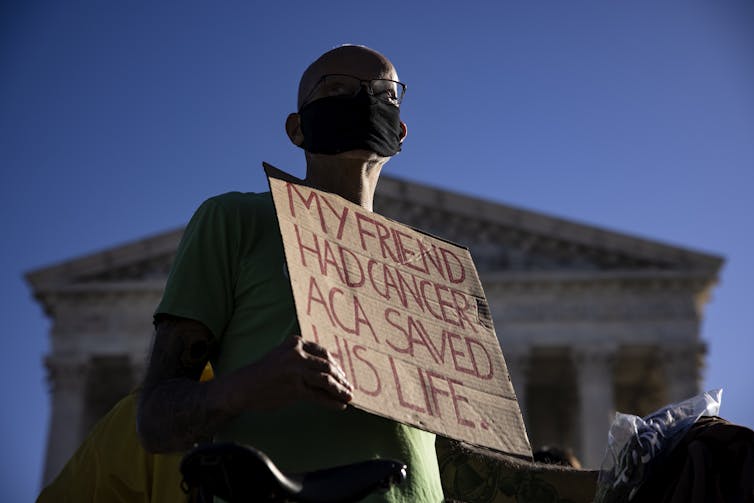
ACA marketplace policies may cost far more
The new law will also make it harder for the more than 24 million Americans who currently get health insurance through Affordable Care Act marketplace plans to remain insured.
For one, it will be much harder for Americans to purchase insurance coverage and qualify for subsidies for 2026.
These changes come on the heels of regulations from the Trump administration that the Congressional Budget Office estimates will lead to almost 1 million people losing their coverage through the ACA marketplace. This includes reducing spending on outreach and enrollment.
What’s more, increased subsidies in place since 2021 are set to expire at the end of the year. Given Republican opposition, it seems unlikely that those subsidies will be extended.
Not extending the subsidies alone could mean premiums will increase by more than 75% in 2026. Once premiums get that unaffordable, an additional 4.2 million Americans could lose coverage, the Congressional Budget Office estimates.
With more political uncertainty and reduced enrollment, more private insurers may also withdraw from the ACA market. Large insurance companies such as Aetna, Cigna and UnitedHealth have already raised concerns about the ACA market’s viability.
Should they exit, there would be fewer choices and higher premiums for people getting their insurance this way. It could also mean that some counties could have no ACA plans offered at all.
Ramifications for the uninsured and rural hospitals
When people lose their health insurance, they inevitably end up in worse health and their medical debts can mount. Because medical treatments usually work better when diagnoses are made early, people who end up uninsured may die sooner than if they’d still had coverage.
Having to struggle to pay the kinds of high medical bills people without insurance face takes a physical, mental and financial toll, not just on people who become uninsured but also their families and friends. It also harms medical providers that don’t get reimbursed for their care.
Public health scholars like me have no doubt that many hospitals and other health care providers will have to make tough choices. Some will close. Others will offer fewer services and fire health care workers. Emergency room wait times will increase for everyone, not just people who lose their health insurance due to changes in Trump’s tax and spending package. https://www.youtube.com/embed/BVpTQLw_QRQ?wmode=transparent&start=0 Rural hospitals play a crucial role in health care access.
Rural hospitals, which were already facing a funding crisis, will experience some of the most acute financial pressure. By one estimate, more than 300 hospitals are at risk of closing.
Children’s hospitals and hospitals located in low-income urban areas also disproportionately rely on Medicaid and will struggle to keep their doors open.
Republicans tried to protect rural hospitals by designating $50 billion in the legislative package for them over 10 years. But this funding comes nowhere near the $155 billion in losses KFF expects those health care providers to incur due to Medicaid cuts. Also, the funding comes with a number of restrictions that could further limit its effectiveness.
What’s next
Some Republicans, including Sens. Mike Crapo and Ron Johnson, have already indicated that more health care policy changes could be coming in another large legislative package.
They could include some of the harsher provisions that were left out of the final version of the legislation Congress approved. Republicans may, for example, try to roll back the ACA’s Medicaid expansion.
Moving forward, spending on Medicare, the insurance program that primarily covers Americans 65 and older, could decline too. Without any further action, the CBO says that the law could trigger an estimated $500 billion in mandatory Medicare cuts from 2026 to 2034 because of the trillions of dollars in new federal debt the law creates.
Trump has repeatedly promised not to cut Medicare or Medicaid. And yet, it’s possible that the Trump administration will issue executive orders that further reduce what the federal government spends on health care — and roll back the coverage gains the Affordable Care Act brought about.
Portions of this article first appeared in a related piece published on June 13, 2025. This article is republished from The Conversation under a Creative Commons license. Read the original article.








MAGA logic: Divine intervention saved DJT from an assassination attempt so he could take away health care coverage to American citizens so that the wealthy and powerful can get secure, long term tax breaks??
Below, from the article is exactly why I predict there will be very little political price for Republicans taking away healthcare from 17,000,000 Americans over 50% of whom voted for Trump. That is my prediction is there will be no political price for Republicans taking away healthcare from about 10,000,000 of their own voters and the reason is:
One of the most brilliant political and marketing strategies ever was Republicans labeling the ACA “Obamacare”. This made most people not affected by the ACA, which is almost everyone who had insurance before the ACA, think the ACA was for Black people or other people of color.
One of the biggest failures of the media and the Democrats is the failure to point out that over 70% of the people who have healthcare for themselves and their children thanks to the ACA are White people with a high school diploma or less and living disproportionally in the South, or as the media calls them, the base of the GOP.
The truth is reports that Black people and others of color and especially immigrants will lose healthcare is exactly what Republicans voters want including White GOP voters who themselves are receiving Medicaid and other Government assistance. The truth is that while most of the people who will be hurt by Trump’s actions will be White and most of them vote for Trump and Republicans, I predict these stories that highlight harm to immigrants and especially people of color will mean White people losing Government benefits will continue to vote for Republicans.
Many White people on Government assistance will tell you that they deserve more but get less because the Government is giving so much to others. That is many White people on Government assistance think as true Americans they deserve more but get less because the Government gives everything to …"
For White people not receiving Government assistance, as far as they know only people of color get Government assistance anyway.
Therefore just like there was little upside and quite the downside to Democrats fighting to provide healthcare to Republicans, I predict there will be no political price to pay for Republicans taking healthcare away from at least 10,000,000 Americans who currently vote for Republicans.
What Republican base voters want, is a return to the 1950s when top marginal tax rates (the tax rate on the NEXT dollar of income) were 90% and Government benefits flowed freely to White people and especially White men and were mostly denied to anyone of color and especially Black people. What they are getting is a return to the late 1800s when there were a few superrich and powerful and most people lived in poverty but that is different discussion.
Glad to see he is screwing the rural hospitals. Another albatross to hang around his neck. And in person for so many propagandized bigots and zealots.
A giant golden millwheel round the neck of the GOP. Love it.
And the moment they do lose it, The Ministry of Truth will instruct them to blame Obama and just like the trained seals they are, they will.
Oh goody. The long-anticipated death spiral. As someone dependent on the ACA, this just ups the ante for our long-planned emigration across the pond next year, assuming the First Felon doesn’t do something, either directly or indirectly, to foreclose that possibility…