

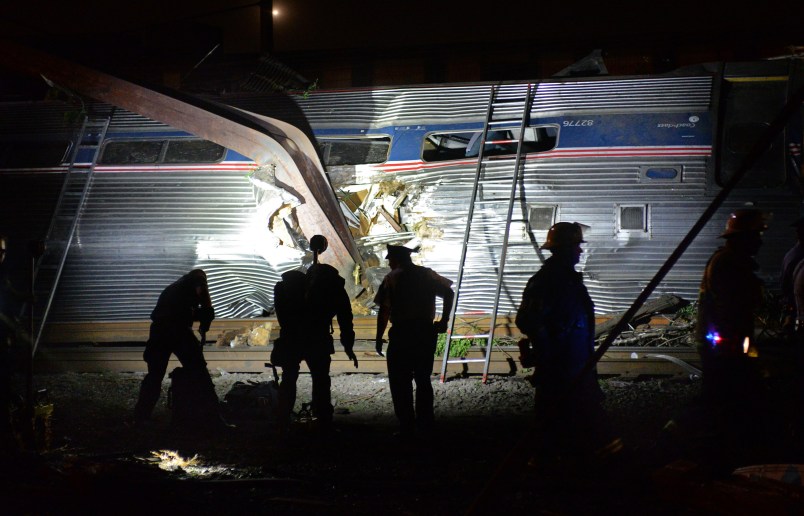
It’s no secret that catastrophes tend to highlight longstanding, overlooked national problems. It’s also true that there’s usually a very small window of time to fix things before we stop paying attention.
It is both ironic and disturbing that the horrendous Amtrak crash in Philadelphia, and the ensuing focus on Amtrak safety and our nation’s infrastructure, may end up circumventing an even larger disaster. Notes Politico, the House Appropriations Committee is about to markup a bill dealing with Amtrak funding:
The version approved earlier by an appropriations subcommittee contains language that would slash Amtrak’s annual funding to $1.13 billion, less than the roughly $1.4 billion it typically receives.
Democrats had already been expected to take a run at boosting the bill’s funding for Amtrak, but the debate at Wednesday’s markup is sure to take on more urgency in light of the crash …
In 2008, Amtrak’s reauthorization “languished for years and funding was static” when in September of that year, 25 people died and more than 100 were injured in a horrific Metrolink train collision in Los Angeles. Writes Colby Itkowitz of the Washington Post:
Suddenly, Congress did what it does best: React.
Instantly, passing a bill addressing rail safety needs became a priority. With the added urgency, Congress attached the stalled Amtrak reauthorization bill to a separate rail safety measure and it cleared Congress within weeks. President George W. Bush, who had once threatened to veto the Amtrak bill, signed it with little fanfare.
Let’s hope this happens again, and Amtrak’s budget is substantially raised so needed safety improvements can be made.
Timing is everything, and at some point the media will move onto the next catastrophe. And sadly, as with every disaster, once the cameras are gone, the victims will be left to struggle on their own. So while this terrible tragedy is still in its very earliest stages, it’s important to talk now not only about infrastructure and how to prevent similar disasters from recurring, but also about the victims and what they may face because of what Congress has done to them, too.
In 1997, Congress established a $200 million overall liability cap for all rail accidents—not just Amtrak’s—no matter how horrific the crash, reckless the rail company or people killed or injured.
This may seem like a lot of money. However, when the 2008 Metrolink crash occurred, people immediately knew that the need for compensation for these victims would far exceed $200 million. The story of one promising young student illustrates why. Before the Metrolink crash, she was studying fashion and was about to go to medical school. Now she can “barely walk” and will “never hold a job” after suffering a “fractured skull, massive brain damage and other disfiguring injuries.” Her lifetime of care will cost millions of dollars. Said her attorney:
And the tragedy is, all she knows is she got on a train. From a vivacious, energetic, joyful person to a confused (and) frightened girl.
In 2008, there was some hope that Congress would raise the railroad liability cap to help these victims, but it didn’t. Superior Court Judge Peter D. Lichtman, who presided over the Metrolink victims’ cases and needed another $64 million to properly compensate them, said in a 33-page ruling:
There is not enough money to compensate the victims for future medical care and past pain and suffering…Impossible decisions had to be made … What was given to one victim had to be taken from another.
Essentially, a ‘Sophie’s Choice’ had to be made on a daily basis. One ‘Sophie’s Choice’ is enough for a lifetime, but over 120 of them defies description.
The railroad liability cap is not just a terribly unfair law. No one saves money with laws that impose arbitrary limits like this. As attorneys and relatives noted in 2008, “As a result [of the liability cap], taxpayers may wind up footing the bill for some crash victims whose awards will not cover future medical expenses.”
This makes no sense. Congress needs to get rid of the railroad liability cap or raise it significantly. We must do better for the victims of railroad catastrophes and now is the time, before the cameras leave Philadelphia and the rest of us move on.
Joanne Doroshow is Executive Director of the Center for Justice & Democracy at New York Law School (CJ&D), based in New York City. CJ&D is the first national consumer organization dedicated exclusively to educating the public about the importance of the civil justice system. She is also co-founder of Americans for Insurance Reform, a coalition of 100 consumer groups from around the country working to strengthen oversight of insurance industry practices. Joanne also helps to edit CJ&D’s blog, ThePopTort.com.







Soon Koch Bros. trains will deliver Koch Bros. mail…
The train engineer was speeding at twice the rate of speed for that railroad tract, can the author of this article explain why and how more money to Amtrack budget would have made any difference?
If anything, this Republican led Congress will do just the opposite. They’d rather privatize all mass transit just like they’d have us do for the United States Postal Service. They’d rather drown it in the bathtub like all other public works projects that serve the public good. Have to keep pandering to their paymasters if they want to stay in office. They have nothing else to offer the public by way of policy, so they can’t rely on measly donations from the public because of that. They have to appeal to the donor class…and that means as its often stated here, “why we can’t have nice things in America anymore” with Republicans in charge of anything, especially as it relates to infrastructure improvements.
I wouldn’t be surprised if this Congress forced railroad workers to pay into funding their pensions at an advanced rate for the next 10 years, virtually bankrupting them like they’re doing to the Postal Service. There’s an easy fix for the Postal Service. Always has been. Remove the pre-funding mechanism Republicans put in place on pensions and the Postal Service becomes solvent again. Watch them do the same to the Amtrak…not because its good for mass transit or the viability of rail service…but simply because they can. They’ll destroy anything associated with “the public” before they allow themselves to fund anything for the public good. They are a spiteful bunch.
Sandy Rios over at the AFA is screeching the engineer might have been gay.
“Let the homos pay for it!”
Right, Sandy?
It was the absence of technology called “positive speed control” which could have prevented the engineer speeding at certain locations on the track. Only the government can fund that. There are eight confirmed victims in this crash. What are their lives worth to their families?