

This excerpt is part of TPM Cafe, TPM’s home for opinion and news analysis.
Democracy’s most radical, yet purist premise is people’s power as exercise of power, not simply consent to power. As I detail in my new book Politics Without Politicians, in classical Athens, governing was not the domain of a political class but a shared civic practice and a duty distributed in part on the basis of random selection (with frequent rotation). Additionally, whatever its profound exclusions in the definition of who counted as a citizen, the Athenian system was built on the idea that no citizen was too poor, too uneducated, or too timid to be deprived of a voice about common affairs. Democracy meant, in those days, ruling and being ruled in turn, as opposed to what it means today: regularly consenting, via elections, to never ruling and always being ruled by career politicians. At a moment when many Americans feel alienated from politics as something done by and for others, it seemed important to revisit a model that treated self-government as a lived, everyday responsibility.
The below excerpt also addresses a common objection head-on: the assumption that modern problems are too complex for ordinary citizens to handle. Climate change, AI, reproductive rights, economic inequality, democratic backsliding — surely these require technocratic management? The Athenian experience suggests that expertise mattered, but it was subordinated to collective judgment. Political capacity was not assumed in advance; it was cultivated through participation. The more citizens were entrusted with real power, the more capable they became. That lesson feels especially urgent today, as distrust of institutions deepens and many democracies slide toward either technocracy or demagoguery.
This passage helps reframe contemporary experiments with citizens’ assemblies not as utopian novelties but as part of a long democratic lineage. When randomly selected bodies proved less manipulable than large open assemblies, the Athenians adjusted their institutions accordingly. They were pragmatic about protecting equality from capture. In our own era of polarization and elite gridlock, citizens’ assemblies represent a similarly pragmatic effort: to create spaces where everyday people can deliberate across difference without the distortions of partisan incentives and campaign finance. The point is not to romanticize Athens, but to recover its most enduring insight — that democracy must constantly evolve its institutions in order to preserve political equality.
Classical Athens (508– 322 BCE) is the first democracy we know of to have introduced a crucial innovation: the use of lot to assign political offices combined with a rotation of offices. These combined practices ensured that politics remained, for all intents and purposes, an amateur’s sport. Politics was for everyone who counted as a citizen in Athens, not just social elites and gifted orators.
What was truly unique in Athens is the way that the poor and the rich were actual political equals. This was unheard of at the city-state level in the ancient world. Another unique feature of the Athenian system is that education and technical expertise were not prerequisites for participating in the assembly, nor, perhaps more surprisingly, were they required for exercising political functions. Citizen involvement was achieved through a combination of open public assemblies, where the masses directly made decisions, and a system of lotteries and rapid rotation for political offices. This approach ensured, as Aristotle famously defined ancient democracy, that everyone had the opportunity “to rule and be ruled in turn.”
Ordinary Citizens as Legislators
Ancient Athenians delegated agenda-setting power to a group of five hundred randomly selected citizens chaired each day by a different, also randomly selected, citizen. The Council of 500, as this assembly was called, was appointed by lot annually and deliberated over policy recommendations and law proposals. These recommendations and proposals were then passed on to a much larger body, the People’s Assembly, which any citizen could join, up to the physical capacity of the venue.
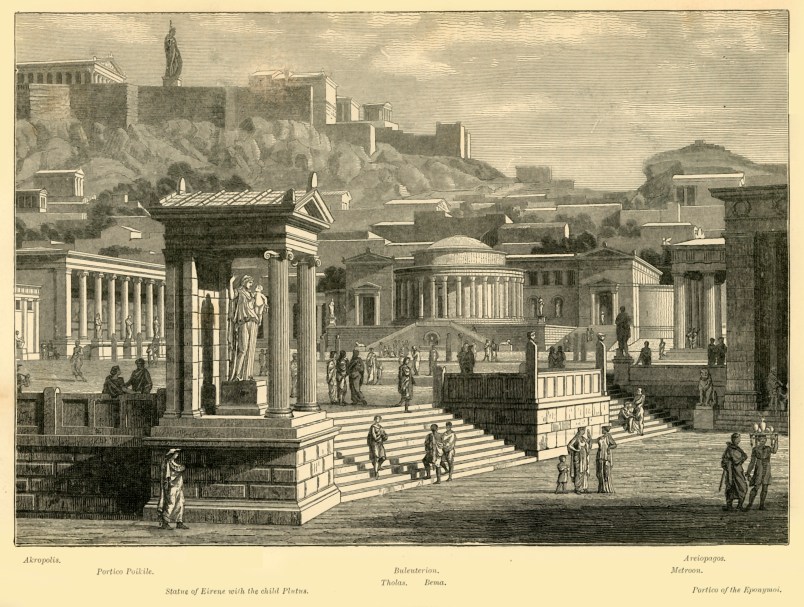
The meetings of the assembly took place initially at the marketplace, the Agora, but were later moved to a bigger and specifically public-oriented space called the Pnyx, on a hill overlooking the city. The Pnyx could accommodate a maximum of around eight thousand people out of the sixty-thousand-strong citizenry. But somehow this subset was identified as “the demos” (the people), and their decisions were binding on those who didn’t directly participate.
To reach a decision, the assembly members first listened to various orators arguing the pros and cons of policy recommendations and laws. Once they were done talking, the assembly voted through a mix of raised hands and the ancient equivalent of an applause meter.
Meanwhile, various citizens’ juries ranging from five hundred to a thousand members were assembled daily to judge political trials, in which they listened to the accusations and rebuttals before casting a judgment (without deliberation).
In 411 and 404 BCE, however, Athenian democracy was lost to oligarchic coups by aristocrats who managed to convince the People’s Assembly to vote for them. When rebuilding their democracy on the heels of these events, the Athenians decided to pass a series of reforms that transferred power from the People’s Assembly to sortition-based bodies, called nomothetai.
While these reforms are sometimes understood to have weakened Athenian democracy, by moving legislative power from the open assembly to the lot-based juries, the changes may on the contrary be interpreted as a way of strengthening it, by preserving the principle of equality but protecting the decision-making from capture by gifted orators and demagogues. The Athenians seemed to have empirically arrived at the conclusion that randomly selected assemblies were not less democratic but less manipulable than large open ones. In fairness, there is some debate as to whether the nomothetai were appointed by lot or some other mechanism. But the key point is that they were supposed to be run by ordinary members of the demos.
A Place for the Shy
The Greeks understood political equality (for those considered free men) as the idea that no one was too humble to participate in politics. Poverty, for example—a common source of shame and political hesitation in most societies—was not seen as a barrier. According to Pericles, as we saw above, “obscurity of condition” was not an obstacle to a political career. It meant that in Athens even the dirt-poor citizen could find himself in the political spotlight—that is, visibly occupying a position of political influence—ruling, not just being ruled, as long as he had the desire for it.
Mere willingness to show up sufficed to access a key position of power in the polity, namely a spot in the People’s Assembly, where the poor (again, as long as they were citizens) had the same opportunity as the rich to speak up and make proposals to the group, and at the very least could vote and shout and murmur to approve or reject a proposal. But citizens could also volunteer for a chance to serve on popular juries, in which they were part of a group that rendered important political judgments. Last but not least, if they put down their name for it, they might even be selected (by lot) for a spot on the Council of 500, on which they set the political agenda for the whole community. Over the course of a lifetime, these op-portunities allowed any person counting as a citizen to feel that they were shaping political decision-making and to develop a real sense of political efficacy.
What’s more, the desire to participate wasn’t taken for granted—it was actively encouraged and incentivized, including through monetary compensation. Citizens were paid an obol per day (the equivalent of ten dollars today) for attending the assembly or serving on juries. While this amount was insignificant to the wealthy, it was a critical incentive for the many poor citizens. For them, it was worth arriving at dawn to secure a spot, as latecomers were turned away once the assembly reached capacity—and without a spot, there was no pay.
What About Accountability?
How were the many randomly selected and self-selected bodies of classical Athens accountable in the absence of the electoral mechanism? First, randomly selected bodies in charge of lawmaking were protected from the risk of corruption by the very fact of their random selection. This made it impossible to predict who was going to be in charge and thus prevented the bribery of decision-makers ahead of time (for example, under the guise of campaign donations).
Random selection also made it impossible for any person to facilitate through donations the accession to power of his underlings. Additionally, facing a randomly selected group, any would‑be corrupter would have had to bribe each individual one by one, in retail fashion, so to speak, rather than in bulk (as is made easier in elected assemblies, in which buying off the party hierarchy gets you all the votes at once). An additional accountability mechanism was periodic and frequent rotation of those same randomly selected assemblies, which made it difficult to build over time the relationships facilitating the desired quid pro quo arrangements. Additional preemptive accountability mechanisms included vetting of citizen volunteers up front for participation in the lottery.
To ensure additional accountability, classical Athens included a system of popular juries before which people accused of leading the city astray had to explain themselves and provide accounts of their proposals and actions, and by which these accused people would ultimately be judged. This was, infamously, what happened to Socrates, who was accused of impiety and corrupting the youth. Accountability was also facilitated by a practice called euthynai or “straightening,” the examination of accounts that every public official underwent upon the expiration of their term.
Was Ancient Democracy Successful?
Classical Athens is the paradigmatic case of politics without politicians. Was Athens politically successful as a result of centering the political wisdom of ordinary citizens rather than that of professional politicians and even experts, as well as in making the knowledge experts statutorily subservient to the will of citizens? Athenians and their contemporaries seemed to believe so, and modern historians concur. For example, Josiah Ober, a Stanford University scholar of ancient Greece, argues that it was the collective wisdom of Athenians and in particular the knowledge-aggregating properties of their democratic procedures that established the commercial, artistic, and even military superiority of Athens over rival city-states, including Sparta.
Of course, superiority did not entail infallibility. Quite apart from and in addition to the moral bankruptcy of slavery, democratic Athens also made terrible political mistakes. Critics are fond of citing the 415 BCE invasion of Sicily, which resulted in a humiliating defeat for the city, though the army itself recovered relatively quickly, and the condemnation to death of Socrates by a popular jury in 399 BCE, which stained the reputation of democracy among philosophers pretty much forever (courtesy of Socrates’s influential student Plato). Athens was not a flawless or entirely inspirational system, and it was ultimately taken over by the much larger Macedonian empire. But during the two hundred and fifty years or so of its existence, democratic Athens was still, on the whole, gloriously outperforming less-democratic regimes of similar sizes in terms of military might, economic prosperity, and flourishing of the arts and sciences.
Greek Lessons for Today
Assuming the Greek system worked well on the whole, what can ancient Athens possibly have to teach us today? We moderns live in huge, multicultural nation-states and in a postindustrial, globalized age in which problems are much more complex than those that ancient people had to face. What could still be of relevance in such ancient models of democracy, even if we ignore their repulsive reliance on and disenfranchisement of enslaved people? Would their form of politics without politicians be able to deal with climate change? Nuclear proliferation? An opioid crisis?
If your intuitive answer to the last question is that ordinary citizens would be incapable of coming up with solutions to these modern problems, you really need to read the rest of this book. For I will argue that what we can learn from the ancient Greeks and from all the people across history who have practiced a form of politics without politicians is that politics is not primarily a matter of expertise and professionalism. It is, instead, the business of every citizen. In ancient Greece, the definition of who counted as a citizen was certainly exclusionary. But once you counted as a citizen, your participation was not conditional on possession of knowledge and expertise any more than it was conditional on socioeconomic status or property ownership.
One implication is that the poorest of the poor had just as much of a chance as the wealthy to enter the People’s Assembly, on a first-come, first-serve basis, since physical space was limited. In fact, a willingness to get up at dawn and wait at the entrance of the assembly site actually gave an advantage to the poor over the rich.
The poorest and the least educated also had the same chance as the wealthy of being selected, once their names were entered in the pool of viable candidates, in the lottery that assigned positions on the Council of 500 or on political juries. In fact, because attendance was paid (even if not much), the poor did, in practice, participate more than the rich. Thus, unsurprisingly, and unlike what happens in our modern societies, policies and laws were more responsive to their needs than to those of the rich. How else would you explain a system in which the rich were expected to pay, and were seemingly happy to pay, for their own expensive military equipment and all public religious celebrations?
The fact that political participation was not conditional on demonstrable expertise at the gate does not mean that ancient Greek democracy did not heavily rely on and make use of expertise. On the contrary, classical Athens was able to mobilize and use experts while keeping them subordinated to citizens’ judgment. Many of these topical experts were slaves. Meanwhile, the practice of engaging in politics regularly educated citizens and created its own kind of expertise.
What we can learn, or relearn, from the Greeks is that political expertise is also acquired on the job. The less we give people an opportunity to participate, the less capable they are. The more we ask of them, the more they learn.
A natural objection could easily arise: Aren’t you then simply asking that every single one of us turn into an expert? Aren’t you basically recreating politics with politicians, just not the elected kind? Josiah Ober points out that in the Athenian context, learning from political practice did not mean turning into a politician: “The effective operation of democracy did not require each participant to be completely socialized into the routines of government or to understand all of the machine’s complex workings.” Athenians, individually, did not have to turn into Pericles or Plato’s philosopher-kings.
James Madison is famous for his criticism of ancient democracy on the grounds that “had every Athenian been a Socrates, every Athenian assembly would still have been a mob.” It would be more accurate to say that “had Pericles never existed, the whole Athenian political system would still have been just as smart.” This was arguably the view held by Pericles himself. In the previously mentioned funeral oration commemorating fallen soldiers of the Peloponnesian War, he is reported as celebrating the merits of public wisdom: “Ordinary citizens, though occupied with the pursuits of industry, are still fair judges of public matters.”
The Greeks remind us that democracy, in its original form, is the daily practice of collective self-government. Today, as trust in institutions collapses and polarization hardens into paralysis, citizens’ assemblies are reemerging as a practical way to restore that practice. By bringing everyday people into structured, good-faith deliberation—and without the poisonous influences of partisan warfare, media incentives, and campaign politics— these assemblies can help address the most entrenched challenges facing American democracy. They offer not just a nostalgic return to ancient Athens, but a modern revival of its most radical insights: that politics is everyone’s responsibility and that ordinary citizens, given the opportunity, can govern.
From POLITICS WITHOUT POLITICIANS: The Case for Citizen Rule by Helene Landemore, published by Thesis, an imprint of Penguin Publishing Group, a division of Penguin Random House, LLC. Copyright (c) 2026 by Helene Landemore.







Pericles and Athenian Democracy didn’t have to deal with massive, organized corporate misinformation campaigns poisoning the public consciousness. No, you don’t have to be, for example, a climate science subject expert to appreciate the need for climate change, but you do have to reliably know which experts to trust. That’s true now, when politicians have dedicated staff whose job is to give them exactly that knowledge. The successful ones build up that staff over a number of campaigns and offices.
Replace that with random selection of whoever, and those staffs become wildly random. And that’s before we get into the issue of keeping your actual job.
Athens in 400 BC had maybe 200,000 inhabitants, including children, women, slaves, etc. It covered an area of less than 40km2. The majority of Athenian Citizens could take a day to attend to public affairs and be back at work after lunch. Athens of the Peloponnesian War era may have been 3 times the size of Cheyenne, Wyoming, but once you get out of the Great Plains, it’s a small town in modern America.
Bob from Idaho isn’t gonna go to DC even 1 day a week and be able to keep his job. He’s either traveling 1-2 additional days every week, or he’s gonna end up exhausted. And things can happen fast, and you can’t always wait for everyone to get back into town after the Japanese hit Pearl Harbor, or there’s a massive earthquake in Georgia or something. Things don’t always need to be handled now, but when they do… they do.
So he’s gong to be gone for his term. Is his boss expected to keep his job open and not fill it? That’s a huge strain on small businesses. If they do fill it, when Bob’s term ends, does he need to find new work, or does his replacement? How’s that fair to either of them?
Athenian democracy worked because it was a product of its time, its culture, and its location. The scale of Athens, the pace at which things happened, and the amount of complexity for most of the considerations involved all played a part. As you scale up, as distances and population numbers increase, direct democracy simply becomes less and less tenable. It’s a lovely idea, but it just can’t work at a modern pace and scale.
I appreciate the context of the Athenian experience of which you remind us.
Yeah, like I said, it’s a great idea… and its echoed in how the Founders imagined politics in America should work: people doing public service for a few years, then going back to their family’s business, moving back and forth between them when they felt they had something to offer. But as society and its problems grew, they got more complex, and the amount of time needed to understand all of the nuances well enough to govern effectively snowballed. It’s why we developed a professional political class in the first place: their job is to know the things most people don’t have time to focus on.
We’re a rich country, so we could make the business/economic aspects of this work if we wanted.
The thing I would worry more about is how to contain the power of civil servants. Permanent staffs act as gatekeepers and give advice to elected/selected officials, and the less knowledge/experience that official has, the more power the staff has. And those people can always be bribed or captured.
On the other hand, the current system where elected officials are endlessly beholden to big donors is a complete mess, as is the system where a politician doesn’t want to offend anyone in their potential base. So randomly selected people who know they’re only going to be in office for a small part of their lives might well not be worse.
Not really. It’s not a question of money. It’s a question of people, and stability. Remember: this is random selection here. So Bob gets randomly selected. Now he’s gotta make sure all his work can be handed off, maybe has to train up his own replacement… goes off to do his public service, and comes back… to no job? To having to learn a new job that probably means a significantly different commute? Fuck all your work friendships, Bob, you get a bunch of new co-workers and get to have to integrate into that new social fabric!
It’s not just about the money.
It is. Elections should be publicly funded. No gifts to politicians except from close family so the kids don’t get screwed on birthdays and christmahaunakwanzikaah.
That’s pretty self-correcting, though, because constituents do get offended by representatives who’re utterly spineless.