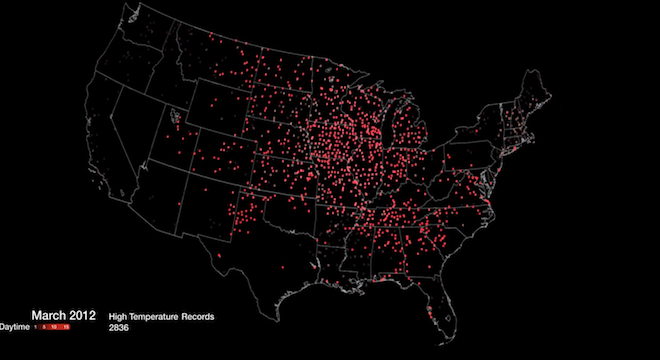
There’s never been a hotter March in the history of the United States than that of 2012, according to the 117-year-old temperature records kept by the National Oceanic and Atmospheric Association (NOAA).
Exactly 15,272 distinct local, all-time warm-weather temperature records were broken across the country in March, NOAA’s National Climatic Data Center revealed in its monthly report. The total included 7,755 daytime temperature records and 7,517 nighttime records.
Handily, NOAA’s Environmental Visualization Lab created an animated video showing exactly where and when the various temperature records were broken over the course of the month, allowing viewers to literally see the hot weather spreading throughout the continental U.S. day by day.
And what a winding course that unusually hot weather weaved, enveloping multi-state regions seemingly at random, first the Southeast, then the Southwest, then the Midwest and Northeast and back around again.
“Many of these records were broken under a large high pressure system, and as the system shifted slightly, so did the location of the record temperatures,” wrote Jake Crouch, a scientist at the National Climatic Data Center, in an email to TPM.
Crouch further explained the entrancing video as follows:
“The red-ish dots on the first loop indicates the daytime warm temperature records. The orange colored dots on the second loop indicates the location of the night time warm temperature records. The shading of the red at the end of the video shows the total number of records being broken for each latitude and longitude point throughout the month. ”
As for whether or not the record-breaking heat is evidence of a global warming trend, Crouch said that one month alone, couldn’t, as usual, tell the full story.
“The spring so far has been much warmer than average, and during the middle of March, daily temperatures across the Midwestern U.S. closer to what we would expect during summer,” Crouch pointed out. “With climate change, we would expect to see more extreme warm temperature outbreaks, similar to the one the U.S. dealt with for most of March. It is difficult to tie a single heat wave to climate change, as several factors contributed to this single event.”
So if not climate change, what does Crouch and his team hope the video illustrates to viewers?
“We hope that viewers will take away that the record warm temperatures during March was a long lasting event, and it was large in spatial extent,” Crouch said.