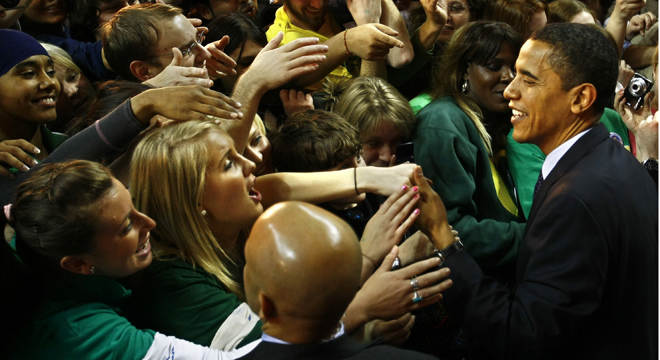
President Obama will need the diverse coalition that powered him to the White House to come back in full force this year if he wants to keep his job. Chief among the groups he needs at its most fired up and ready to go: young people.
Obama is launching a campus blitz this Tuesday at the University of North Carolina to highlight legislation the White House is pushing that would prevent interest rates on subsidized student loans from doubling to 6.8 percent. Republicans in the House are wary of extending the lower rates enacted as a temporary measure in 2007, arguing the $6 billion price tag for a one-year patch outweighs the bill’s benefits, which the White House estimates at about $1,000 in lower payments for the average student over the entire life of a loan.“This is really a full court press to do the right thing by students to make sure they’re able to continue to go to college and won’t be so saddled by debt that they won’t be able to attend in the first place,” one senior administration official said, describing the president’s college tour.
While the loan fight is being run officially through the White House and not the Obama campaign, there’s little doubt that the policy and politics go hand in hand. Student loans, which have exploded over the last decade to over $1 trillion in outstanding obligations, more than even total credit card debt in America, are an important plank of Obama’s message to young voters, who are crucial to his re-election. The issue was an emotional touchstone of the Occupy Wall Street protests, a movement that served as a placeholder for some of the idealistic energy of Obama’s first campaign.
Obama took 66 percent of voters under 30 in the 2008 election, easily the highest share of any presidential candidate since exit polling began. What’s more, they turned out in higher-than-usual numbers and boosted the campaign as volunteers and attendees at the candidate’s trademark high-energy events.
That year, voters were attracted to the promise of an exciting politician with an optimistic, post-partisan vision in the White House. The goal this time, according to campaign officials, is to persuade those voters that they have plenty to show for their effort — even if the sausage-making process in Congress has been ugly and frustrating.
Student loans are one area where the administration can tout concrete gains: In 2009, Obama passed student-loan reform through a controversial reconciliation procedure, transferring billions of dollars from private lenders to funding for more generous grants and loan terms. But there are other issues that the campaign thinks are particularly potent to young voters: Ending the Iraq war is a big applause line on campuses, as is as the president’s successful push to allow gays to openly serve in the military. And some of the Affordable Care Act’s most popular elements have particular weight with young voters, including a provision allowing Americans to stay on their parent’s health insurance up to age 26: Over 2.5 million more young people are insured as a result, according to the Department of Health and Human Services.
There’s no question that Obama’s still the most popular political figure among voters who can’t quote “Cheers” episodes. The latest Pew Research poll shows him leading by 2008-level margins against Romney, whose campaign has never exactly been considered a youth movement.
But Republicans see an opening to at least minimize their impact this election by capitalizing on young people’s disproportionately high unemployment — and any drop-off in participation among disillusioned Dems could help them on Election Day.
“Based on every poll I’ve seen, youth remain a Democratic constituency, ” Peter Levine, director of the Center for Information and Research on Civic Learning and Engagement (CIRCLE), told TPM.”But it’s hard to tell about excitement level and turnout.”
The Romney campaign insists it will make an active play for these voters, pointing to events at colleges and efforts by the campaign to organize campus volunteers as the seeds of a broader effort that will grow in scope as the general election nears.
“Young voters are worried about getting a job and filling their gas tank. In the Obama economy, we have record unemployment, plummeting salaries and skyrocketing gas prices,” spokeswoman Andrea Saul told TPM.
Alex Schriver, chairman of the College Republican National Committee, said he sees a chance to make inroads with his recently graduated based on their struggles, citing record student loan debt, a significantly unemployment rate than the national average, and — perhaps most galling — the inability of many graduates to move out of their parents’ house.
“I think this election is going to be about independence,” Schriver, whose group is independent of the Romney campaign, told TPM. “Platforms and proposals that will allow young people to go out and be successful on their own versus being on the dole with someone else.”
But one of the biggest potential threats to Democratic efforts to win over young voters is taking place at the state level, where Republican-led legislatures have enacted new barriers to voting and registration. Students and other young voters are much less likely to have a drivers license or similar ID, as laws passed in several states after the 2010 Republican wave now require, or may find themselves forced to jump through hoops to get an additional in-state license now needed to vote in college. While most of the affected states are unlikely to be in play in the general election, the one state with perhaps the most far-reaching change is absolutely critical.
Under legislation signed by Florida Gov. Rick Scott (R), groups devoted to registering new voters face major penalties if they don’t submit their forms within 48 hours of signing up, prompting various organizations to shut down their operations in the state. Among them is Rock the Vote, the Millennial-focused group that’s set a goal of registering 1.5 million voters nationally in 2012.
“These new, extremely strict laws are very new creatures, and in our opinion Florida’s is the harshest in the country,” said Mimi Marziani, counsel at the Brennan Center, which is leading a legal effort to overturn the law in court. “This has a huge impact for young voters. A large percentage of young people register to vote through these third-party drives.”
The Obama campaign is keeping an eye on the various new state laws and how they might affect their efforts, but for now the task at hand is to draw young voters back into the fold and get them engaged early as volunteers, donors and grassroots spokesmen. The long slog begins Tuesday in North Carolina.