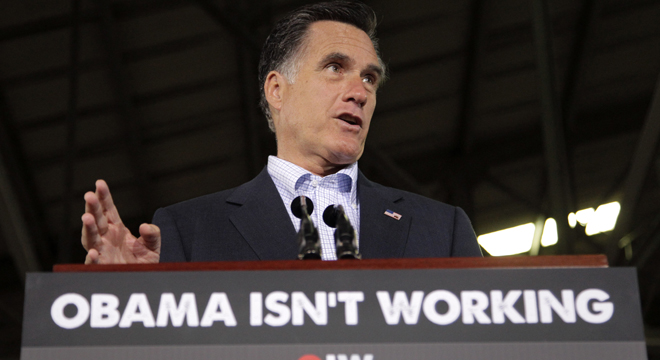
Mitt Romney is determined to make this election all about the economy. On Friday, a lackluster jobs report amounted to a golden opportunity dropped in Romney’s lap — a key data point to back up his assertions that Obama isn’t equipped to put America back on track, and a chance to put Democrats on the defensive.
But Romney’s response to the news — a set of lofty economic promises — are at best unrealistic, and at worst pure panders that could paint him as divorced from reality on the economy, more than one economist told TPM Friday.
It’s possible Romney’s trying to set a trap for the Democrats that leaves them having to fight pure optimism with a far less exciting reality. Just as likely: He simply overplayed his hand.
Romney appeared on Fox News just after the numbers were released and slammed the 115,000 jobs created (a figure well below expectations).
“We should be seeing numbers in the 500,000 jobs created per month,” Romney said. “This is way, way, way off from what should happen in a normal recovery.”
At a campaign rally later in the day, he set an equally high bar for what constitutes an acceptable unemployment rate.
“Anything over 8 percent, anything near 8 percent, anything over 4 percent, is not a cause for celebration,” he said.
Even conservative economists say Romney is pushing it when it comes to his economic standards.
“I understand the desire for low unemployment and the current 8.1 is unacceptable,” Douglas Holtz-Eakin, president of the American Action Forum said. “But 4 percent is not a realistic target.”
Unemployment has not been below 4 percent since April 2000, according to Jared Bernstein, senior fellow at the left-leaning Center on Budget and Policy Priorities. It was 3.8 percent that month. That was during the Clinton administration, and it was a very good year: the average unemployment rate was 4 percent.
Bernstein noted that, officially, “full employment” is pegged at a rate of around 5 percent by the Congressional Budget Office currently. That means that if the unemployment rate actually dipped below that mark (say, in the halcyon days of a first Romney term), the Federal Reserve would probably try to raise it to mitigate the chances of inflation.
The economy, therefore, isn’t just unlikely to meet the goals Romney is setting for it — there could actually be a backlash if it did.
Such wildly optimistic projections could hurt Romney in two ways. First, should he win the presidency, he’s setting himself up for the kind of political attacks about the economy Obama’s been dealing with since he promised to keep the unemployment rate below 8 percent early in his term.
“I don’t understand how this would help Romney in his re-election,” said one Republican strategist unaligned with the Romney campaign. “Four percent won’t happen. And he will have set himself a metric that he can’t achieve. The 2016 ad would write itself.”
Second, the targets could undermine Romney’s claim that he’s an economic expert, not just a politician who’s “in over his head,” as he claims Obama is.
“The key point is that this is a different type of downturn. We had the collapse of a housing bubble, we have not seen anything like this since the Great Depression,” said Dean Baker, co-founder of the Center for Economic and Policy Research. “Either Romney doesn’t understand this, in which case he is hopelessly out to lunch, or he does and he’s just not being honest.”
“You cannot have the same sort of recovery from a housing crash as an ordinary recession,” Baker said. “It’s like expecting someone to recover from cancer the same way they recover from a cold — you know they are both illnesses.”
It might seem like a juicy hit for Democrats — dinging Romney for over-promising fits nicely within the Democratic construct that Romney is a politician who’ll say anything to get elected — but so far, Team Obama isn’t biting.
There are signs that Democrats are wary of falling into a trap by highlighting Romney’s comments — there are plenty of easier things to attack Romney over than wanting to make the economy too awesome. While even the slightest missteps from Romney are usually greeted with a flood of snarky reactions from Democratic operatives and an inevitable press release from the Obama campaign, so far they’ve stayed silent. A statement by Obama campaign spokeswoman Lis Smith on Romney’s speech today made no mention of either the 500,000 jobs or 4 percent unemployment figure, though she declared the speech overall to be “filled with dishonesty and distortions about both President Obama’s record and his own.”
But Bernstein suggested Romney’s characterization of the recovery gives Democrats ample opportunity to draw stark contrasts on issues of fairness and economic equality, major talking points of the Obama campaign. Bernstein praised Romney for setting expectations so high, but said the rubber doesn’t meet the road when it comes to Romney’s actual economic policy agenda.
“It’s absolutely appropriate for policymakers to aspire to full employment. Sign me up if you have a plan that would get us there,” he said. “I don’t see that when I look at Gov. Romney’s economic vision. I see something much closer to supply-side, trickle-down, deregulatory measures that led to an unemployment rate that’s been stuck above 8 percent.”